
Tōshiya and the Ōmato Taikai (Sanjūsangen-dō)
Other spellings and namesTōshiya (通し矢) / Ōmato Taikai (大的大会) / Ōmato Zenkoku Taikai (大的全国大会) / Sanjūsangen-dō Ōmato Zenkoku Taikai / Dōsha (堂射)
Key points
In 2026 it was on Sunday, January 18; the 2027 date had not been announced as of November 2026
In today's Ōmato Taikai, archers aim at targets about 60 m away (as of the 2020 tournament)
The best Edo-period record is 8,133 arrows sent through by Wasa Daihachirō of the Kishū domain in 1686 (Jōkyō 3)
On the day of the Ōmato Taikai, admission is free all day and the parking lot is closed all day
When and where: the Sunday closest to January 15
Sanjūsangen-dō's Ōmato Taikai and Yanagi no Okaji are held on the same day every year, the Sunday closest to January 15. In 2026 it was Sunday, January 18; the hall was open from 9:00 to 16:00, with entry until 15:30. The 2027 date had not yet been announced as of November 2026.
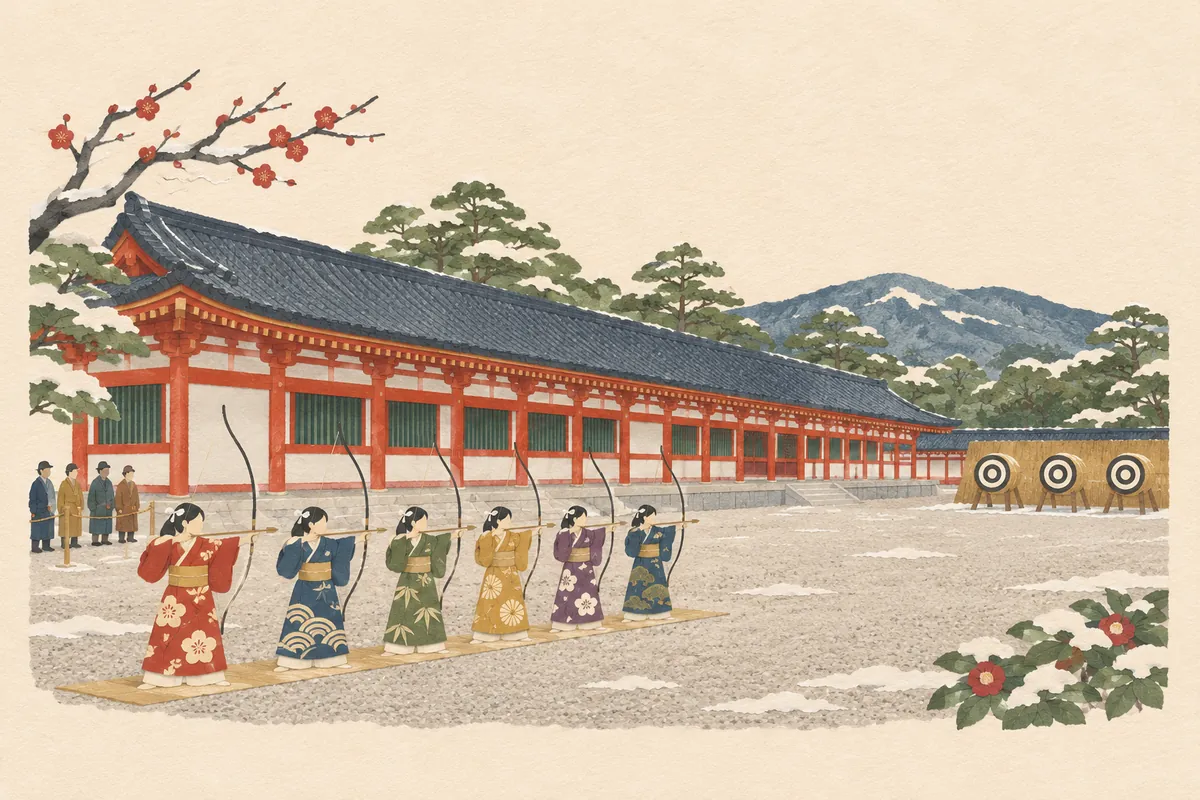
The Ōmato Taikai is a kyūdō (Japanese archery) tournament that recalls the Edo-period tōshiya, and more than 2,000 people take part from all over Japan. The sight of new adults competing in formal kimono is regarded as a New Year tradition of Kyoto. The history of the hall itself and its 1,001 standing statues of Senju Kannon are covered in the Sanjūsangen-dō entry.
Edo-period tōshiya: shooting the length of the roughly 120 m west veranda
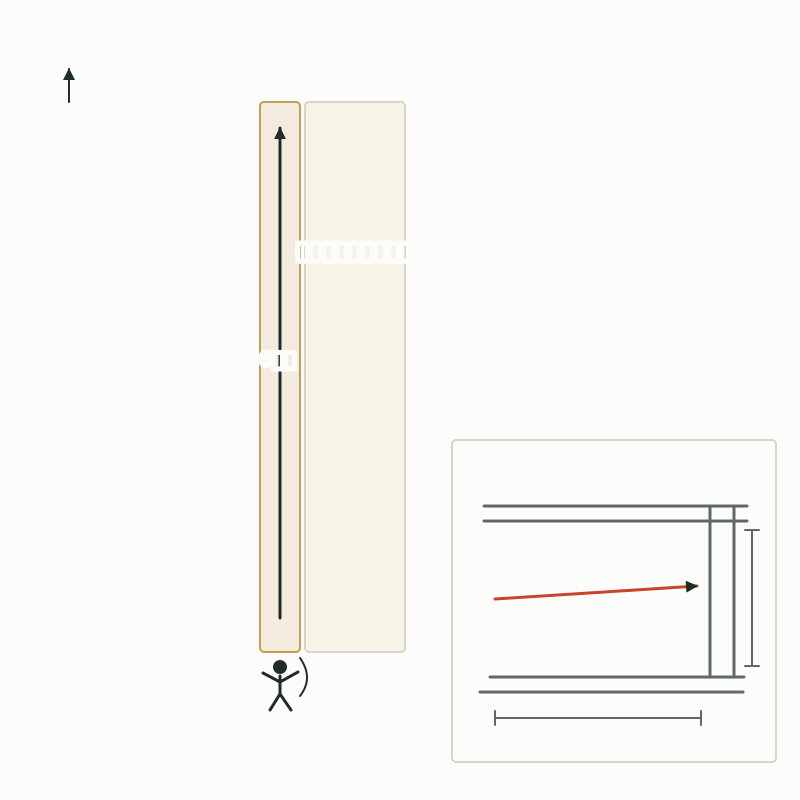
Tōshiya, also called dōsha (堂射), was archery in which arrows were shot through the full length of the veranda on the west side of the main hall, from the south end to the north end. The distance was 66 ken (about 120 m), the veranda was about 2.2 m wide, and the height to the ceiling was about 5 m. The "thirty-three ken" (sanjūsan-gen) in the hall's name is the number of bays between pillars, a different way of counting from the 66 ken of the unit of length.
There are various theories about its beginnings. A story from the Hōgen era (1156–1159) is said to be the oldest, but it remains a legend, and another theory places its start in the Tenshō era (1573–1592). The earliest surviving record is Asaoka Heibei's 51 arrows in 1606 (Keichō 11).
Events included hyakusha and sensha (a hundred and a thousand shots), which competed on how many of a set number of arrows passed through; hiyakazu (also called koyakazu), shot over half a day; and ōyakazu, in which archers kept shooting for a full day and night, from evening until the same time the next day. The ōyakazu was the most popular with the townspeople, and as the Owari and Kishū domains vied for the record, its fame grew until it became one of Kyoto's attractions. The top archer of the year was called "Sōichi" or "Yumi no Tenka" (master of the bow), and a plaque bearing his name was hung in the hall.
In 1642 (Kan'ei 19) a Sanjūsangen-dō was also built in Asakusa in Edo (later moved to Fukagawa), and tōshiya flourished there as in Kyoto. In time, tōshiya gradually declined as records leveled off, samurai finances worsened, and attitudes changed.
The West Veranda of the Main Hall Where Tōshiya Was Shot
The records of Hoshino Kanzaemon and Wasa Daihachirō
Hoshino Kanzaemon of the Owari domain broke the ōyakazu record several times, and on the 2nd day of the 5th month of 1669 (Kanbun 9) he achieved 8,000 arrows passed. Seventeen years later, in the 4th month of 1686 (Jōkyō 3), Wasa Daihachirō (わさだいはちろう) of the Kishū domain sent 8,133 of 13,053 arrows through, which is regarded as the best record. Wasa is said to have been 18 years old at the time.
Tōshiya records of Hoshino Kanzaemon and Wasa Daihachirō
| Date | Archer (domain) | Arrows passed | Total arrows |
|---|---|---|---|
| 4th day of the 4th month, 1660 (Manji 3) | Hoshino Kanzaemon (Owari) | 5,265 | 7,772 |
| 2nd day of the 5th month, 1669 (Kanbun 9) | Hoshino Kanzaemon (Owari) | 8,000 | 10,542 |
| 4th month, 1686 (Jōkyō 3) | Wasa Daihachirō (Kishū) | 8,133 | 13,053 |
Today's Ōmato Taikai: a large target about 60 m away
Whereas Edo-period tōshiya sent arrows the roughly 120 m length of the veranda, in today's Ōmato Taikai archers aim at a target about 60 m away (as of the 2020 tournament). New adults draw their bows in formal kimono.
Regular admission is 600 yen for adults, 400 yen for junior high and high school students, and 300 yen for elementary school students (as of November 2026). On the day of the tournament, January 18, 2026, admission was free all day.
The Yanagi no Okaji and crowds on the day
The Yanagi no Okaji is regarded as the most important service at Sanjūsangen-dō, a rite said to have come from India and to have a tradition going back to the Heian period. Holy water, prayed over to Kannon for seven days, is sprinkled on worshippers with a branch of willow, considered a sacred tree, and is said to drive away illness. It is said to be especially effective for headaches, and the service is associated with Retired Emperor Go-Shirakawa, the temple's founder. Its beginnings are legendary and unclear, but it is said to have already been performed in the Momoyama period.
About 10,000 people are said to have attended the Yanagi no Okaji in 2026. On the day, the parking lot is closed all day to ease congestion and keep people safe, and bicycles and motorbikes must be parked in designated areas. With small children, it is best to use public transportation as far as possible and keep an eye on the time when entry closes.
Getting there
Sanjūsangen-dō is at 657 Sanjūsangendō-mawari-chō, Higashiyama Ward. It is right by the "Hakubutsukan Sanjūsangendō-mae" city bus stop, about a 7-minute walk from Keihan Shichijō Station, and about a 15-minute walk from JR Kyoto Station.
Mini quiz for this entry
On the same day as the Ōmato Taikai, Sanjūsangen-dō holds a service in which holy water prayed over to Kannon is sprinkled on worshippers. This holy water is said to be especially effective for what?
In 1669 (Kanbun 9), Hoshino Kanzaemon sent 8,000 arrows through in Sanjūsangen-dō's ōyakazu. Which domain did this samurai serve?
Sources and verification
Content checked: November 8, 2026
Updated: November 8, 2026
References are in Japanese.
- 蓮華王院 三十三間堂「楊枝のお加持と大的大会」
- 蓮華王院 三十三間堂「年中行事」
- 蓮華王院 三十三間堂「令和8年1月18日 楊枝のお加持」(2025年12月14日)
- 蓮華王院 三十三間堂「お知らせ」
- 蓮華王院 三十三間堂「拝観」
- 京都市観光協会 京都観光Navi「大的全国大会(通し矢)【三十三間堂】」(2026年)
- 京都市観光協会 京都観光Navi「楊枝のお加持【三十三間堂】」(2026年)
- 京都府立京都学・歴彩館「『京の記憶アーカイブ』の中から通し矢の資料をご紹介!」(令和3年12月1日)
- コトバンク「通し矢」(デジタル大辞泉・日本大百科全書・改訂新版 世界大百科事典・ブリタニカ国際大百科事典ほか)
- コトバンク「星野勘左衛門」(日本大百科全書・デジタル版 日本人名大辞典+Plus)
- 日本経済新聞「新成人、弓の腕前競う 京都・三十三間堂で通し矢」(2020年1月12日)