
Kennin-ji and Its Hattō
Key points
Kyoto's first Zen temple and the head temple of the Kennin-ji school of Rinzai Zen; its name comes from the era name Kennin at its founding
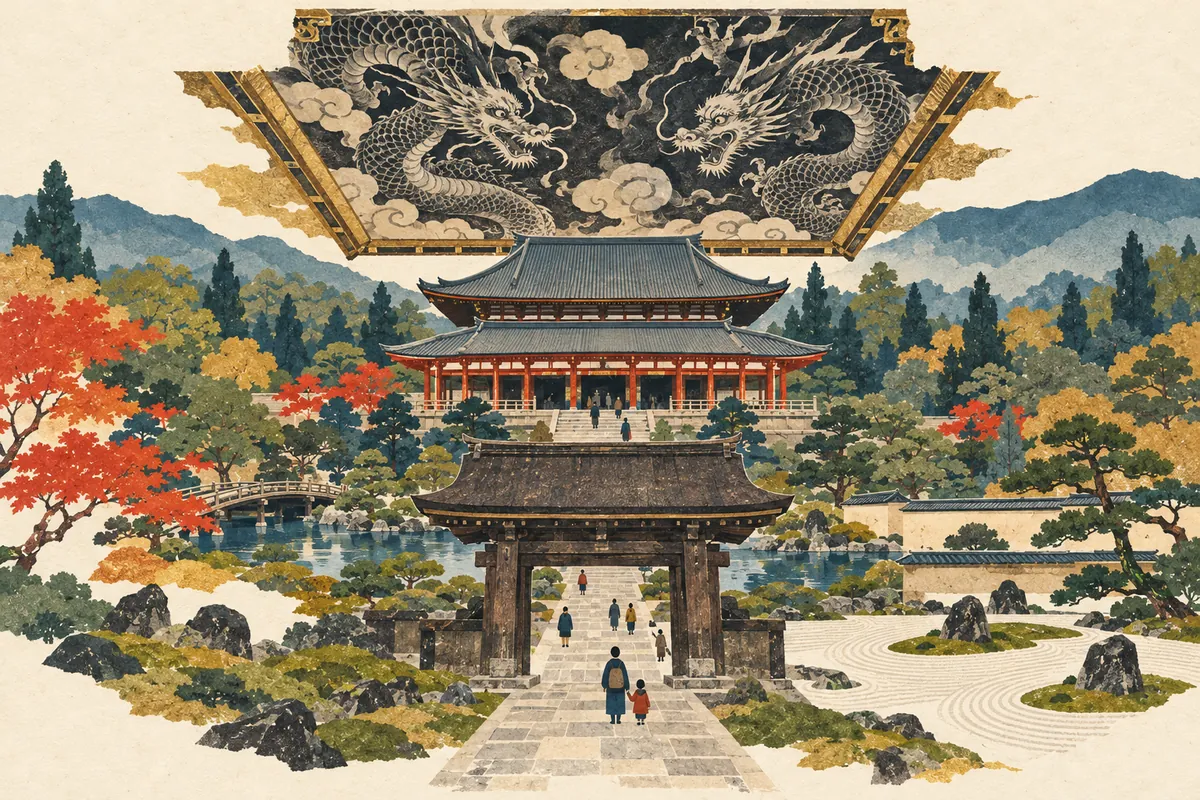
The Hattō ceiling bears Koizumi Junsaku's Twin Dragons (completed in 2002)
The Hattō was recommended as the largest Zen-style hall of the mid-to-late Edo period, with details typical of its time
The "Wind God and Thunder God" screens shown at the temple are a reproduction; the originals are on deposit at the Kyoto National Museum
A Zen temple founded by Eisai in 1202
Kennin-ji was built in 1202 (Kennin 2), when Minamoto no Yoriie, the second shogun of the Kamakura shogunate, donated the temple land and Eisai became its founding abbot. It was modeled on Baizhangshan (Hyakujōzan) in Song China, takes the era name of the time as its temple name, and has the mountain name (sangō) Tōzan. It was the first Zen temple founded in Kyoto.
At its founding, however, it was a training place where the three schools of Tendai, Esoteric Buddhism, and Zen were studied together, with two halls, a Shingon-in and a Shikan-in. It became a purely Zen training place after Lanxi Daolong (Rankei Dōryū), a Zen monk from Song China, came as its 11th abbot in 1259 (Shōgen 1), and in the Muromachi period it flourished as third of the Kyoto Gozan (Five Mountains). It lost the Hattō and other halls in the Great Tenbun Fire, and its revival began when Ankokuji Ekei moved a Hōjō here in 1599 (Keichō 4). In the Meiji era, land left over from the merging and closing of sub-temples (tatchū) was given to the state, and the grounds shrank to nearly half their size.
Eisai and tea
Eisai traveled to Song China twice, brought back tea seeds and encouraged their cultivation, and wrote the "Kissa Yōjōki" (Drinking Tea for Health), spreading the habit of drinking tea; for this he is revered as the father of tea in Japan. East of the tea monument in the grounds is the "Heisei Tea Garden," planted in 1991 (Heisei 3) to mark 800 years since tea was brought to Japan, where tea is picked every May. On April 20, Eisai's birthday, the Yotsugashira Chakai tea ceremony is held, which has its origins in the tea etiquette of great temples of the Southern Song and Yuan dynasties; in 2012 it became a Kyoto City Registered Intangible Folk Cultural Property.
The Hattō and the twin dragons
The Hattō, which also serves as the Buddha hall, is called the "Nengedō," and its ridgepole was raised in 1765 (Meiwa 2). It is a five-bay hall in the Zen style (zenshūyō) with a mokoshi (pent roof), and on its altar (shumidan) are enshrined the principal image, a seated Shaka Nyorai, and the two venerable disciples Kashō (Mahākāśyapa) and Anan (Ānanda). After vowing to rebuild it in 1727 (Kyōhō 12), the temple raised funds over a long period through donations, borrowing, and developing temple land, and built it after overcoming financial difficulties.
On October 16, 2026, the Council for Cultural Affairs recommended to the Minister of Education, Culture, Sports, Science and Technology that the Hattō be designated an Important Cultural Property. The recommendation describes it as the largest Zen-style Buddhist hall built in the mid-to-late Edo period, with details such as the kibana (projecting beam ends) and kaerumata (frog-leg struts) that show the features of their time well. The designation becomes official only when it is announced in the official gazette.
The Twin Dragons (Sōryū-zu), filling the whole ceiling, were painted by Koizumi Junsaku over 1 year and 10 months to mark the temple's 800th anniversary and completed in April 2002. On a ceiling that until then had been plain, unpainted wood with no dragon, the painting, 11.4 m by 15.7 m or the size of 108 tatami mats, shows two dragons with their mouths in the a-un (open and closed) form, and the dragon with the open mouth grasps a jewel.
The Wind God and Thunder God screens and the Hōjō paintings
The best-known treasure of Kennin-ji is Tawaraya Sōtatsu's National Treasure "Wind God and Thunder God" folding screens. They are now on deposit at the Kyoto National Museum, and the temple displays a high-resolution reproduction of the screens. The Hōjō is a building of 1487 (Bunmei 19), moved here in Keichō 4 from Ankoku-ji in Aki Province (Hiroshima Prefecture). The paintings by Kaihō Yūshō that were on the sliding doors of the Hōjō have now been remounted as hanging scrolls and are Important Cultural Properties.
Main National Treasures and Important Cultural Properties of Kennin-ji
| Name | Type | Category | Year of designation |
|---|---|---|---|
| Wind God and Thunder God folding screens (by Tawaraya Sōtatsu, pair of two-panel screens) | Painting | National Treasure | 1952 |
| Hōjō | Building | Important Cultural Property | 1899 |
| Chokushimon (Yanone-mon) | Building | Important Cultural Property | 1902 |
| Sixteen Arhats (16 scrolls) | Painting | Important Cultural Property | 1907 |
| Dragons and Clouds, Flowers and Birds, Seven Sages of the Bamboo Grove, and the Four Accomplishments (formerly sliding-door paintings of the Hōjō) | Painting | Important Cultural Property | 1919 |
| Landscape (formerly sliding-door paintings of the Hōjō) | Painting | Important Cultural Property | 1921 |
The layout of the buildings and the link with Gion
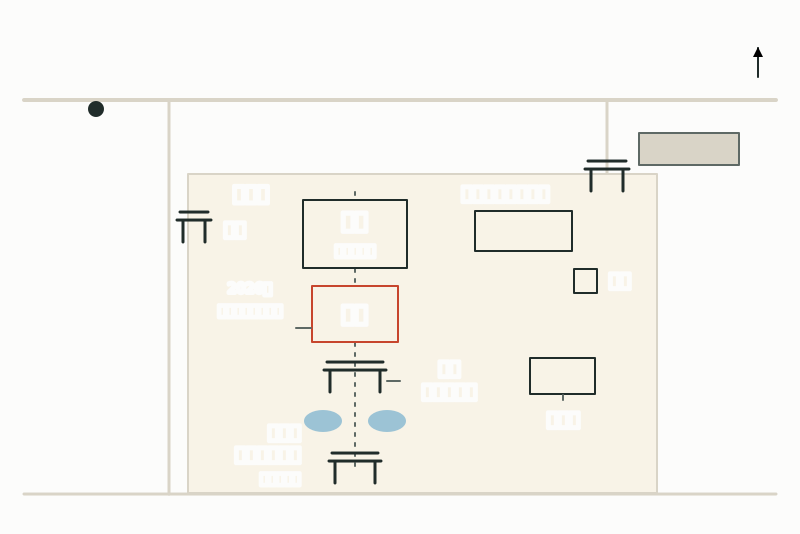
The buildings line up in an almost straight row running north from the Chokushimon (Imperial Messenger Gate), which faces Yasaka-dōri to the south, through the pond, the Sanmon, the Hattō, and the Hōjō. The Chokushimon is a late Kamakura-period four-legged gate, also called the "Yanone-mon" (Arrowhead Gate) because its pillars and doors bear the marks of arrows from wartime fighting. The Sanmon was moved here in 1923 (Taishō 12) from Annei-ji in Shizuoka Prefecture and named the "Bōketsurō," meaning a tower from which one gazes toward the Imperial Palace.
The North Gate is at the southern dead end of Hanamikōji-dōri, and if you leave through it and walk north you come to Shijō-dōri. Northeast of the North Gate is the Gion Kōbu Kaburenjō theater, and Gion Kōbu is a hanamachi (geisha district) whose southern boundary is Kenninji-dōri.
Layout of the Buildings of Kennin-ji (Schematic Diagram)
Visiting hours and admission from 2027
Kennin-ji is at 584 Komatsu-chō, Yamatoōji-dōri Shijō-sagaru, Higashiyama Ward: a 7-minute walk from Keihan Gion-Shijō Station, a 10-minute walk from Hankyū Kyoto-Kawaramachi Station, and a 5-minute walk from the "Higashiyama Yasui" city bus stop. Visiting hours are 10:00 until reception closes at 16:30 (gates close at 17:00), and reception is at the Honbō, the main residence (as of October 2026). Admission is 800 yen for adults, 500 yen for elementary, junior high, and high school students, and free for preschool children. From January 1, 2027, the adult fee becomes 1,000 yen, while the fee for elementary, junior high, and high school students stays at 500 yen. Visits are suspended on April 19 and 20 and June 4 and 5, and on some other days for Buddhist services.
On a visit, the Hōjō, the gardens, the tea room "Tōyōbō," and other areas are always open. Children of elementary school age or younger cannot visit on their own. Eating and drinking, filming video, and using tripods or selfie sticks are prohibited in the grounds.
Mini quiz for this entry
On October 16, 2026, the Council for Cultural Affairs recommended that Kennin-ji's Hattō be designated an Important Cultural Property. How did the recommendation assess it?
From which temple was Kennin-ji's Hōjō (Important Cultural Property) moved in 1599 (Keichō 4)?
Sources and verification
Content checked: October 22, 2026
Updated: October 22, 2026
References are in Japanese.
- 大本山 建仁寺「トップページ」
- 大本山 建仁寺「建仁寺を知る」(建仁寺の歴史・栄西禅師)
- 大本山 建仁寺「建仁寺を巡る」(境内のご案内)
- 大本山 建仁寺「建仁寺の文化財」
- 大本山 建仁寺「建仁寺と茶」
- 大本山 建仁寺「四頭茶会」
- 大本山 建仁寺「アクセス」
- 大本山 建仁寺「[重要] 拝観料改定のお知らせ」(2026年9月14日)
- 大本山 建仁寺「【重要なお知らせ】ご参拝に際しての注意事項」
- 大本山 建仁寺「2026年11月の千光会(坐禅会)のご案内」
- 文化庁「文化審議会の答申(重要文化財(建造物)の指定)」(令和8年10月16日 報道発表)
- 文化庁「文化審議会の答申(重要文化財(建造物)の指定)別紙 概要」(令和8年10月16日)
- 文化庁「国指定文化財等データベース 紙本金地著色風神雷神図〈俵屋宗達筆/二曲屏風〉」
- 文化庁「国指定文化財等データベース 建仁寺方丈」
- 文化庁「国指定文化財等データベース 建仁寺勅使門(矢の根門)」
- 文化庁「国指定文化財等データベース 絹本著色十六羅漢像」(所有者 建仁寺)
- 文化庁「国指定文化財等データベース 紙本墨画竹林七賢図」(所有者 建仁寺)
- 文化庁「国指定文化財等データベース 紙本墨画花鳥図」(所有者 建仁寺)
- 文化庁「国指定文化財等データベース 紙本淡彩琴棋書画図」(所有者 建仁寺)
- 文化庁「国指定文化財等データベース 紙本墨画雲竜図」(所有者 建仁寺)
- 文化庁「国指定文化財等データベース 紙本墨画山水図」(所有者 建仁寺)
- 京都市観光協会「京都観光Navi 建仁寺」
- 京都市「京都をつなぐ無形文化遺産 五花街の紹介」
- 京都市「京都をつなぐ無形文化遺産 花街に伝わる伝統行事」