
Setsubun in Kyoto
Key points
The date follows Risshun, so it is not fixed; in 2025 it fell on February 2
Yoshida Shrine's oni-yarai keeps the old form of a court rite dating to the early Heian period
The three demons, red, blue, and black, that appear in Rozan-ji's demon dance represent three human worldly desires (bonnō)
Yomo-mairi is the custom of visiting, on Setsubun, four shrines and temples where demons are believed to appear
The seasonal divide and the tsuina rite
Setsubun originally meant the division between seasons and referred to the day before Risshun, Rikka, Risshū, and Rittō (the starts of spring, summer, autumn, and winter), so it came four times a year. In the view that the year begins in spring, the day before Risshun is the last day of the year, so Setsubun held the place of what we now call New Year's Eve. The tsuina rites, held on this day to chase away misfortune and welcome good fortune for the new year, came from China and were performed at the imperial court by the Heian period. There are several theories about how bean-throwing began, and it is thought to have come into practice among ordinary people around the Muromachi period.
Risshun is the day when the sun's ecliptic longitude reaches 315 degrees, so the date of Setsubun also shifts from year to year. It was February 2 in 2025 (Reiwa 7) and is February 3 in 2026 (Reiwa 8) and 2027 (Reiwa 9). The ehō, the lucky direction you face when eating ehōmaki rolls, is the direction where that year's deity Toshitokujin resides, and it changes every year. The Ehō-sha at Shinsen-en in Nakagyō Ward is a shrine that can be rotated, and each year it is turned to face that year's ehō.
Tsuina-shiki and the Karosai at Yoshida Shrine
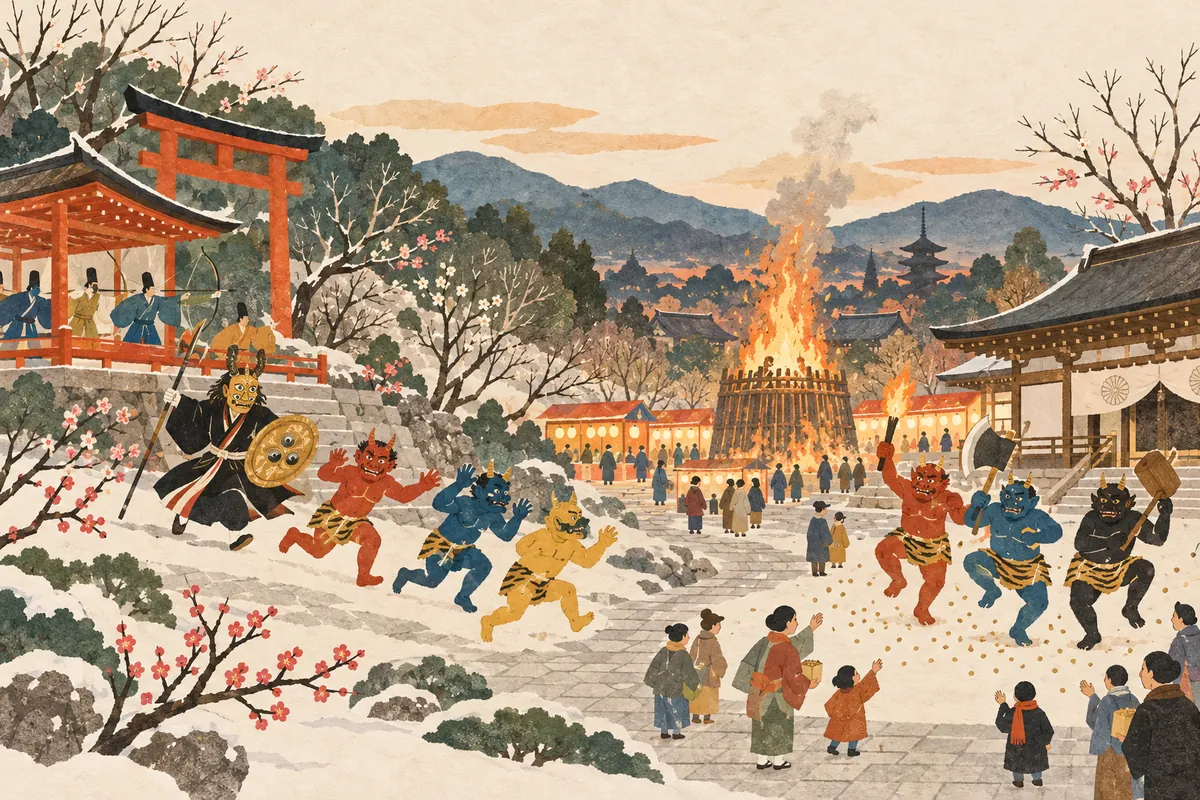
The Setsubun Festival of Yoshida Shrine (Yoshida Kaguraoka-chō, Sakyō Ward) began in the Muromachi period and is held over 3 days centered on Setsubun itself. An estimated 500,000 people visit each year, and about 800 stalls line the grounds on the day before Setsubun and on Setsubun. The tsuina-shiki on the afternoon of the day before is called "oni-yarai" (driving out demons) and follows ancient forms to hand down a rite performed at the imperial court since the early Heian period. The Hōsōshi, wearing a golden four-eyed mask and holding a shield and halberd, chases the demons, and finally courtiers shoot reed arrows from peach-wood bows to drive away the demons of pestilence.
On the afternoon of Setsubun is the Karosai (fire-pit ceremony), in which old talismans brought by worshippers are burned in a large fire pit set up in front of the third torii. Only old talismans (shinsatsu) and amulets (omamori) may be brought. During the Setsubun period only, a special gardenia-yellow (kuchinashi-iro) talisman against evil and misfortune-warding lucky beans with a lottery ticket are also given out.
Rozan-ji's demon dance and Senbon Shakadō's Okame Fuku Setsubun-e
The Setsubun-e of Rozan-ji (Kamigyō Ward), east of the Kyoto Imperial Palace and facing Teramachi-dōri, held on the afternoon of Setsubun, is called "Tsuina-shiki Oni Hōraku" and is popularly known as the "Oni Odori" (demon dance). A red demon holding a torch and a sacred sword, a blue demon with a large axe, and a black demon with a large mallet appear on the stage in front of the Daishi-dō, enter the hall, and dance around the goma fire ritual to obstruct the rites. The three demons represent the three worldly desires that harm a person's good heart, greed (don'yoku), anger (shin'i), and ignorance (guchi), and they flee out the gate, chased by the ritual bow of the tsuina master and the throwing of lucky rice cakes and red-and-white Hōrai beans. On this day only, two treasures that tradition links to Ganzan Daishi are also put on view: the tokko and sanko (ritual vajras) with which he subdued demons, and the gōma-men (demon-subduing mask) he used at the imperial court.
At Senbon Shakadō (Daihōon-ji, Kamigyō Ward), the "Okame Fuku Setsubun-e" is held on Setsubun, named after the legend of Okame, wife of the master carpenter who built the main hall. The ceremony includes an offering of kiyari ondo (work songs) in the main hall, a memorial service in front of the Okame Mound, and an old-style demon-chasing rite performed through kyōgen, followed by bean-throwing.
Mibu-dera, Yasaka Shrine, Kitano Tenmangū, and "yomo-mairi"
According to tradition, the Setsubun-e of Mibu-dera (Nakagyō Ward) began at the wish of Emperor Shirakawa and has a history of more than 900 years. Mibu-dera, at Kyoto's ura-kimon (rear demon gate, the southwest), has long played a part in the Setsubun custom of visiting the demon-gate directions. Services to ward off misfortune are held for 3 days starting the day before Setsubun. There is a custom of buying an unglazed hōroku (炮烙) plate along the approach, writing the ages and wishes of family members on it in ink, and offering it; the offered plates are smashed in the Mibu Kyōgen play "Hōroku-wari" (Plate Smashing), and there is a belief that those who offered them will escape misfortune that year. On the day before Setsubun and on Setsubun, the Mibu Kyōgen play "Setsubun" is performed free of charge every hour on the hour from 17:00 through the 20:00 performance.
At Yasaka Shrine (Higashiyama Ward), on the day before Setsubun and on Setsubun, bean-throwing follows dance offerings by the four kagai (geisha districts) on the Buden stage. At Kitano Tenmangū (Kamigyō Ward), on Setsubun, after the Setsubun Festival in the main sanctuary, the Kitano Tsuina Kyōgen by the Shigeyama Sengorō company and Japanese dance by the geiko and maiko of Kamishichiken are offered in the Kaguraden, followed by bean-throwing at the end.
According to legend, the demons that escaped from Yoshida Shrine, at the omote-kimon (front demon gate), ran about from place to place and were finally sealed up in the Fukube-sha, an auxiliary shrine of Kitano Tenmangū. Making the rounds on Setsubun of the four places where demons are believed to appear, Yoshida Shrine, Mibu-dera, Fushimi Inari Taisha (or Yasaka Shrine), and Kitano Tenmangū, is called "Yomo-mairi" (四方参り, "visiting the four directions").
Getting there and tips for the day
Yoshida Shrine is about a 5-minute walk from the "Kyōdai Seimon-mae" city bus stop and about 20 minutes on foot from Keihan Demachiyanagi Station. Rozan-ji (Teramachi-dōri Hirokōji-agaru) is about 5 minutes from the "Furitsu Idai Byōin-mae" city bus stop, and cannot be entered from the Kawaramachi-dōri side. Mibu-dera is about a 3-minute walk from the "Mibudera-michi" city bus stop and about 10 minutes on foot from Hankyū Ōmiya Station and Randen Shijō-Ōmiya Station. For Senbon Shakadō, get off at the "Kamishichiken" city bus stop. For Kitano Tenmangū, get off at the "Kitano Tenmangū-mae" city bus stop or walk 5 minutes from Randen Kitano-Hakubaichō Station; Yasaka Shrine is about a 5-minute walk from Keihan Gion-Shijō Station.
At Yoshida Shrine, the temporary parking lot in the grounds cannot be used during the Setsubun Festival, so come by public transportation. Rozan-ji may limit entry to the grounds, and photos using stepladders or tripods are not allowed.
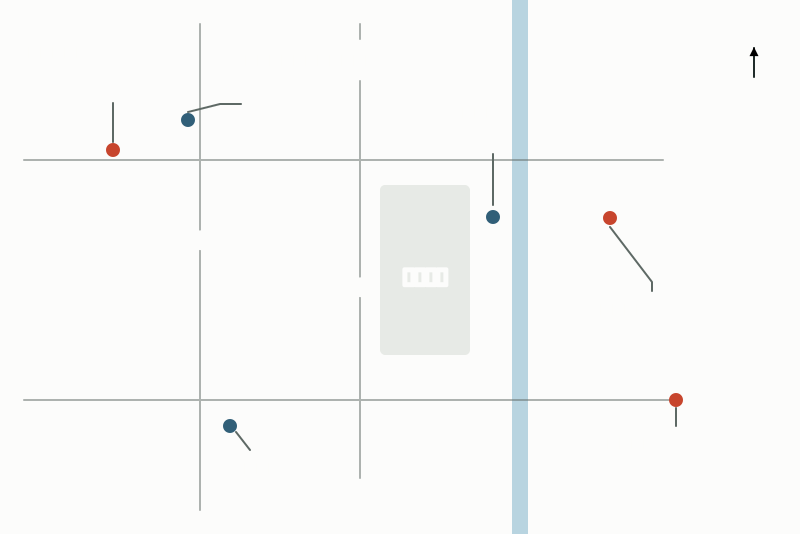
Temples and Shrines of Kyoto's Main Setsubun Events (Schematic Map)
Mini quiz for this entry
On the day of the Oni Odori at Rozan-ji, the tokko and sanko ritual vajras are put on view. Who is said to have subdued demons with them?
At Mibu-dera's Setsubun-e, what unglazed vessel do people buy along the approach, write their family members' ages and wishes on in ink, and offer, to be smashed later in a Mibu Kyōgen play?
Sources and verification
Content checked: October 22, 2026
Updated: October 22, 2026
References are in Japanese.
- 京都市観光協会「京都観光Navi 季節の行事 節分祭」
- 京都総合観光案内所「2026年 節分祭一覧」(2026年1月6日)
- 国立天文台暦計算室「令和7年(2025)暦要項 二十四節気および雑節」
- 国立天文台暦計算室「令和8年(2026)暦要項 二十四節気および雑節」
- 国立天文台暦計算室「令和9年(2027)暦要項 二十四節気および雑節」
- 吉田神社「節分祭について」
- 吉田神社「アクセス」
- 廬山寺「節分会 追儺式鬼法楽(通称:鬼おどり)」
- 廬山寺「お問い合わせ・アクセス」
- 京都府 CO-KYOTO「京都府内のユニークな節分祭〜踊る鬼・鬼やろう・鬼は内!?〜」(2024年1月19日時点の内容)
- 壬生寺「節分会」
- 壬生寺「交通アクセス」
- 大報恩寺(千本釈迦堂)「拝観案内」
- 八坂神社「年中行事」
- 八坂神社「境内マップ・アクセス」
- 北野天満宮「年中行事」
- 北野天満宮「参拝時間・アクセス」