
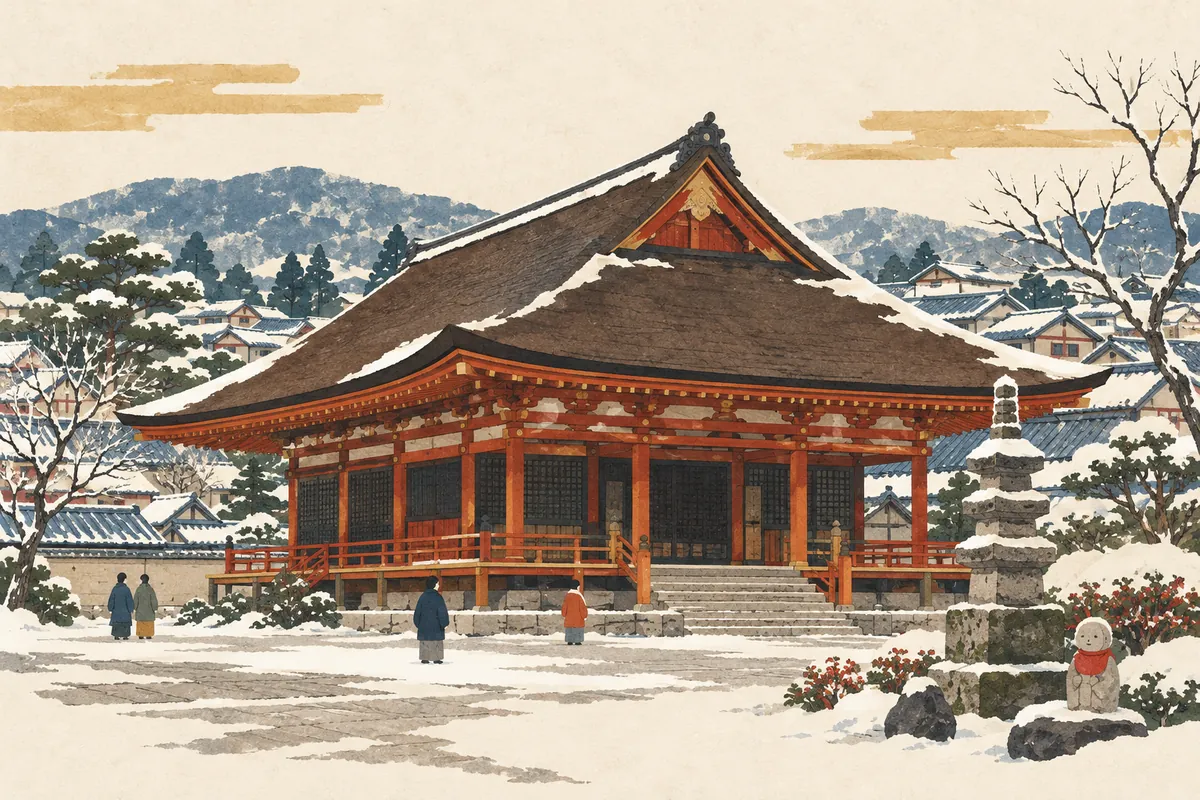
Senbon Shakadō (Daihōon-ji Hondō)
Key points
Heian-period National Treasure buildings such as Daigo-ji's pagoda stand in the hills and suburbs; within Rakuchū, this hall, raised in 1227, is the oldest
The legend of Okame, who rescued her husband after he cut a pillar too short, lives on in the Okame Mound and a ridge-raising custom
The Six Kannon are the only set with all six figures surviving; with a Jizō statue added, the seven became National Treasures in 2024
Spared by the Ōnin War fires in what became Nishijin, the Hondō was returned to its original cypress-bark-roofed form in the 1950s restoration
The Hondō: date and form
Senbon Shakadō is the Hondō of Daihōon-ji, a temple of the Chisan branch of Shingon Buddhism at Shichihonmatsu-dōri Imadegawa-agaru in Kamigyō Ward. It is called the "Shakadō" because its principal image is Shaka Nyorai (the historical Buddha), and it is the only old hall surviving at the temple. Ink inscriptions on the ridge beam (munagi) show that the roof was raised in 1227 (Antei 1).
Kyoto City has National Treasure buildings from the Heian period, such as the five-story pagoda of Daigo-ji (952), but all of these are at temples in the hills or on the outskirts; among buildings remaining in the city center (Rakuchū), the Daihōon-ji Hondō is the oldest. It is a representative Buddhist hall in the Japanese (wayō) style of the early Kamakura period.
Inside, it is divided into an inner sanctuary (naijin) for the statues and a worship hall (raidō) for visitors; the plan, with four "heavenly pillars" (shitenbashira) at the corners of the inner sanctuary, derives from the Jōgyōdō and Hokkedō halls of the Tendai school.
Overview of the Daihōon-ji Hondō (Senbon Shakadō)
| Item | Details |
|---|---|
| Designated name | Daihōon-ji Hondō (Senbon Shakadō), 1 building |
| Size | Five bays by six bays, single story, with a one-bay entrance porch (kōhai) |
| Roof | Hip-and-gable (irimoya), cypress bark (hiwadabuki) |
| Designation | December 28, 1897, Specially Protected Building → March 29, 1952, National Treasure |
| Attached items (tsuketari) | 1 shrine cabinet (zushi), 3 old ridge beams, 3 ridge plaques |
A Hondō that escaped the fires of the Ōnin War
Daihōon-ji was founded around 1220 (Jōkyū 2) by the Tendai monk Gikū (1172–1241), based on devotion to Shaka. In 1235 (Katei 1) it became a temple of imperial prayer (goganji).
In the Ōnin-Bunmei War, which began in 1467 (Ōnin 1), the Western Army set up camp around Horikawa Kamidachiuri, and most of the town of Kamigyō burned. Daihōon-ji stands inside that Western Army camp, the later neighborhood of "Nishijin." The temple too lost most of its halls in repeated fires, beginning with the Ōnin War, but the Hondō alone survived. Sword and spear marks from the time of the Ōnin War are said to remain on the pillars of the inner sanctuary.
Repairs in 1669 (Kanbun 9) changed its appearance, including a switch to a tiled roof, but the dismantling repairs of 1951–1955 (Shōwa 26–30) returned each part to its original form, and the roof is once again cypress bark.
The legend of Okame and the "Okame Mound"
A legend about Okame, the wife of the master carpenter (tōryō), is attached to the building of the Hondō. During the construction that began in 1223 (Jōō 2), the master carpenter Nagai Takatsugu mistakenly cut one of the important pillars too short, and on the advice of his wife Okame, he cut all the pillars to the same length and made up the height with bracket complexes (masugumi) on top of them.
Okame worried that her husband's honor would suffer if it became known that the idea had come from a woman, and took her own life the day before the ridge-raising ceremony in 1227; the priest Gikū, honoring her virtue, built a mound in the grounds in her memory. The stone hōkyōin-tō pagoda by the wall on the east side of the grounds is the "Okame Mound"; it has drawn the devotion of carpenters, and the custom of attaching an Okame mask to the ceremonial staff (gohei) at ridge-raising ceremonies is traced to this story. Every February at Setsubun the temple holds the "Okame Fuku Setsubun-e."
The statues in the treasure hall
The six wooden statues of the Six Kannon Bodhisattvas are thought to have been made in 1224 (Jōō 3) by a team of six sculptors led by Higo Jōkei, whose name is recorded in an inscription on the Juntei Kannon. It is the only case in which all six, Shō Kannon, Senju (Thousand-Armed) Kannon, Batō (Horse-Headed) Kannon, Jūichimen (Eleven-Headed) Kannon, Juntei Kannon, and Nyoirin Kannon, survive, with their original halos and pedestals. They became Important Cultural Properties in 1956 (Shōwa 31), and on August 27, 2024 (Reiwa 6), the seven statues, including a standing Jizō Bodhisattva thought to belong to the same set, were designated National Treasures.
The ten wooden standing statues of the Ten Great Disciples are Important Cultural Properties made late in life by Kaikei, who carved the Kongō Rikishi (Niō) guardians of the Great South Gate of Tōdai-ji together with Unkei; they originally stood in the Hondō surrounding the principal image. The principal image, a seated wooden Shaka Nyorai (Important Cultural Property), is the work of Kaikei's pupil Gyōkai and is normally a hidden image. The Six Kannon and the Ten Great Disciples are kept in the Reihōden treasure hall in the grounds. In 2018 the Tokyo National Museum held a special exhibition on Daihōon-ji.
Daikon-daki and relics of the Kitano Kyōōdō
Senbon Shakadō holds daikon-daki, the daikon radish stew, every year on December 7 and 8. To mark the Jōdō-e, the day the Buddha attained enlightenment, daikon inscribed with Sanskrit characters are blessed and simmered with fried tofu, then served to visitors. It runs 10:00–16:00, and a serving costs 1,000 yen (as of October 2026). On both days the hidden principal image is also unveiled.
Daihōon-ji also preserves cultural properties connected with the Kitano Kyōōdō, a huge building that once stood in the grounds of Kitano Tenmangū: the Kitano Kyōōdō complete Buddhist canon of more than 5,000 volumes, and the seated statue of Fu Daishi with two standing attendant boys from 1418 (Ōei 25), all Important Cultural Properties.
Access and visiting
Daihōon-ji is at Mizomae-chō, Itsutsuji-dōri Rokkenchō nishi-iru, Kamigyō Ward (Shichihonmatsu-dōri Imadegawa-agaru). The nearest stop is the "Kamishichiken" city bus stop, about 3 minutes on foot. From JR Kyoto Station take city bus route 50, from JR Nijō Station route 55, and from Imadegawa subway station routes 51 or 203.
The gate opens at 9:00 and closes at 17:00. Entry and worship in the grounds are free, and the exterior of the National Treasure Hondō and the Okame Mound can be seen from the grounds. The interior of the Hondō and the Reihōden charge admission, and you need to enter the Reihōden by 16:00.
Mini quiz for this entry
In the story of the "Okame Mound" at Senbon Shakadō (Daihōon-ji), when the master carpenter cut a pillar too short, what solution did his wife Okame suggest?
How is the roof of Senbon Shakadō (the Hondō of Daihōon-ji, a National Treasure) described in the national designation data?
Among the statues in the treasure hall of Senbon Shakadō (Daihōon-ji), which were promoted from Important Cultural Property to National Treasure in August 2024 (Reiwa 6)?
Sources and verification
Content checked: October 18, 2026
Updated: October 18, 2026
References are in Japanese.
- 文化庁「国指定文化財等データベース 大報恩寺本堂(千本釈迦堂)」
- 文化庁「国指定文化財等データベース 木造六観音菩薩像 木造地蔵菩薩立像」
- 文化庁「国宝・重要文化財(美術工芸品)の指定について 解説」(令和6年)
- 大報恩寺「大報恩寺(千本釈迦堂)拝観案内」
- 大報恩寺「大報恩寺について」
- 京都市上京区役所「上京区の史蹟百選 大報恩寺」
- 京都市観光協会「京都観光Navi 大報恩寺(千本釈迦堂)」
- 京都市観光協会「京都観光Navi 駒札 大報恩寺(千本釈迦堂)」
- 京都市観光協会「京都観光Navi 成道会法要と大根(だいこ)焚き【千本釈迦堂】」
- 京都市「京都ミュージアム 千本釈迦堂 大報恩寺霊宝殿」
- 東京国立博物館「特別展 京都 大報恩寺 快慶・定慶のみほとけ 出品目録」
- 国土交通省「多言語解説文データベース 大報恩寺(千本釈迦堂)」
- 大報恩寺「建造物」
- 大報恩寺「年中行事」