
Nishin Soba
Other spellings and names鰊そば / 鰊蕎麦 / Herring soba
Key points
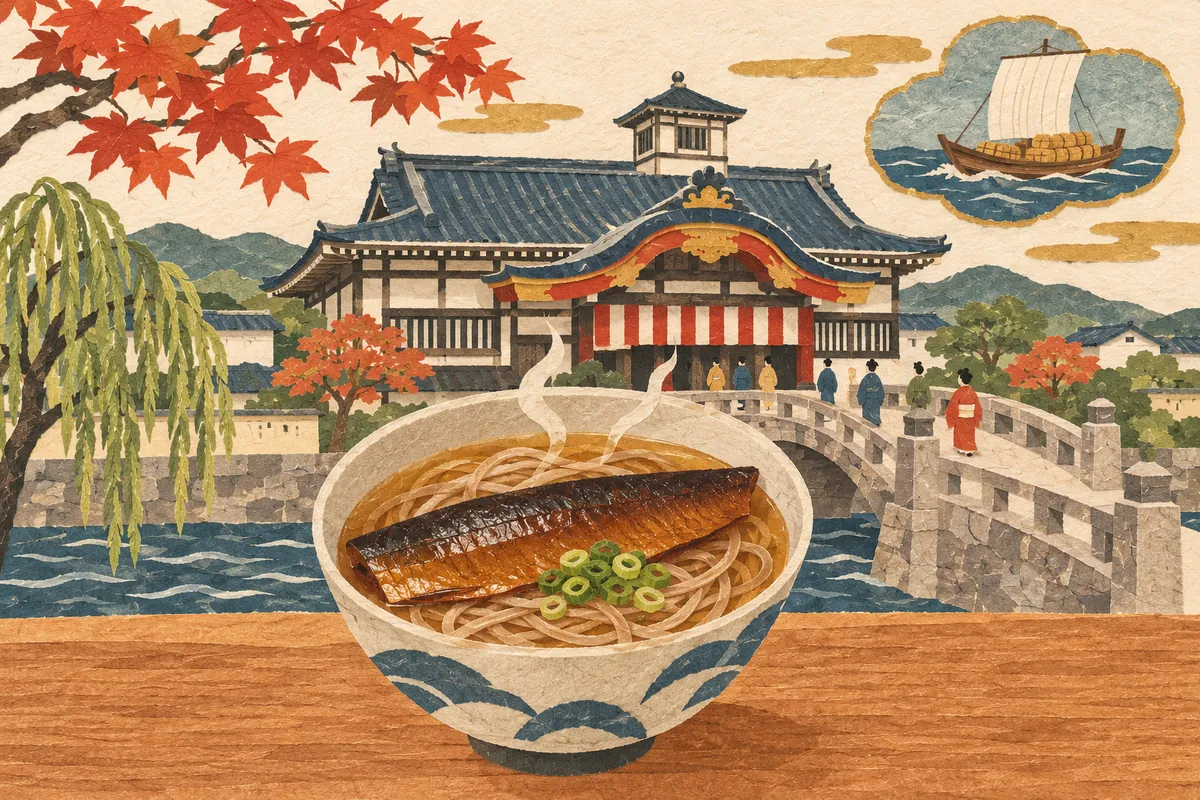
Topped with kanroni of migaki nishin; in Kyoto it comes in a light broth of kombu and usukuchi (light-colored) soy sauce
Migaki nishin is a preserved food carried from Hokkaido by kitamaebune ships
Said to have been created around 1882 (Meiji 15) at a soba shop in a corner of the Minamiza
It has also long existed in Esashi, Hokkaido, and one theory places its origin there
Kake soba topped with simmered dried herring
Nishin soba is made by simmering migaki nishin in soy sauce, sugar, mirin, and other seasonings until sweet and savory, and placing it on kake soba. Migaki nishin is a preserved food made by removing the innards of herring and drying it. Herring dried hard is left overnight in rice-rinsing water until soft, its bitterness (aku) is taken out over time, and it is then cooked gently until it absorbs the seasoning.
Kyoto's nishin soba is made with a lightly seasoned broth using kombu and usukuchi soy sauce. Hokkaido has a local dish of the same name, which is said to be often eaten there with a sweetish broth.
Migaki nishin brought by kitamaebune ships
From the late Edo period to around the Meiji era, herring fishing flourished along the coasts of Hokkaido. In spring, when great schools of herring swarmed to the coast to spawn, the sea is said to have turned white, a sight called kuki (群来). Before freezing technology, the huge catches were processed into migaki nishin so that they would keep, and carried to Honshu by kitamaebune.
Migaki nishin was one of the foods brought by the kitamaebune, which sailed between Hokkaido and the Kansai region from the Edo period to the Meiji era, and it was put to great use in Kyoto, an inland city where seafood was hard to get. There is also a view that migaki nishin carried from Wakasa to Kyoto gave rise to the famous nishin soba. Herring fishing peaked in the Meiji era, but from around the Shōwa 30s (1955–64) the kuki suddenly declined, and herring could hardly be caught any more.
The soba shop in a corner of the Minamiza said to have created it
Nishin soba is said to have originated in Kyoto. The soba shop Matsuba, at the east end of Shijō Ōhashi Bridge, is said to have begun when its first owner, Matsuno Yoemon, opened a soba shop in 1861 (Bunkyū 1). It is said that in 1882 (Meiji 15) the second-generation owner, Matsuno Yosakichi, came up with nishin soba, moved to a corner of the Minamiza, and named the shop Matsuba.
There is also a view that it was a Kyoto innovation, making use of herring and bōdara (dried cod) that arrived overland from the Hokuriku region.
On the other hand, Esashi Town in Hokkaido has also long had nishin soba as a specialty, and one theory places its origin in Esashi. Hokkaido's nishin soba is said to have begun with a recipe handed down in the Yokoyama family, net owners (amimoto) in the days when herring fishing flourished in Esashi.
Ties with the Minamiza
Matsuba's shop stood in a corner of the Minamiza from the Meiji era on. In 1945 (Shōwa 20), at the end of the Pacific War, the shop building was designated for compulsory demolition (kyōsei sokai) to protect the Minamiza from air raids, and the Meiji-era Japanese house was torn down, leaving an empty lot. After the war, in 1951 (Shōwa 26), a reinforced-concrete building was built on that lot.
The present main shop is at the east end of Shijō Ōhashi Bridge in Higashiyama Ward, right next door to the west of the Minamiza. The history of the Minamiza and the December Kaomise are covered in a separate entry.
When is it eaten? Kyoto dishes made with migaki nishin
Because migaki nishin keeps well, nishin soba is eaten all year round. In Kyoto, nishin soba is said to be often used as toshikoshi soba, the soba eaten on New Year's Eve.
Besides nishin soba, migaki nishin has long been used in Kyoto home cooking. In the world of Kyō-ryōri (Kyoto cuisine), dishes that combine ingredients that share a season or go well together are called "deaimon," and nishin nasu, in which oily migaki nishin is simmered with eggplant, which soaks up the oil well, is one of them; it is often made from summer to autumn. There are also grilled herring and nishin no konmaki, herring rolled in kombu and simmered.
In okimari ryōri, the custom of eating set dishes on set days of each month, simmered herring and kombu is eaten on the 1st. Playing on the astringency (shibumi) of herring and on kombu, it carries the wish to live "shibuu, kobuu" (frugally).
Mini quiz for this entry
From the Edo period to the Meiji era, what ships carried the migaki nishin (dried herring) used in nishin soba from Hokkaido to Kansai?
In 1882 (Meiji 15), the soba shop said to have created nishin soba moved and took the name "Matsuba." Where did it move?
Apart from Kyoto, one theory places the origin of nishin soba in a Hokkaido town that thrived on herring fishing. Which town?
Sources and verification
Content checked: November 8, 2026
Updated: November 8, 2026
References are in Japanese.