
Modern Architecture on Sanjō-dōri
Key points
In the Meiji period, Sanjō-dōri, with the Bank of Japan and the post office, was the center of modern Kyoto
When Shijō-dōri and Karasuma-dōri were widened in 1912, the bustle moved away and old buildings survived
The six buildings covered here range from an Important Cultural Property to nationally and city-registered properties
From Teramachi-dōri to Shinmachi-dōri is a landscape district where changing a building needs the mayor's approval
Meiji-era Sanjō-dōri, the center of modern Kyoto
Sanjō-dōri leads east to Sanjō Ōhashi Bridge over the Kamo River. Sanjō Ōhashi is the end point of the Fifty-three Stations of the Tōkaidō, the road that ran from Edo. Seen from Kyoto, this is the western starting point of the Tōkaidō, and in the Edo period Sanjō-dōri was Kyoto's main street, lined with inns (hatago), wholesalers, and money changers.
In the Meiji period, cultural, educational, financial, and communications institutions gathered on Sanjō-dōri, and between Teramachi-dōri and Shinmachi-dōri, modern Western-style buildings stood alongside merchant houses in traditional styles. In particular, the stretch from Takakura-dōri to Higashinotōin-dōri, with the Bank of Japan, the post office, and the large textile trading companies, was the center of modern Kyoto. When Shijō-dōri and Karasuma-dōri were widened in 1912 (Meiji 45), the bustle moved there, but this ended up preserving many historic buildings.
The former Bank of Japan Kyoto Branch
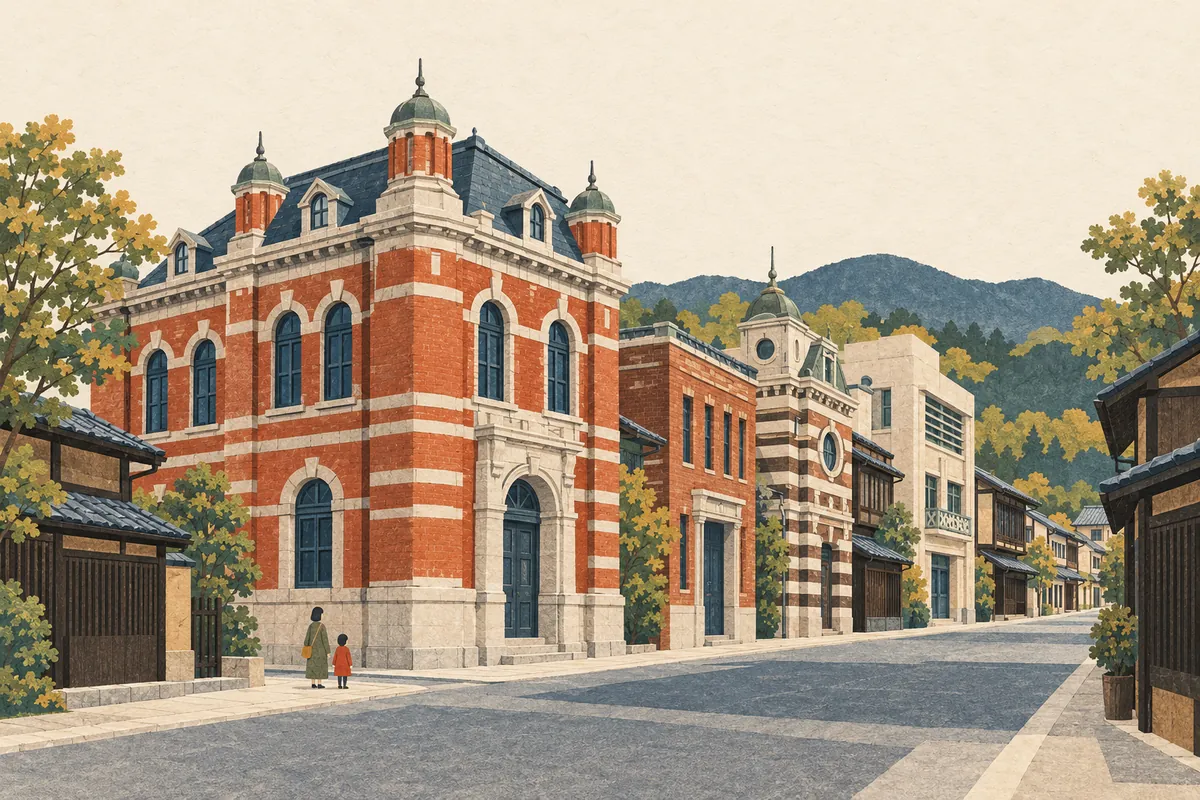
The red-brick building on the northwest corner of Sanjō-dōri and Takakura-dōri is a Bank of Japan office designed by Tatsuno Kingo, who also designed Tokyo Station, and his pupil Nagano Uheiji, and completed in June 1906 (Meiji 39). At the time it was called the Bank of Japan Kyoto Agency, and it became the Kyoto Branch in 1911 (Meiji 44). It is a two-story brick building (with a partial basement), and its symmetrical exterior facing Sanjō-dōri sets white granite against red brick, with ventilation towers and skylight windows lined up on the roof.
When the Bank of Japan Kyoto Branch moved to Kawaramachi-dōri Nijō in 1965 (Shōwa 40), the building became the Heian Museum in 1968 (Shōwa 43); it was donated to Kyoto Prefecture in 1986 (Shōwa 61), and since 1988 (Shōwa 63) it has been open as the Annex of the Museum of Kyoto. The former banking hall is now used as an event hall.
The Nakagyō Post Office
The Nakagyō Post Office, on the northeast corner of Sanjō-dōri and Higashinotōin-dōri, is a Neo-Renaissance post office building erected in 1902 (Meiji 35) as the Kyoto Post and Telegraph Office, designed by the Building and Repairs Section of the Ministry of Communications (Teishinshō). After serving as the Kyoto Central Post Office, it is now used as the Nakagyō Post Office.
When it was rebuilt in 1976 (Shōwa 51), the outer walls of the old building's south face (on the Sanjō-dōri side) and parts of its east and west sides were kept, along with the roof. This exterior is a Kyoto City Registered Tangible Cultural Property.
Four buildings from Sakaimachi-dōri to Teramachi-dōri
On the north side between Sakaimachi-dōri and Yanaginobamba-dōri (toward Yanaginobamba-dōri), part of the former Nippon Life Kyoto Branch, completed in 1914 (Taishō 3), survives. What remains is one span facing the street, including the tower (tōya); it was designed by the Tatsuno Kataoka Architectural Office, and its outer walls are clad in stone. SACRA (former Kyoto Branch of the Fudō Chokin Bank), on the northwest corner with Tominokōji-dōri, is a three-story building of timber-framed brick construction (mokkotsu renga-zō) from around 1916 (Taishō 5), recognizable by the striped pattern of its first floor and the circular ornament at the center of its facade.
Across Tominokōji-dōri to the east, on the south side, the brick shop of the Yabe Toku Clock Shop (1890, Meiji 23) faces north onto the street, its ground floor decorated with three arches. Inside are a vault and a spiral staircase, and together with the wooden main house at the back it is a national Registered Tangible Cultural Property. The 1928 Building (former Kyoto bureau of the Mainichi Shimbun), on the southeast corner with Gokōmachi-dōri, is a reinforced concrete building designed by Takeda Goichi and built in 1928 (Shōwa 3); the influence of F. L. Wright can be seen in the horizontal louvers on its facade, and that of Art Deco in the balconies and the lamp covers on either side of the entrance.
Main modern buildings on Sanjō-dōri (Karasuma-dōri to Teramachi-dōri)
| Building name (former name) | Type of cultural property |
|---|---|
| Nakagyō Post Office (former Kyoto Post and Telegraph Office) | Kyoto City Registered Tangible Cultural Property (exterior of the old building, 1986) |
| Museum of Kyoto Annex (former Bank of Japan Kyoto Branch) | Important Cultural Property (designated 1969) |
| Nippon Life Kyoto Sanjō Building, Old Wing (former Nippon Life Kyoto Branch) | National Registered Tangible Cultural Property (1997) |
| SACRA (former Kyoto Branch of the Fudō Chokin Bank) | National Registered Tangible Cultural Property (1997) |
| Yabe Toku Clock Shop (Yabe Family Residence), shop building | National Registered Tangible Cultural Property (2005) |
| 1928 Building (former Kyoto bureau of the Mainichi Shimbun) | Kyoto City Registered Tangible Cultural Property (1983) |
The Sanjō-dōri Neighborhood Landscape Improvement District
Since March 1997 (Heisei 9), about 7 hectares along Sanjō-dōri, from Teramachi-dōri to Shinmachi-dōri, have formed Kyoto City's Sanjō-dōri Neighborhood Landscape Improvement District (三条通界わい景観整備地区). Building or remodeling a structure within the district requires the mayor's approval. As of September 2022, seven buildings, including the Nippon Life Kyoto Sanjō Building, were designated "neighborhood landscape buildings," and they included homes and shops in everyday use.
Walking from Karasuma Oike Station to Teramachi-dōri
The Museum of Kyoto is about 3 minutes' walk east along Sanjō-dōri from Exit 5 of Karasuma Oike Subway Station. The Annex is free to enter (some events charge a fee) and is open 10:00–19:30 (subject to change for events); it is closed on Mondays (or the following day if Monday is a holiday) and from December 28 to January 3 (as of October 2026). From Keihan Sanjō Station, it is about 15 minutes' walk west along Sanjō-dōri.
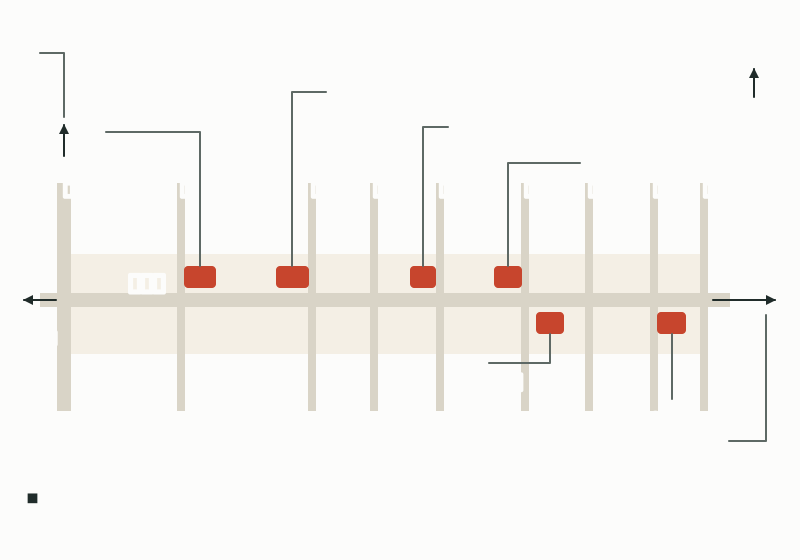
Walking Sanjō-dōri from Karasuma-dōri to Teramachi-dōri, you can see the exteriors of the six buildings described here from the street, one after another.
Where the Modern Buildings on Sanjō-dōri (Karasuma-dōri to Teramachi-dōri) Are
Mini quiz for this entry
The Annex of the Museum of Kyoto stands on the corner of Sanjō-dōri and Takakura-dōri. What was the building originally?
The 1928 Building (former Kyoto bureau of the Mainichi Shimbun) stands on the corner of Sanjō-dōri and Gokōmachi-dōri. Whose influence shows in the horizontal louvers on its facade?
When the Nakagyō Post Office was rebuilt, part of the Meiji-era building of the former Kyoto Post and Telegraph Office was kept. What was kept?
Sources and verification
Content checked: October 19, 2026
Updated: October 19, 2026
References are in Japanese.
- 京都市「三条通界わい景観整備地区界わい景観整備計画」
- 京都市「三条通界わい景観整備地区計画図」
- 京都市「三条京阪駅周辺地区 都市再生整備計画」(令和6年2月)
- 文化庁 国指定文化財等データベース「旧日本銀行京都支店」
- 京都府京都文化博物館「別館について」
- 京都府京都文化博物館「今昔物語(日銀時代)」
- 京都府京都文化博物館「建築小噺(洋館建築)」
- 京都府京都文化博物館「料金・開館時間」
- 京都府京都文化博物館「よくあるご質問」
- 京都市文化財保護課「京都市指定・登録文化財データベース 中京郵便局旧庁舎外観」
- 京都市文化財保護課「京都市指定・登録文化財データベース 旧毎日新聞社京都支局」
- 文化庁 国指定文化財等データベース「日本生命京都三条ビル旧棟(旧日本生命京都支店)」
- 文化庁 国指定文化財等データベース「SACRA(旧不動貯金銀行京都支店)」
- 文化庁 国指定文化財等データベース「家邊徳時計店(家邊家住宅)店舗」
- 文化庁 国指定文化財等データベース「家邊徳時計店(家邊家住宅)主屋」