
The Kyoto City KYOCERA Museum of Art and Okazaki's Modern Architecture
Other spellings and namesKyoto Municipal Museum of Art / Tairei Kinen Kyoto Bijutsukan (Enthronement Commemorative Kyoto Museum of Art)
Key points
"KYOCERA" is a popular name under a 50-year naming-rights agreement signed in 2017; the museum's own name is the Kyoto Municipal Museum of Art
The main building of the Kyoto Municipal Museum of Art, from 1933 (Shōwa 8), is the oldest surviving public art museum building in Japan
Museums, a library, and a hall gathered on the former expo grounds from the Meiji era to the postwar years, and the whole area became an Important Cultural Landscape
The Collection Room is free for elementary, junior high, and high school students who live or study in Kyoto City, and for preschool children
A cultural district built on the former exposition grounds
In 1895 (Meiji 28), the Commemorative Festival for the 1,100th Anniversary of the Heian Capital and the 4th National Industrial Exhibition were held at the same time on a large area of land created by the Lake Biwa Canal turning twice at right angles. On the site, the Butokuden was built in 1899 (Meiji 32) and the Kyoto City Commemorative Zoo opened in 1903 (Meiji 36), and in 1904 (Meiji 37) about 4.3 ha centered on the approach to Heian Shrine became Okazaki Park.
Later, the prefectural library and the Kyoto Municipal Museum of Art were built, followed after the war by Kyoto Kaikan and the National Museum of Modern Art, Kyoto, and Okazaki became Kyoto's leading district for culture and education. In 2015 (Heisei 27), the Okazaki area was selected as an Important Cultural Landscape, the "Cultural Landscape of Kyoto Okazaki."
The Kyoto City KYOCERA Museum of Art
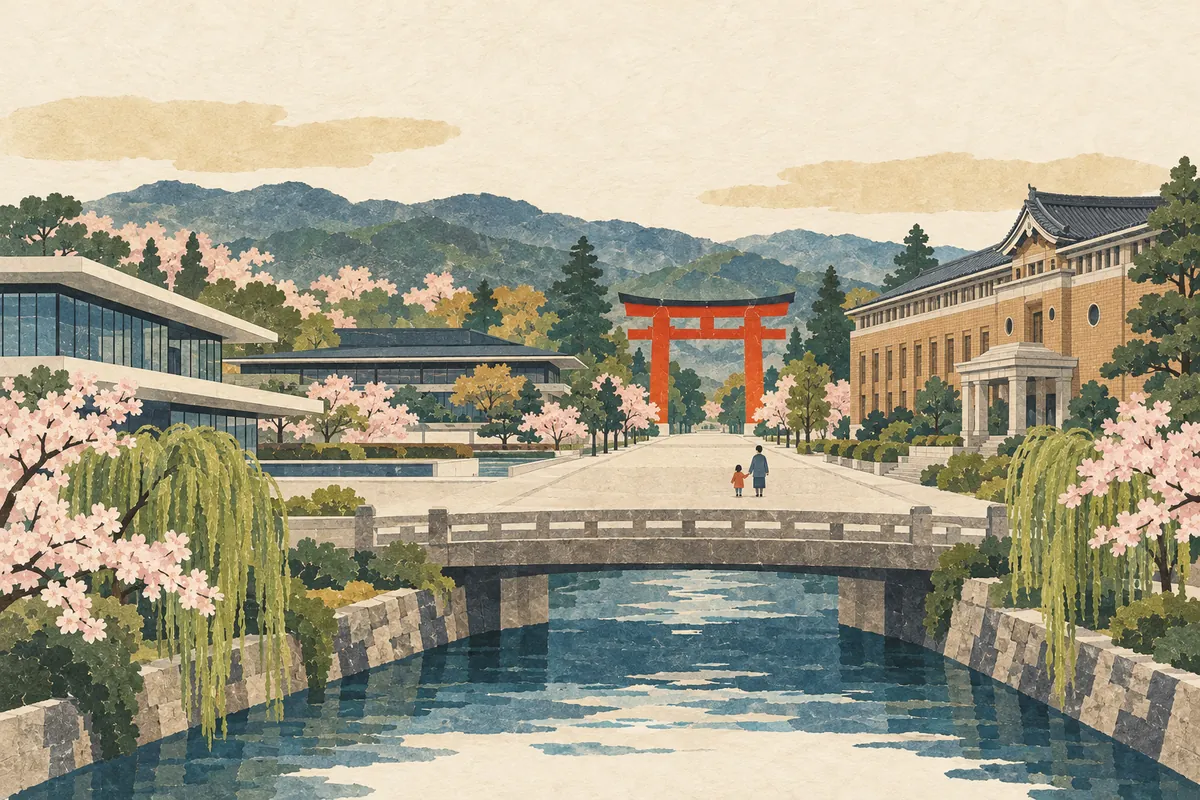
To commemorate the enthronement ceremony held in Kyoto in 1928 (Shōwa 3), the museum was built with donations from the Kansai business and art worlds and from citizens, and it opened in 1933 (Shōwa 8) as the "Tairei Kinen Kyoto Bijutsukan" (Enthronement Commemorative Kyoto Museum of Art). It was designed by the architect Maeda Kenjirō, chosen through an open design competition whose conditions included a design based on Japanese taste. Its design, which blends Japanese and Western styles, is regarded as representative of the so-called Imperial Crown Style (帝冠様式, teikan yōshiki), and it is the oldest surviving public art museum building in Japan.
After the war it was requisitioned by the occupation forces, and when it was returned in 1952 (Shōwa 27) it was renamed the "Kyoto Municipal Museum of Art." Kyoto City introduced naming rights to fund a redevelopment, and in 2017 it signed a 50-year agreement with Kyocera Corporation under which the city received support of about 5 billion yen and the museum took the popular name "Kyoto City KYOCERA Museum of Art." To a design by Aoki Jun and Nishizawa Tetsuo, the main building was renovated while being preserved, a new wing, the "Higashiyama Cube," was added, and the museum reopened on May 26, 2020.
The main building became a national Registered Tangible Cultural Property on August 17, 2020 (Reiwa 2), and the main gates (north and south), north gate, east gate, and notice boards (north and south) were registered at the same time. Of these, the east gate is a stone gate from the late Meiji period.
The Prefectural Library, Kyoto Kaikan, and the Museum of Modern Art
The Kyoto Prefectural Library moved to Okazaki in 1909 (Meiji 42), when Ōmori Shōichi, the 10th governor of Kyoto Prefecture, promoted its construction at a new site as a project commemorating victory in the Russo-Japanese War. The site was part of the former exhibition grounds and had been used as a firebreak for Heian Shrine. It was designed by Takeda Goichi, later called "the father of Kansai architecture," and in 2001 it was rebuilt, keeping the front facade.
ROHM Theatre Kyoto, on the north side of Nijō-dōri west of Okazaki Park, is the former Kyoto Kaikan, which opened on April 29, 1960 (Shōwa 35) as one of the first multipurpose public cultural halls in Japan. It was built with funds that included donations from citizens and companies. Its designer, Maekawa Kunio, gave it a design that brings out horizontal lines so that it would blend into the surrounding Okazaki landscape. It was redeveloped to a basic design by Kōyama Hisao, and under a naming-rights agreement signed with ROHM Co., Ltd. in 2011 it was reborn as "ROHM Theatre Kyoto" on January 10, 2016.
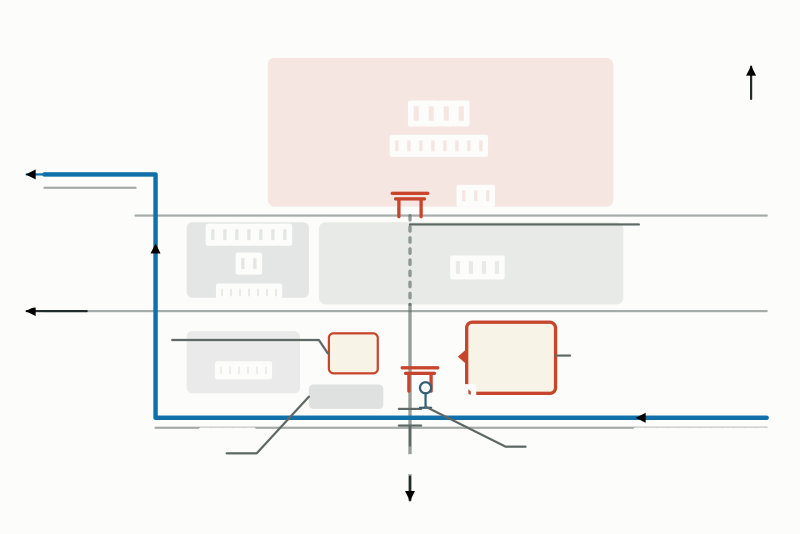
The National Museum of Modern Art, Kyoto, on the west side of Jingū-michi southwest of the Great Torii, began in 1963 (Shōwa 38) as the Kyoto branch of the National Museum of Modern Art, in a renovated annex of the Kyoto City Kangyōkan (industrial exhibition hall). The present building was designed by Maki Fumihiko and completed in 1986 (Shōwa 61). Okazaki Park is a scenic district, and buildings inside it may not be taller than the Great Torii of Heian Shrine. Within that limit, the building was made to feel open by keeping the second floor small to give a high-ceilinged lobby and by using large panes of glass on the canal side.
Kyoto City Hall's main building
Takeda Goichi also served as adviser on the main building of Kyoto City Hall, which faces south onto Oike-dōri in Nakagyō Ward. It was built in 1927 (Shōwa 2) and extended in 1931 (Shōwa 6), and it was designed by the Kyoto City Building and Repairs Section. It is a reinforced-concrete building with 4 floors above ground and 1 below and a tower at the center, and in the stair hall inside, Eastern-style decoration, including arches reminiscent of Islamic architecture, can be seen throughout. Its renovation was completed in 2021 (Reiwa 3), and on March 13, 2025 (Reiwa 7), its registration as a national Registered Tangible Cultural Property was announced.
Getting to Okazaki Park, and opening hours
To reach Okazaki Park, leave Higashiyama Station on the Tōzai subway line by Exit 1, walk east along Sanjō-dōri, and turn north on Jingū-michi. After passing under the Great Torii, the entrance to the Kyoto City KYOCERA Museum of Art is on the right (east) side, about an 8-minute walk from the station; the Kyoto Prefectural Library is about a 10-minute walk. From Kyoto Station, take city bus 5 to "Okazaki Kōen Bijutsukan/Heian Jingū-mae," which is right there.
The Kyoto City KYOCERA Museum of Art (124 Okazaki Enshōji-chō, Sakyō Ward) is open 10:00 to 18:00 and closed on Mondays (open on national holidays and other holidays) and from December 28 to January 2 (as of October 2026). Fees vary by exhibition. For the Collection Room, which shows works from the museum's collection, general admission is 520 yen for Kyoto City residents and 730 yen for others; elementary, junior high, and high school students and the like are free if they live or attend school in Kyoto City (300 yen for others), and children below elementary school age are free. Strollers can be taken into the galleries, and there is a nursing room in the East Hall on the 1st floor.
At the Kyoto Prefectural Library (Okazaki Seishōji-chō, Sakyō Ward), anyone can freely read books, newspapers, and magazines inside the library. It is open 9:30 to 19:00 Tuesday to Friday and 9:30 to 17:00 on Saturdays, Sundays, and national holidays, and closed on Mondays (open on national holidays), the 4th Thursday of each month, and other days. Kyoto City Hall's main building (Teramachi-dōri Oike-agaru) is open 8:45 to 17:30, except on Saturdays, Sundays, national holidays, and the New Year holidays.
Locations of the Museums, Library, and Theater Around Okazaki Park (Schematic Map)
Mini quiz for this entry
Why does the Kyoto City KYOCERA Museum of Art in Okazaki have "KYOCERA" in its name?
Which architect designed Kyoto Kaikan (today's ROHM Theatre Kyoto), which opened in Okazaki in 1960 (Shōwa 35), with a strong emphasis on horizontal lines?
Inside Okazaki Park, where the National Museum of Modern Art, Kyoto stands, there is a rule on building height. Buildings cannot be built taller than what?
Sources and verification
Content checked: October 22, 2026
Updated: October 22, 2026
References are in Japanese.
- 京都市京セラ美術館「ごあいさつ・沿革」
- 京都市京セラ美術館「建築」
- 京都市京セラ美術館「来館情報(時間・料金等)」
- 京都市京セラ美術館「交通アクセス」
- 文化庁「国指定文化財等データベース 京都市美術館本館」
- 文化庁「国指定文化財等データベース 京都市美術館東門」
- 文化庁「国指定文化財等データベース 京都市美術館正門(北)」
- 文化庁「国指定文化財等データベース 京都市役所本庁舎」
- 文化庁「国指定文化財等データベース 京都岡崎の文化的景観」
- 京都府立図書館「府立図書館『岡崎』110年の歩み 岡崎公園編」
- 京都府立図書館「岡崎周辺 武田五一の建築巡り」(令和元年10月14日の講座案内)
- 京都府立図書館「明治・大正の建築に関連する本 武田五一をはじめとする関西の近代建築」
- 京都府立図書館「利用案内(開館時間・休館日)」
- 京都府立図書館「よくある質問 利用(図書館カード作成)に関すること」
- 京都府立図書館「アクセス(交通案内)」
- ロームシアター京都「ロームシアター京都について」
- 京都国立近代美術館「建築について」
- 京都国立近代美術館「美術館の歴史」
- 京都市「京都市役所本庁舎を紹介するリーフレットについて」
- 京都市文化財保護課「京都岡崎の文化的景観」(重要文化的景観選定記念パンフレット)