
Doshisha's Red-Brick Buildings and the Reizei Family Residence
Key points
Doshisha's red-brick buildings can be seen from the outside while the campus gates are open; the Harris Science Hall can be entered as a gallery
When the court nobles' quarter was cleared to make Kyoto Gyoen, only the Reizei Family Residence stayed on its original land; it is normally closed to the public
The Imadegawa Campus began in 1876 (Meiji 9), when the Doshisha English School moved to the site of the former Satsuma domain residence
The Reizeike Shiguretei Bunko holds 5 National Treasures, including the autograph manuscript of Fujiwara no Teika's diary, the "Meigetsuki"
School buildings and a court noble's mansion north of the Imperial Park
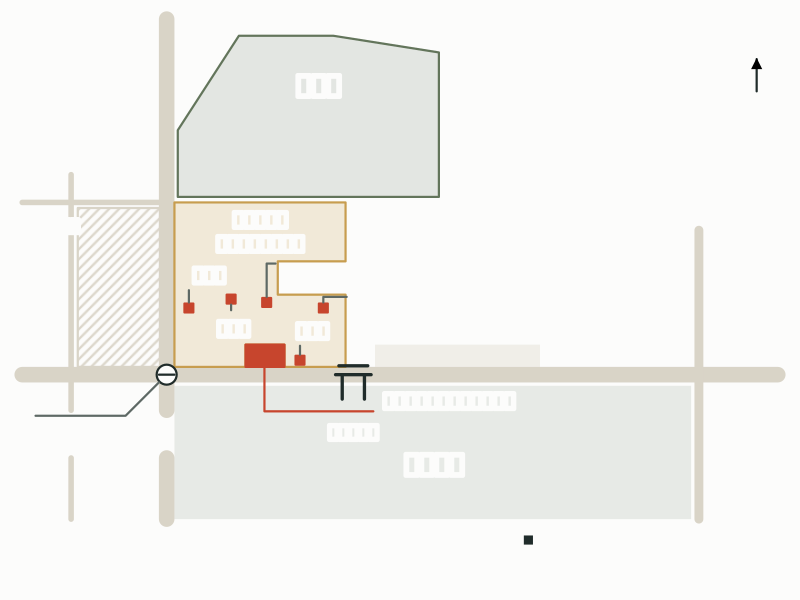
Heading east from the Karasuma-Imadegawa intersection, where Imadegawa Station on the Karasuma subway line is located, the north side of Imadegawa-dōri is Doshisha University's Imadegawa Campus. The south side of the street is Kyoto Gyoen, and the grounds of Shōkoku-ji adjoin the north of the campus. The Reizei Family Residence faces Imadegawa-dōri in the middle of the campus and is surrounded on three sides, west, north, and east, by Doshisha land. The Harris Science Hall stands just to its north, and the Yūshūkan next door to the east.
On the west side across Karasuma-dōri, the area bounded by Imadegawa-dōri, Kamidachiuri-dōri, and Muromachi-dōri is the site of Ashikaga Yoshimitsu's Muromachi-dono (Hana no Gosho, the "Palace of Flowers"), and Doshisha's Muromachi Campus is there today.
Around Imadegawa-dōri Karasuma Higashi-iru (Doshisha, the Reizei Family Residence, Shōkoku-ji, and Kyoto Gyoen)
Opening at Teramachi-Marutamachi and the move to Imadegawa
On November 29, 1875 (Meiji 8), Niijima Jō (Joseph Hardy Neesima) opened the Doshisha English School in a school building made from half of the Takamatsu Yasuzane residence, which he rented, at Teramachi-dōri Marutamachi-agaru. There were two teachers, Niijima and the missionary J. D. Davis, and eight students. In September of the following year, 1876 (Meiji 9), the school built two wooden school buildings and a dining hall on the site of the former Satsuma domain residence, north of the Imperial Palace in front of the gate of Shōkoku-ji, and moved there; this was the beginning of the Imadegawa Campus.
The 5 red-brick buildings
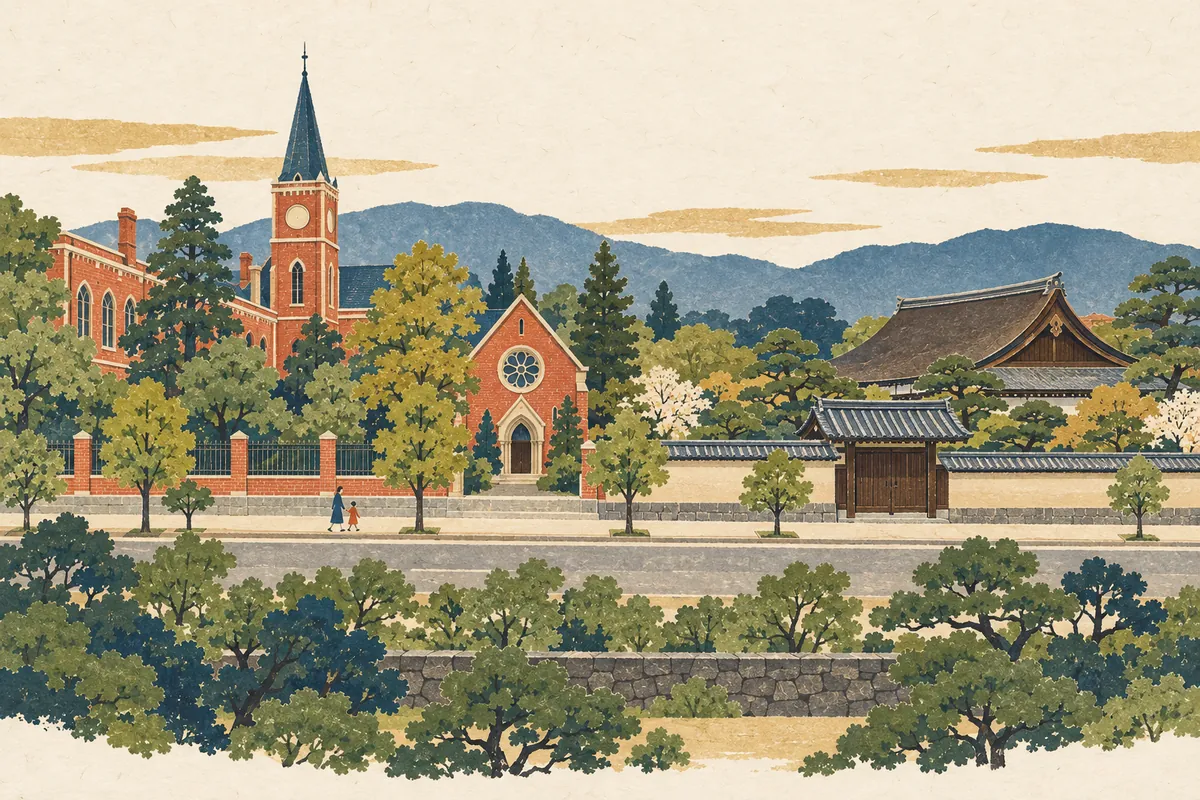
Doshisha's 5 buildings were built one after another over about 10 years, from the Shōeikan in 1884 (Meiji 17) to the Clarke Memorial Hall in 1894 (Meiji 27). The Shōeikan, the Chapel, and the Yūshūkan were designed by an American, the Harris Science Hall by an Englishman, and the Clarke Memorial Hall by a German. The national designation name is "Doshisha (Former English School, Theological School, and Harris School of Science)."
The Shōeikan is the oldest surviving brick building in Kyoto City; though its exterior is Western in style, its interior partition walls and koyagumi (roof framing) are purely Japanese. The Chapel is the oldest surviving Protestant brick chapel in Japan, and the round rose window in the center of its front and its pointed-arch entrance show features of Gothic architecture.
The Yūshūkan was Doshisha's first library (originally the "Shojakukan"), the Harris Science Hall was the building of the Harris School of Science, funded by a donation from J. N. Harris, and the Clarke Memorial Hall was the "Clarke Theological Hall," funded by a donation from Mr. and Mrs. B. W. Clarke.
Important Cultural Property buildings of Doshisha and the Reizei Family Residence
| Name | Year built | Designer | Year designated |
|---|---|---|---|
| Shōeikan (Doshisha) | 1884 (Meiji 17) | D. C. Greene | 1979 (Shōwa 54) |
| Chapel (Doshisha) | 1886 (Meiji 19) | D. C. Greene | 1963 (Shōwa 38) |
| Yūshūkan (Doshisha) | 1887 (Meiji 20) | D. C. Greene | 1979 (Shōwa 54) |
| Harris Science Hall (Doshisha) | 1890 (Meiji 23) | A. N. Hansell | 1979 (Shōwa 54) |
| Clarke Memorial Hall (Doshisha) | 1894 (Meiji 27) | R. Seel | 1979 (Shōwa 54) |
| Reizei Family Residence: zashiki and kitchen | 1790 (Kansei 2) | — | 1982 (Shōwa 57) |
| Reizei Family Residence: Obunko (library storehouse) | Mid-Edo period | — | 1982 (Shōwa 57) |
| Reizei Family Residence: kitchen storehouse | Mid-Edo period | — | 1982 (Shōwa 57) |
| Reizei Family Residence: front gate | 1790 (Kansei 2) | — | 1982 (Shōwa 57) |
The Reizei Family Residence
The Reizei family is a house of waka poetry descended from a grandson of Fujiwara no Teika, and since the Genna era (1615–1624) it has kept its mansion on the present site, north of the Imperial Palace. The present buildings were rebuilt in 1790 (Kansei 2). The features of a court noble's residence show clearly in its arrangement, with the zashiki and the kitchen in separate buildings, a large shikidai (formal entrance step) at the front, and a tatejitomi (standing lattice screen), a tomomachi (waiting room for attendants), and a heijūmon gate beside it, and in its floor plan, which divides the formal (omote) and private (oku) areas front and back.
When many court nobles moved to Tokyo with the emperor's move there in 1869 (Meiji 2), the court nobles' quarter around the palace quickly fell into ruin, and the mansions were removed and the area was made into today's Kyoto Gyoen. Among them, the Reizei Family Residence is the only example of this type of residence preserved on its original land, and it is designated an Important Cultural Property together with the land.
The Shiguretei Bunko
The books and old documents handed down in the Reizei family, centered on those related to waka poetry, number in the tens of thousands. To preserve and hand down these, the mansion, and events such as poetry gatherings, the Reizeike Shiguretei Bunko foundation was established in April 1981 (Shōwa 56), and it became a public interest incorporated foundation in April 2011 (Heisei 23).
There are 5 National Treasures: the "Kokin Wakashū" (1226, Karoku 2) and the "Gosen Wakashū" (1234, Tenpuku 2), copied by Fujiwara no Teika; the "Korai Fūteishō," a treatise on poetry by Teika's father, Fujiwara no Shunzei; the autograph manuscript of the "Shūi Gusō"; and the autograph manuscript of Teika's diary, the "Meigetsuki." The "Meigetsuki" records the movements of the court and the warrior class from the Genpei War to after the Jōkyū War, and is a first-rate historical source for the early Kamakura period.
Visiting from Imadegawa Station
Doshisha's Imadegawa Campus is a 1-minute walk from Imadegawa Station on the Karasuma subway line, a 1-minute walk from the Karasuma-Imadegawa city bus stop, and a 15-minute walk from Keihan Demachiyanagi Station.
- Doshisha campus: you can visit freely while the gates are open, and groups of fewer than 30 do not need to apply. You cannot enter when the Main Gate and West Gate are closed, such as during the summer break or over the New Year holidays. On a self-guided visit you cannot go inside the Important Cultural Property buildings, so you see them from the outside.
- Campus tours: regular tours on Saturdays, in which student guides show you around mainly the 5 Important Cultural Property buildings (advance reservation required; exteriors only).
- Harris Science Hall Doshisha Gallery: inside the Important Cultural Property Harris Science Hall is an exhibition facility introducing the history of Doshisha and Niijima Jō, and admission is free. Open 10:00–17:00 (last entry 16:30). Closed on Mondays, public holidays, and Sundays (open during special exhibitions), and during Golden Week and parts of the summer and winter breaks. It is right by Exit 3 of Imadegawa Station.
- Reizei Family Residence: normally closed to the public.
Mini quiz for this entry
Who opened Dōshisha English School in Kyoto in 1875 (Meiji 8)?
The National Treasure Meigetsuki, Fujiwara no Teika's diary whose autograph manuscript is handed down in the Reizei family, covers which period?
Among Doshisha's 5 brick Important Cultural Property buildings, which was designed by a German?
Sources and verification
Content checked: October 22, 2026
Updated: October 22, 2026
References are in Japanese.
- 文化庁 国指定文化財等データベース「同志社(旧英学校、神学校及び波理須理科学校)彰栄館」
- 文化庁 国指定文化財等データベース「同志社(旧英学校、神学校及び波理須理科学校)礼拝堂」
- 文化庁 国指定文化財等データベース「同志社(旧英学校、神学校及び波理須理科学校)有終館」
- 文化庁 国指定文化財等データベース「同志社(旧英学校、神学校及び波理須理科学校)ハリス理化学館」
- 文化庁 国指定文化財等データベース「同志社(旧英学校、神学校及び波理須理科学校)クラーク記念館」
- 文化庁 国指定文化財等データベース「冷泉家住宅 座敷及び台所」
- 文化庁 国指定文化財等データベース「冷泉家住宅 御文庫」
- 文化庁 国指定文化財等データベース「冷泉家住宅 台所蔵」
- 文化庁 国指定文化財等データベース「冷泉家住宅 表門」
- 文化庁 国指定文化財等データベース「古今和歌集〈藤原定家筆〉」
- 文化庁 国指定文化財等データベース「後撰和歌集〈藤原定家筆〉」
- 文化庁 国指定文化財等データベース「古来風躰抄〈上下(初撰本)/自筆本〉」
- 文化庁 国指定文化財等データベース「拾遺愚草〈上中下/自筆本〉」
- 文化庁 国指定文化財等データベース「明月記〈自筆本〉」
- 公益財団法人冷泉家時雨亭文庫「冷泉家とは・財団概要・理事長あいさつ」
- 同志社大学「建物紹介」
- 同志社大学「今出川校地」
- 同志社大学「年表 〜新島襄の誕生から現在まで〜」
- 同志社大学「建学の精神と新島襄」
- 同志社大学「キャンパスツアー紹介」
- 同志社大学「今出川校地 自由散策」
- 同志社大学「交通アクセス」
- ハリス理化学館同志社ギャラリー「開館時間・料金」
- ハリス理化学館同志社ギャラリー「アクセスマップ」
- 環境省 京都御苑「京都御苑の歴史」