
Japanese羽束師(はづかし)
Hazukashi
Other spellings and namesHazukashi Shrine (羽束師神社) / Hazukashi-ni-imasu-Takamimusubi Shrine / Hazukashi no Mori (羽束師の森)
In short
Hazukashi (羽束師) is an area name in Fushimi Ward, preserved in town names such as Hazukashi-Shimizu-chō and Hazukashi-Hishikawa-chō. The name goes back to the ancient Hatsukashi district of Otokuni County, and theories of its origin include one linking it to the Haji clan, one linking it to the hatsukashibe (泥部), who handled earthwork and building, and one tying it to arrow-making. At the heart of the area is Hazukashi Shrine, recorded as "Hatsukashi no Kami" (波都賀志神) in the Shoku Nihongi.Key points in 30 seconds
Read Hazukashi (はづかし); an area on the right bank of the Katsura River
A place name going back to the ancient Hatsukashi district (羽束郷) of Otokuni County, Yamashiro Province
Theories of origin include the Haji clan, the hatsukashibe (泥部), and arrow-making
Hazukashi Shrine is recorded as "Hatsukashi no Kami" in the Shoku Nihongi entry for 701 (Taihō 1)
Towns on the Katsura River's right bank, read "Hazukashi"
Fushimi Ward has four towns—Hazukashi-Kamogawa-chō, Hazukashi-Shimizu-chō, Hazukashi-Hishikawa-chō, and Hazukashi-Furukawa-chō—each read with "Hazukashi," as in はづかしかもがわちょう (Hazukashi-Kamogawa-chō). All four towns attend Kamikawa Junior High School.
Hazukashi is land on the right bank of the Katsura River that belonged to the former Otokuni County. It is now part of Fushimi Ward, but it was once part of Otokuni County on the west side of the river. The three characters 羽 ("feather"), 束 ("bundle"), and 師 ("master") are thought to have originally been chosen for their sounds, to write the name Hazukashi (see the next section).
Town names with "Hazukashi" (Fushimi Ward)
| Town name | Reading | Elementary school district |
|---|---|---|
| 羽束師鴨川町 Hazukashi-Kamogawa-chō | はづかしかもがわちょう | Divided between Kuga no Mori and Kamikawa depending on lot number |
| 羽束師志水町 Hazukashi-Shimizu-chō | はづかししみずちょう | Hazukashi |
| 羽束師菱川町 Hazukashi-Hishikawa-chō | はづかしひしかわちょう | Hazukashi |
| 羽束師古川町 Hazukashi-Furukawa-chō | はづかしふるかわちょう | Hazukashi |
There is more than one theory of its origin
The Heian-period dictionary Wamyō Ruijushō lists a district called 羽束郷 in Otokuni County, Yamashiro Province, and it is identified with the area around Hazukashi in Fushimi Ward. Manuscripts note its reading as 波津加之 and 波豆賀之, and it is thought to have been called Hatsukashi or Hazukashi since ancient times. The Kōzan-ji manuscript also notes that it was originally written with the three characters 羽束志. The "Hatsukashi Village (羽束里), Yamashiro Province" that appears in a document of 749 (Tenpyō Shōhō 1) is regarded as the oldest example of a place name in Otokuni County written with 羽束.
There are several theories about the name's meaning. One links it to the Haji clan. The history of Hazukashi Shrine is said to go back to the Haji clan, makers of unglazed earthenware (hajiki), and some regard this as a leading explanation for the name Hazukashi.
On the other hand, the hatsukashibe (泥部)—people under the ancient Imperial Household Ministry's office of earthworks who plastered walls and fired tiles and lime—were called in old times by a name corresponding to hatsukashi no tomogara, and linking these hatsukashibe with the Hatsukashi district was the generally accepted view. In contrast, there is also a theory that 羽束 ("bundling feathers") refers to binding feathers to arrow shafts, tying the name to arrow-making, while some research supports the hatsukashibe theory for the Hatsukashi district of Otokuni County. None of the theories is decisive, so it is safest to take the origin of the place name as "there are several theories."
Main theories of the origin of the name Hazukashi
| Theory | Content |
|---|---|
| Haji clan theory | Traces back to the Haji clan, who made earthenware (hajiki) |
| Hatsukashibe theory | Comes from the dwelling place of the hatsukashibe (泥部), who handled earthwork and building |
| Arrow-making theory | Comes from making arrows by binding feathers |
"Hatsukashi no Kami" in the Shoku Nihongi
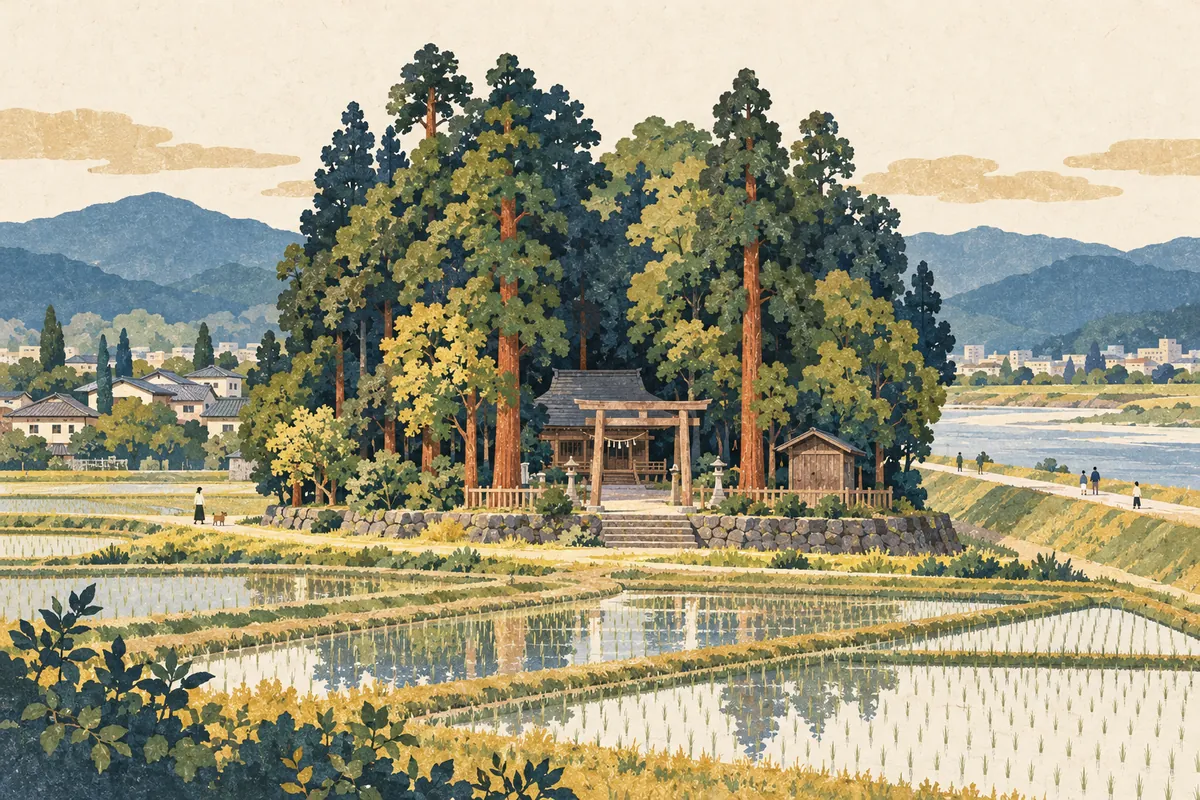
Hazukashi-ni-imasu-Takamimusubi Shrine (羽束師坐高御産日神社, はづかしにますたかみむすびじんじゃ) is one of the oldest shrines in Kyoto City, recorded as "Hatsukashi no Kami" (波都賀志神) in the Shoku Nihongi entry for the 3rd day of the 4th month of 701 (Taihō 1). Its grounds are called Hazukashi no Mori (the Hazukashi Grove), and in 1996 (Heisei 8) they were designated a Kyoto City Historic Site as a valuable historic place in the increasingly developed Katsura River basin.
The main hall and worship hall, rebuilt in 1853 (Kaei 6), are Registered Cultural Properties of the city. According to the shrine's tradition, it was established in 477, in the time of Emperor Yūryaku, and it is said to be listed first in the Yamashiro no Kuni Jinmyōchō (register of shrines of Yamashiro Province).
Hazukashi no Mori and Michizane's poem
The grounds of Hazukashi Shrine are also known as Hazukashi no Mori. Kitamuki Mikaeri Tenmangū, east of the first torii, is said to stand where, in 901 (Engi 1), Sugawara no Michizane stopped to worship on his way into exile at Dazaifu and composed a poem containing the words "mi o hazukashi no mori" ("the grove of Hazukashi, where I feel ashamed of myself").
This is said to be the place where Michizane looked back toward the Dairi (Imperial Palace) to the north and composed a poem expressing his reluctance to leave the capital, and there is also a tradition that Michizane, a descendant of the Haji clan, stopped at Hazukashi Shrine because of its ties to his ancestors. In the waka, the place name Hazukashi is used as a pun on hazukashi (恥づかし), "ashamed."
Land that has lived with water
Hazukashi benefited from water but also suffered from floods time and again. During the Bunsei era of the Edo period, the chief priest of Hazukashi Shrine planned the excavation of the Hazukashi River, which was completed in 1825 (Bunsei 8) after 20 years, and the area is said to have been spared from floods thereafter.
The shrine's festivals also continue. At the ujigami festival in May 2007 (Heisei 19), the procession of a mid-Edo-period mikoshi (portable shrine) was revived for the first time in 70 years. As of 2018 (Heisei 30), the Kankōsai (return procession) was held every year on the second Sunday of May, with the mikoshi making its way around the parish.
- Read Hazukashi (はづかし). The town names are Hazukashi-Kamogawa-chō, -Shimizu-chō, -Hishikawa-chō, and -Furukawa-chō
- Theories of origin include the Haji clan, the hatsukashibe, and arrow-making; none is settled
- The grounds of Hazukashi Shrine (Hazukashi no Mori) are a Kyoto City Historic Site
- East of the first torii is Kitamuki Mikaeri Tenmangū, where the tradition of Michizane's poem lives on
Mini quiz for this entry
Check what you've read with 2 multiple-choice questions.
How is 羽束師, an area on the right bank of the Katsura River in Fushimi Ward, read?
Which ancient clan is considered a leading explanation for the origin of the name Hazukashi?
Sources and verification
Content checked: October 11, 2026
Updated: October 11, 2026
References are in Japanese.