
Japanese物集女(もずめ)
Mozume
Other spellings and namesMozume-chō / Mozume Castle Site / Mozume Kaidō / 物集女
In short
物集女 is read Mozume (もずめ), a place name that survives in Mozume-chō in northern Mukō City. In medieval times the Mozume estate (Mozume-no-shō) was located here, and in the Muromachi and Sengoku periods the Mozume clan, based in this area, built a fortified residence. The Mozume Castle site was designated a National Historic Site in 2024, and the town also has the Mozume Kurumazuka Tumulus, whose stone burial chamber is open to the public.Key points in 30 seconds
Mozume-chō, Mozume Castle, and the Mozume clan are all read Mozume (もずめ)
The Mozume estate was located here in medieval times
The Mozume Castle site was designated a National Historic Site on October 11, 2024
The Mozume Kaidō branches off the Saigoku Kaidō at Terado and was also called the Atago road
Not "Monoatsume" (ものあつめ) but Mozume
物集女城 is read Mozume-jō (Mozume Castle), and 物集女氏 is read Mozume-shi (the Mozume clan). It is hard to guess the reading from the three kanji, yet the name is used for the town of Mozume-chō in Mukō City as well as for the Mozume Castle site and the Mozume Kaidō road.
Mozume-chō lies in the northern part of the city, at the tip of a river terrace. In medieval times, estates such as the Mozume, Terado, and Kaide (鶏冠井) estates were located here, developing as estates in Rakugai, the outskirts of Kyoto. This shows that the name Mozume has been used for an estate and a warrior family since at least the medieval period.
Until the Edo period, the area of today's Mukō City consisted of the town of Mukōmachi and villages such as Mozume, Terado, Kaide, and Kami-Ueno. When the municipal system took effect in 1889 (Meiji 22), Mukōmachi merged with five surrounding villages to form a new Mukōmachi, and Mozume went from being a village to being part of Mukōmachi.
The Mozume Clan and the Mozume Castle Site
Mozume Castle is thought to have been the residence of the Mozume clan, kunishū (local warrior lords) based in this area from the Muromachi to the Sengoku period. The Mozume clan appears in a document from 1487 as one of the representatives of the sōkoku (a self-governing league of local lords) on the right bank of the Katsura River.
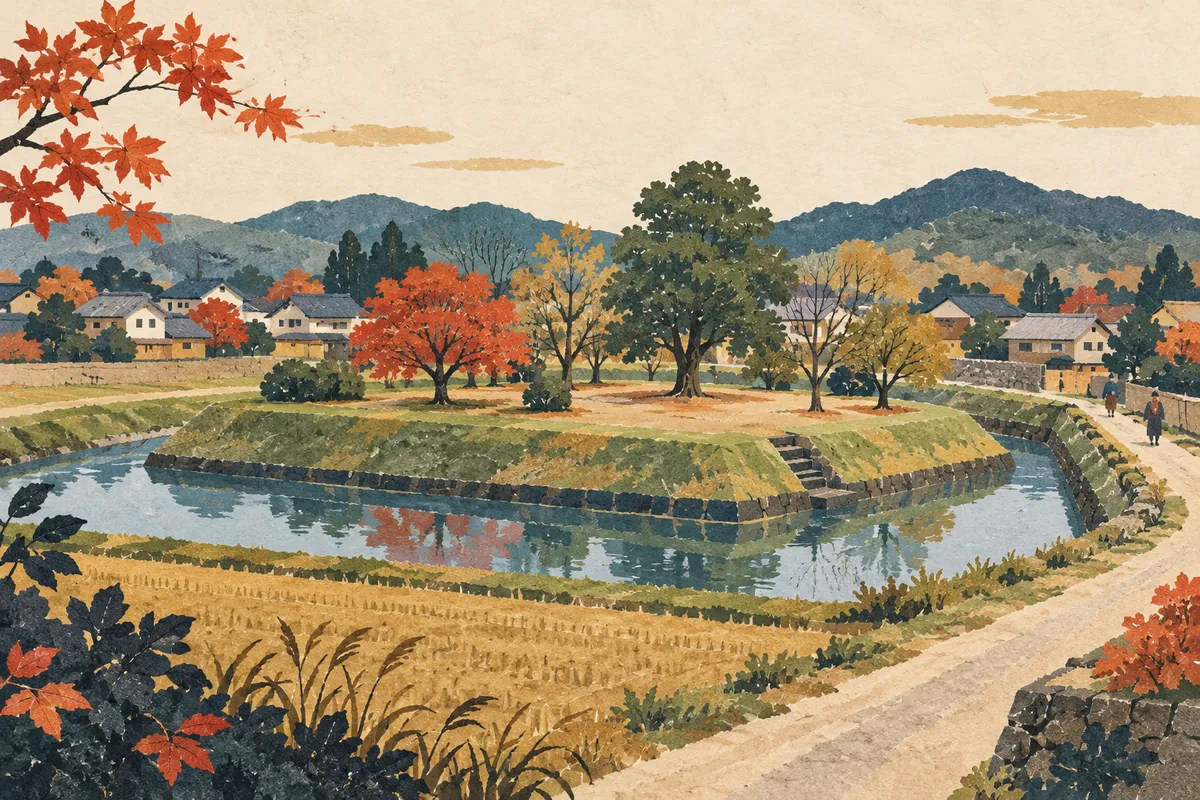
The castle site is a square residence about 70 m east to west and about 75 m north to south, surrounded by moats and earthen ramparts. It was designated a National Historic Site on October 11, 2024. The name Chūjō (中条) in Mozume-chō Chūjō, near the castle, is also said to come from naka-jō (中城), meaning "inside the castle."
After the Ōnin War and other conflicts, local warrior families such as the Takeda, Mozume, and Kaide grew powerful in this region, but once Oda Nobunaga brought Yamashiro Province under his control, the local lords died out. In 1573 (Tenshō 1), Tadashige, head of the Mozume clan, is said to have refused to pay his respects to Hosokawa Fujitaka, whom Nobunaga had entrusted with the lands west of the Katsura River, and to have been killed near Shōryūji Castle.
Few medieval castle residences survive around Kyoto, and the Mozume Castle site is the first medieval castle residence in Kyoto Prefecture to be designated a National Historic Site. The castle stood where it could control the crossing of the Mozume Kaidō and the Tanba road (Fushimi road), and the site is now Mozume Castle Park.
A short history of Mozume
| Period | Event |
|---|---|
| Kofun period | The Mozume Kurumazuka Tumulus (a keyhole-shaped mound) is built |
| Medieval period | The Mozume estate is established |
| 1422 (Ōei 29) | Surrounding villages including Mozume build the main hall of Mukō Shrine |
| 1487 (Chōkyō 1) | Mozume Mitsushige signs as one of the representatives of the sōkoku on the right bank of the Katsura River |
| 1573 (Tenshō 1) | Clan head Tadashige is said to have been killed near Shōryūji Castle |
| 1889 (Meiji 22) | Mukōmachi and surrounding villages merge into a new Mukōmachi |
| 2024 (Reiwa 6) | The Mozume Castle site is designated a National Historic Site |
An Even Older Mozume: The Kurumazuka Tumulus
Mozume also has a historic site far older than the castle. The Mozume Kurumazuka Tumulus (物集女車塚古墳, Mozume Kurumazuka Kofun), at the tip of the terrace in Mozume-chō, is a keyhole-shaped mound with a huge corridor-style stone chamber and is one of the Otokuni Tumulus Group, a National Historic Site. Judging from the structure of the chamber and the artifacts found there, it is also thought to have been connected to the political upheaval of Emperor Keitai's reign.
Restoration of the tumulus began in 1983 (Shōwa 58) and was completed in 1995 (Heisei 7), including the corridor-style stone chamber. Since then, the chamber has been open to the public. This tumulus is said to have been the last large tomb, such as a keyhole-shaped mound, built in the area of today's city.
The Mozume Kaidō, Heading into Western Kyoto
The name Mozume also survives in a road. The Mozume Kaidō branches off the Saigoku Kaidō and runs north through western Kyoto City; it splits off at Terado village (today's Terado-chō in Mukō City) and joins the San'in Kaidō at Katagihara.
Its northern end is unclear, and one theory says it continued via Arashiyama to the Atago Kaidō. Roads in the Edo period were often named after their destinations: a 1771 (Meiwa 8) map reportedly labels it "Atago-michi" (Atago road), and the Gokinaishi gazetteer "Atago-ji." "Mozume Kaidō" can be seen as a name taken from a village along the way.
Mukōmachi, a town that grew up in the early Edo period, spread along the Saigoku Kaidō in front of Mukō Shrine and extended north to around the fork with the Mozume Kaidō. The ridge tag of Mukō Shrine's current main hall (an Important Cultural Property) records that it was built in 1422 (Ōei 29) by the surrounding villages, including Mozume, Terado, and Kaide.
- Read Mozume (もずめ): the town, castle, clan, and road all use the same reading
- The Mozume Castle site (Mozume-chō Chūjō) became a National Historic Site in 2024
- The Mozume Kurumazuka Tumulus is a keyhole-shaped mound with a stone chamber open to the public
- The Mozume Kaidō branches off the Saigoku Kaidō at Terado and meets the San'in road at Katagihara
Mini quiz for this entry
Check what you've read with 2 multiple-choice questions.
How is the Mukō City place name 物集女 read?
The Mozume Castle site was designated a National Historic Site in 2024. Which local lords made this fortified residence their seat?
Sources and verification
Content checked: October 11, 2026
Updated: October 11, 2026
References are in Japanese.