
Japanese車折神社(くるまざきじんじゃ)
Kurumazaki Jinja
Other spellings and namesKurumazaki Shrine / Kurumazaki-jinja Station / Sakura no Miya / 車折
In short
車折神社 is a shrine in Saga, Ukyō Ward, read Kurumazaki Jinja (くるまざきじんじゃ), and its name is also used for a Randen station and a bus stop. Tradition says that when Emperor Go-Saga was on his way to the Ōi River, the shafts of his ox carriage broke in front of the shrine; he granted it the divine title Kurumazaki Daimyōjin, and it has been called Kurumazaki Jinja ever since.Key points in 30 seconds
Read Kurumazaki Jinja, right next to Randen's Kurumazaki-jinja Station (A10)
The name is said to come from the shafts of Emperor Go-Saga's ox carriage breaking in front of the shrine
The enshrined deity is Kiyohara no Yorinari, a late Heian-period Confucian scholar; the shrine was originally called Sakura no Miya
The town name of its address is Saga Asahi-chō, Ukyō Ward; "Kurumazaki" is used for the shrine, the station, and the bus stop
Not Kuruma-ore but Kurumazaki
車折神社 is read Kurumazaki Jinja (くるまざきじんじゃ). Because the character 折 usually means "break" (oreru), you might be tempted to read it Kuruma-ore or Kuruma-ori, but both the shrine and the Keifuku Electric Railroad (Randen) station named after it are read Kurumazaki. The stone at the shrine gate, 車折石, is also read Kurumazaki-ishi.
The shrine's address is 23 Saga Asahi-chō, Ukyō Ward, Kyoto City. "Kurumazaki" is not a town name; it is the shrine's name, also used for the station and bus stop named after it.
The legend of the broken carriage shafts
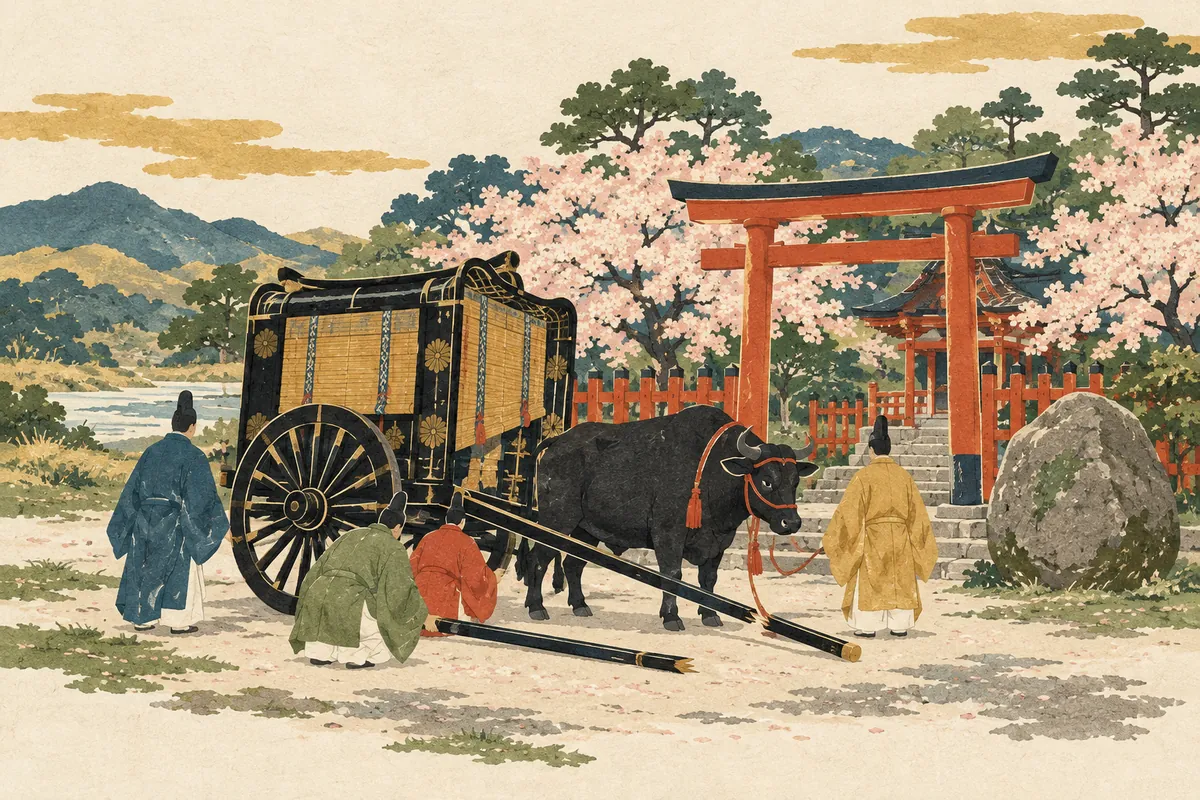
Tradition says that when Emperor Go-Saga made an excursion to the Ōi River at Arashiyama, the shafts (nagae) of his ox carriage broke in front of this shrine, so he granted it the divine title Kurumazaki Daimyōjin ("Great Deity of the Broken Carriage") and the highest court rank, Shō Ichii. From then on, it is said, the shrine was called Kurumazaki Jinja. Nagae are the two long poles that stick out from the front of an ox carriage and are attached to the ox.
The shrine's own tradition is also told this way: when Emperor Go-Saga tried to pass in front of the shrine in his ox carriage, the ox suddenly refused to move and the carriage shafts broke, and so it came to be called Kurumazaki Jinja.
It is also said that the emperor, in awe of the deity's power, named the stone on the right side of the gate Kurumazaki-ishi and granted the title Shō Ichii Kurumazaki Daimyōjin. The details of the legend differ slightly from one account to another, but they all agree that a carriage broke in front of the shrine.
The deity is Kiyohara no Yorinari; the shrine was once Sakura no Miya
The enshrined deity, Kiyohara no Yorinari, was a Confucian scholar of the late Heian period and a descendant of Prince Toneri. His clan included Kiyohara no Motosuke, one of the Thirty-Six Immortal Poets, and Motosuke's daughter Sei Shōnagon. Yorinari served as Daigeki (senior court secretary) for 24 years, and in his later years his learning was so respected that Kujō Kanezane consulted him on political matters.
Yorinari died in 1189 (Bunji 5) and was buried on the present shrine grounds, which were then Kiyohara family land, and a mausoleum was built there. Later a temple called Hōju-in, named after his Buddhist name, was established, and when Ashikaga Takauji founded Tenryū-ji in Arashiyama in the Muromachi period, it is said to have become a branch temple of Tenryū-ji.
Because Yorinari loved cherry blossoms during his lifetime, many cherry trees were planted at the mausoleum, and at first it was reportedly called Sakura no Miya ("Cherry Shrine"). Kurumazaki Jinja is thus the later name of this Sakura no Miya. Owing to Yorinari's learning and virtue, he is worshipped as a deity of academic success and of keeping one's promises.
Where can you see it today? Station, bus stop, and shrine grounds
On Randen's Arashiyama Main Line, Kurumazaki-jinja Station (A10) lies between Arisugawa and Rokuō-in. The shrine is about a one-minute walk from Keifuku's Kurumazaki-jinja Station, and also about a one-minute walk from the Kurumazaki-jinja-mae bus stop served by Kyoto City Bus and Kyoto Bus.
Within the grounds is Geinō Jinja, a shrine to Ame-no-Uzume-no-Mikoto, regarded as the ancestral deity of the performing arts. More than 4,000 vermilion fence plaques bearing stage names and group names have been dedicated there. The small Kinen Shinseki (prayer stones) received at the shrine office are customarily returned, together with a thank-you stone, once your wish comes true.
Things that carry the name 車折 (Kurumazaki)
| Name | Reading | What it is |
|---|---|---|
| 車折神社 | Kurumazaki Jinja | Shrine at 23 Saga Asahi-chō, Ukyō Ward. Enshrined deity: Kiyohara no Yorinari |
| 車折大明神 | Kurumazaki Daimyōjin | Divine title said to have been granted by Emperor Go-Saga |
| 車折石 | Kurumazaki-ishi | Stone on the right side of the gate |
| 車折神社駅 | Kurumazaki-jinja | Station on Randen's Arashiyama Main Line (A10), between Arisugawa and Rokuō-in |
| 車折神社前 | Kurumazaki-jinja-mae | Kyoto City Bus and Kyoto Bus stop |
Visiting: one minute from the station, and the Ōi River in May
Get off at Randen's Kurumazaki-jinja Station and you are right at the shrine grounds. As of October 2026, it is open from 9:30 to 17:00, and admission is free. Look at the Kurumazaki-ishi stone at the gate and the vermilion fence plaques of Geinō Jinja inside, and you will grasp both the origin of the shrine's name and the faith it attracts today.
In 2026, the Mifune Matsuri was held on Sunday, May 17, on the Ōi River upstream of Togetsukyō Bridge in Arashiyama. It is held every year on the third Sunday of May; boats such as the imperial gozabune and boats with dragon-head and bird-head (gekisu) prows are floated on the river, and fans are set adrift on the water while bugaku dance and gagaku court music are offered. It is a day to watch courtly boat play on the very river Emperor Go-Saga is said to have visited.
Mini quiz for this entry
Check what you've read with 2 multiple-choice questions.
How is 車折神社, a shrine in Saga, Ukyō Ward, that is also a Randen station name, read?
What event, as handed down at Kurumazaki Shrine, gave the shrine its name ("broken carriage")?
Sources and verification
Content checked: October 11, 2026
Updated: October 11, 2026
References are in Japanese.