
Japanese百足屋町(むかでやちょう)
Mukadeya-cho
Other spellings and namesMukadeya-chō / Minami Kannon-yama / Mukadeya / 百足屋町
In short
百足屋町 is a town name in Nakagyō Ward read Mukadeya-chō (むかでやちょう). It is said to come from Mukadeya, a wealthy merchant house that took its name from the centipede (mukade), whose many legs were likened to many customers—a lucky sign. Nakagyō Ward has two towns called Mukadeya-chō: one at Ebisugawa-dōri and Sakaimachi, and one at Shinmachi-dōri Takoyakushi-sagaru.Key points in 30 seconds
百足 ("hundred legs") is read mukade, "centipede," giving Mukadeya-chō
Said to come from the trade name of the wealthy merchant Mukadeya
Nakagyō Ward has two towns with this name (Ebisugawa-dōri Sakaimachi / Shinmachi-dōri Takoyakushi-sagaru)
Near the Mukadeya-chō on Shinmachi-dōri, the Minami Kannon-yama float of the Gion Festival's Ato Matsuri is set up
百足 Means Centipede
The 百足 ("hundred legs") in 百足屋町 means mukade, the many-legged creature known in English as the centipede. Mukadeya-chō in Nakagyō Ward is read むかでやちょう. This is a jukujikun reading, in which a whole word is assigned to a set of kanji; it cannot be derived from the usual readings of 百 or 足.
Nakagyō Ward has two towns named Mukadeya-chō, told apart by street-name landmarks. One is at Ebisugawa-dōri Sakaimachi higashi-iru / nishi-iru, and the other is at Shinmachi-dōri Takoyakushi-sagaru. Because the town name alone does not pin down the location, the street names are added to distinguish them.
The two Mukadeya-chō towns in Nakagyō Ward
| Town name | Landmark (street names) | Elementary school zone | Junior high school zone |
|---|---|---|---|
| Mukadeya-chō (百足屋町) | Ebisugawa-dōri Sakaimachi higashi-iru / nishi-iru | Goshominami | Kyōto Oike |
| Mukadeya-chō (百足屋町) | Shinmachi-dōri Takoyakushi-sagaru | Takakura | Kyōto Oike |
Mukadeya, a Merchant Who Wished for Many Customers
The centipede is considered a lucky creature because its many legs suggest many customers (in Japanese, kyakuashi, literally "customer feet")—in other words, thriving trade. The town name is said to come from Mukadeya, a wealthy merchant house that adopted the name for good luck.
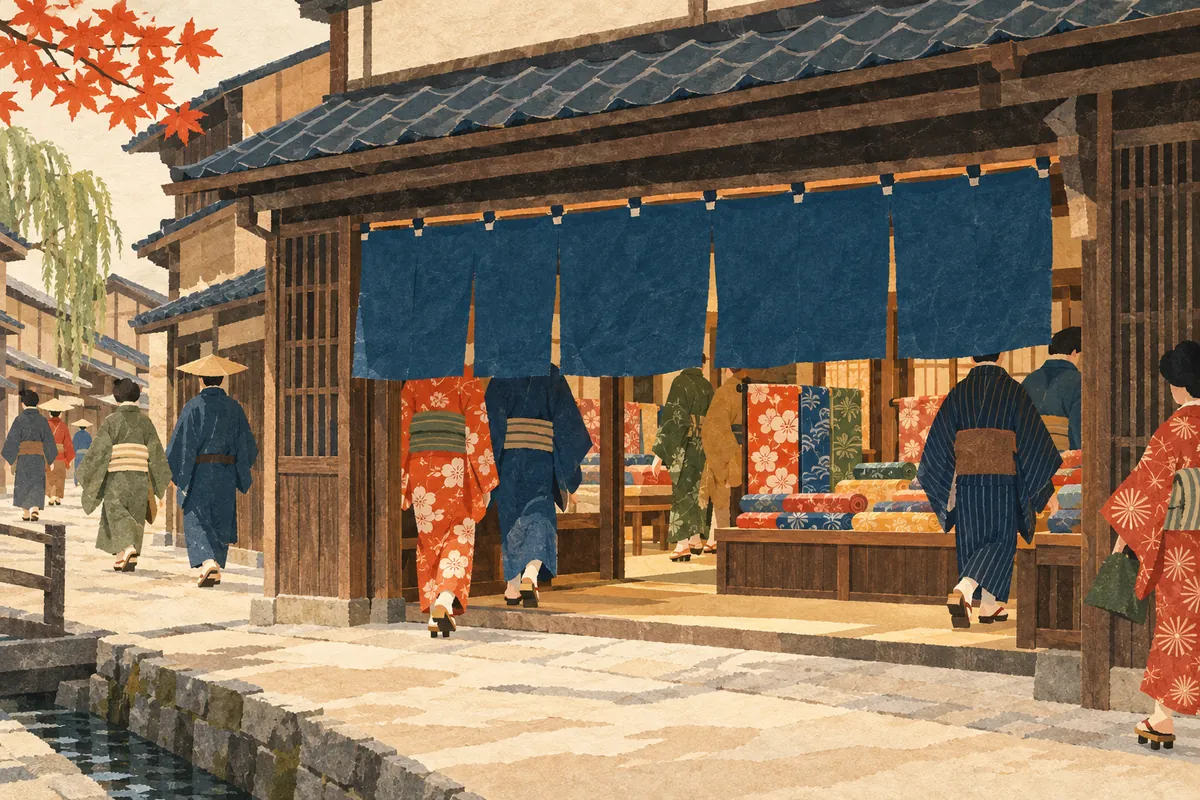
Both Mukadeya-chō towns in Kyoto are on streets lined with shops—one a town of kimono fabric dealers and the other a town of joinery (fittings such as sliding doors)—and the name is said to express the hope of attracting more customers. However, which Mukadeya-chō was the kimono town and which the joinery town, and who the merchant Mukadeya was and when, have not been confirmed.
Mukadeya-chō on Shinmachi-dōri and the Minami Kannon-yama Float
The Mukadeya-chō at Shinmachi-dōri Takoyakushi-sagaru lies within the Meirin gakku (school district), bounded by Karasuma-dōri, Shijō-dōri, Sanjō-dōri, and Nishinotōin-dōri. Meirin is a central community that carries on the Gion Festival, sending out as many as 13 yamaboko floats.
The Minami Kannon-yama float of the Ato Matsuri (later festival) is based at Shinmachi-dōri Nishikikōji-agaru in Nakagyō Ward, on the same stretch of Shinmachi-dōri as Mukadeya-chō's landmark, Shinmachi-dōri Takoyakushi-sagaru. Minami Kannon-yama is also called Kudari Kannon-yama. Its principal image, a seated Yōryū Kannon (Willow Kannon) from the Kamakura period, is said to have lost all but its head and chest in the Great Tenmei Fire.
The float is said to ward off illness; in the procession it carries a large willow branch, and carved wooden kusudama (medicine balls) of chrysanthemum, bamboo, plum, and orchid hang at its four corners. In 2026, the Ato Matsuri yoiyama (festival eves) were held July 21–23, and the yamaboko procession on July 24. Minami Kannon-yama is said to be one of the kuji-torazu floats, whose place in the Ato Matsuri procession is fixed rather than drawn by lot.
Other Town Names Inspired by Living Creatures
Mukadeya-chō is not the only town name inspired by a living creature. Some, like Mukadeya-chō, are said to have come from merchants' trade names—a reminder that central Kyoto was a city of commerce.
- Kita-Kaniya-chō and Minami-Kaniya-chō (Kamigyō Ward): a shop owner, delighted that his pet crab (kani) had grown attached to him, named his shop Kaniya ("Crab House")
- Shōjō-chō (Nakagyō Ward): a sake shop that placed a figure of the shōjō, an imaginary sake-loving creature, on its roof prospered and was called "the shōjō sake shop"
- Karigane-chō (Nakagyō Ward): named for a well on the north side of the town called Karigane no I, because wild geese (kari) flew up from it
- Niwatoriboko-chō (Shimogyō Ward): named because the town maintains and preserves the Niwatori-boko (Rooster float) of the Gion Festival (there are several theories)
Visiting? Use the Street-Name Landmarks
When visiting Mukadeya-chō, the town name alone does not tell you which of the two is meant. Check first whether it is "Ebisugawa-dōri Sakaimachi" or "Shinmachi-dōri Takoyakushi-sagaru," and you will not get lost. With two towns of the same name, Mukadeya-chō shows clearly why street names are added to Kyoto addresses.
If you walk along Shinmachi-dōri during the Gion Festival's Ato Matsuri, you can see Minami Kannon-yama set up near Mukadeya-chō and view the float up close amid the bustle of yoiyama. The festival crowds may let you feel the "many customers" behind the town's name.
Mini quiz for this entry
Check what you've read with 2 multiple-choice questions.
How is 百足屋町, a town name in Nakagyō Ward, read?
The wealthy merchant house Mukadeya, said to be the origin of Mukadeya-chō, took the centipede as a lucky emblem. Why?
Sources and verification
Content checked: October 11, 2026
Updated: October 11, 2026
References are in Japanese.