
Japanese笋町(たかんなちょう)
Takanna-cho
Other spellings and namesTakannacho / Mōsō-yama (孟宗山) / Takanna (笋), old word for bamboo shoot
In short
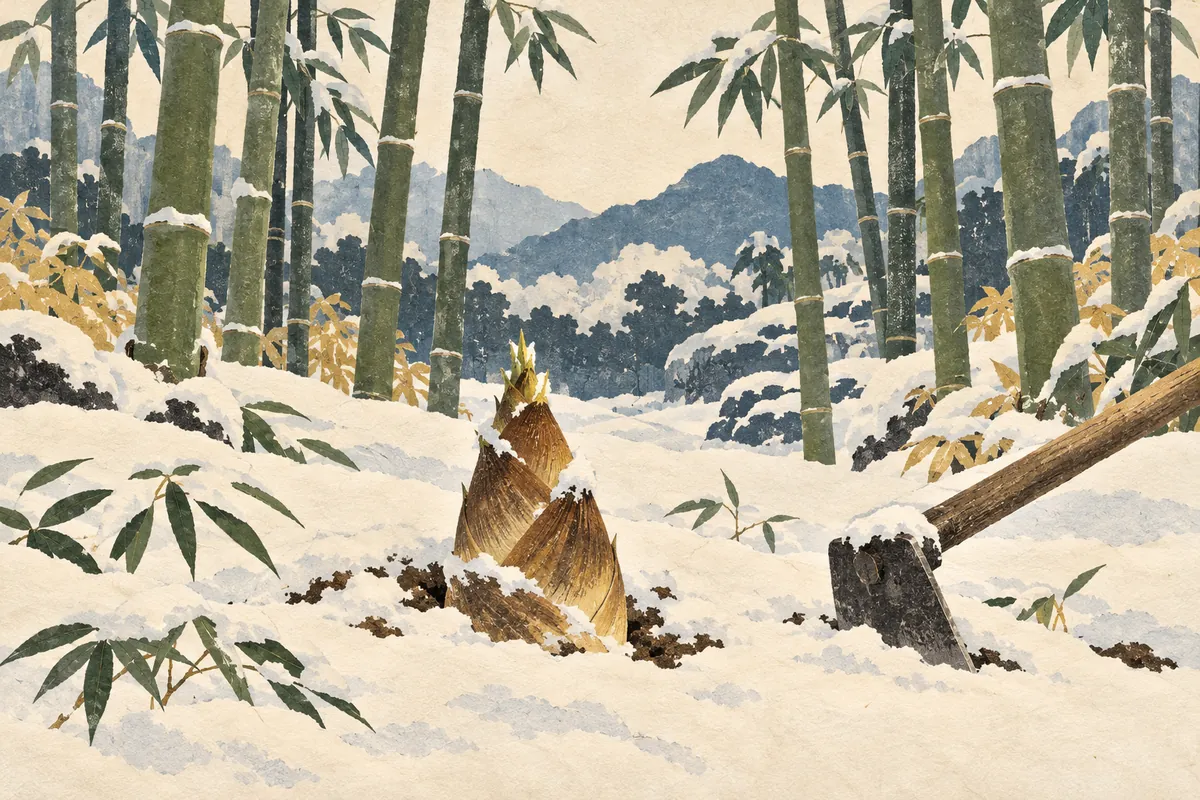
笋町, read Takanna-chō (たかんなちょう), is a town name in Nakagyō Ward. Takanna (笋) is an old word for bamboo shoot, and this town north of Shijō-Karasuma is the one that puts out the Mōsō-yama float in the Gion Festival. Mōsō-yama depicts the tale of Mōsō (Meng Zong), who dug up a bamboo shoot in the snow for his sick mother.Key points in 30 seconds
Takanna (笋) is an old word for bamboo shoot (takenoko)
A town north of Shijō-Karasuma that puts out the Gion Festival's Mōsō-yama (Takenoko-yama) float
Mōsō-yama is based on the story of Mōsō (Meng Zong) from China's "Twenty-Four Filial Exemplars"
The Mōsō-yama guild hall is a Kyoto City designated cultural property
Takanna: An Old Word for Bamboo Shoot
Takanna-chō, north of Shijō-Karasuma, is famous as Kyoto's hardest town name to read. 笋 (takanna) is an old word for bamboo shoot, and 笋町 in Nakagyō Ward is read Takanna-chō (たかんなちょう).
Only one Takanna-chō appears in the list of town names, so there is no need to add a street name to tell it apart, as with Mukadeya-chō. Neither the character nor the reading gives much hint of what the town is like, but once you know that takanna means bamboo shoot, the connection to the Gion Festival float comes into view.
Mōsō-yama and the Tale of Mōsō
The name Takanna-chō comes from the town being the home of the Gion Festival's Mōsō-yama float. Mōsō-yama is based on a Chinese tale in which a man named Mōsō (Meng Zong) dug up a bamboo shoot in the snow in the depths of winter for his sick mother.
To tell the story in a little more detail: his sick mother longed to eat fresh bamboo shoots, which should have been impossible to get in winter, and when Mōsō dug in the snowy ground while praying to the gods, the frozen earth opened and he found bamboo shoots. As a story of devotion to one's mother, it is counted among China's "Twenty-Four Filial Exemplars" (Nijūshikō).
Mōsō-yama is also called Takenoko-yama ("bamboo shoot float"), and the sacred figure displayed on it is drawn from the Twenty-Four Filial Exemplars. The figure wears Chinese-style clothing and a hat, holding a snow-covered bamboo shoot in his right hand and shouldering a hoe with his left, and it is said to be the work of Kōchō Sakyō, a Buddhist sculptor of the Shichijō school. The float is located at Karasuma-dōri Shijō agaru in Nakagyō Ward—exactly "north of Shijō-Karasuma."
Highlights of Mōsō-yama
Mōsō-yama is also distinctive for its decorative hangings. Since 1940 (Shōwa 15), its rear hanging (miokuri) has been a painting of a bamboo grove in ink on a white ground by Takeuchi Seihō. Among floats that are mostly brilliantly colored, this understated ink painting is said to stand out all the more.
Main decorations of Mōsō-yama
| Part | Description |
|---|---|
| Sacred figure | Mōsō, who dug up a bamboo shoot in the snow; said to be the work of Kōchō Sakyō, a Buddhist sculptor of the Shichijō school |
| Miokuri (rear hanging) | Ink painting of a bamboo grove on a white ground by Takeuchi Seihō (since 1940); previously a tapestry with a cloud-and-dragon pattern |
| Dōkake (side hangings) | Hirayama Ikuo's Caravan in the Desert (Sun) and Caravan in the Desert (Moon) (newly made in 2008 and 2009) |
| Metal fittings on the railing | Engraved metalwork of flocks of birds; designs by Kōno Bairei (1844–1895) |
The Meirin School District, Keeper of the Gion Festival
The Meirin school district lies at the very center of downtown Kyoto, bounded by Karasuma-dōri, Shijō-dōri, Sanjō-dōri, and Nishinotōin-dōri. It puts out as many as 13 floats for the Gion Festival and is a central community that carries on the festival.
Many town names in the district are connected with the Gion Festival, and the guild halls of Koyuidana-chō (Hōka-boko), Takanna-chō (Mōsō-yama), and Tenjinyama-chō (Arare Tenjin-yama) are Kyoto City designated cultural properties. Takanna-chō is now within the school district of Takakura Elementary School and Kyoto Oike Junior High School.
Of the three towns whose guild halls are designated cultural properties, Koyuidana-chō's Hōka-boko is considered one of the kuji-torazu floats of the Saki Matsuri (first procession), whose position in the procession is not decided by lot. Together with Takanna-chō's Mōsō-yama, this shows how several well-known floats are gathered within one school district, with the history of the festival recorded in their town names and guild halls.
To See Mōsō-yama: Yoiyama and the Saki Matsuri Procession
In the 2026 Gion Festival, the Saki Matsuri Yoiyama (eve festivities) ran from July 14 to 16, and the Saki Matsuri float procession was on July 17. Mōsō-yama belongs to the Saki Matsuri, and it was 11th in the procession order in 2026. The days of the week change from year to year, so check the official information for the year you go.
If you walk north of Shijō-Karasuma during Yoiyama, you can see up close the Mōsō-yama float that gave the town its name. Even a town name you cannot read should stick in your memory, along with the meaning of takanna, once you see the figure of Mōsō holding a bamboo shoot on top of the float.
Other Hard-to-Read Place Names
Kyoto City has many other hard-to-read place names besides Takanna-chō. Some of them are explained in their own entries in this dictionary.
- 都市町 (Toichi-chō)
- 天使突抜 (Tenshitsukinuke)
- 悪王子町 (Akuōji-chō)
- 皀莢町 (Saikachi-chō)
- 雲母坂 (Kirarazaka)
- 不明門通 (Akezu-dōri)
Mini quiz for this entry
Check what you've read with 2 multiple-choice questions.
How is 笋町, a town just north of Shijō-Karasuma in Nakagyō Ward, read?
Which float does Takanna-chō (笋町) contribute to the Gion Festival?
Sources and verification
Content checked: October 11, 2026
Updated: October 11, 2026
References are in Japanese.