
Japanese都市町(といちちょう)
Toichi-cho
Other spellings and namesToichicho / Ichihime Shrine (市比賣神社) / Eastern and Western Markets (東市・西市) / Ichiza (市座)
In short
都市町, read Toichi-chō (といちちょう), is a town name in Shimogyō Ward, southwest of Gojō Ōhashi Bridge. The name is said to come from the otabisho (resting place for the deity during festivals) of Ichihime Shrine, the guardian deity of the Eastern and Western Markets opened the year after the capital moved to Heian-kyō. Both its reading and its meaning differ from the ordinary word 都市, read toshi.Key points in 30 seconds
Read Toichi-chō (といちちょう), not toshi
The name is said to come from the otabisho of Ichihime Shrine, guardian of the Eastern and Western Markets
Ichihime Shrine is said to have been founded in 795 and moved to its present site in 1591
Today it is in the Shimogyō Shōsei Elementary School and Shimogyō Junior High School districts
Not "Toshi" but "Toichi"
都市町 in Shimogyō Ward is read Toichi-chō (といちちょう). It is a town southwest of Gojō Ōhashi Bridge.
Toichi-chō is in the school district of Shimogyō Shōsei Elementary School and Shimogyō Junior High School. Along with names such as 雲母坂 (Kirarazaka) and 皀莢町 (Saikachi-chō), it is counted among the hard-to-read place names whose names preserve how things once were or where they came from.
The two-character word 都市 is normally read toshi and means "city" or "urban area." The town name Toichi-chō has nothing to do with that word; instead, 都 is read to and 市 is read ichi. Ichi (市) means a market, and if you think of the town name as directly preserving the memory of Heian-kyō's markets, the reading becomes easier to remember.
The Markets of Heian-kyō and Ichihime Shrine's Otabisho
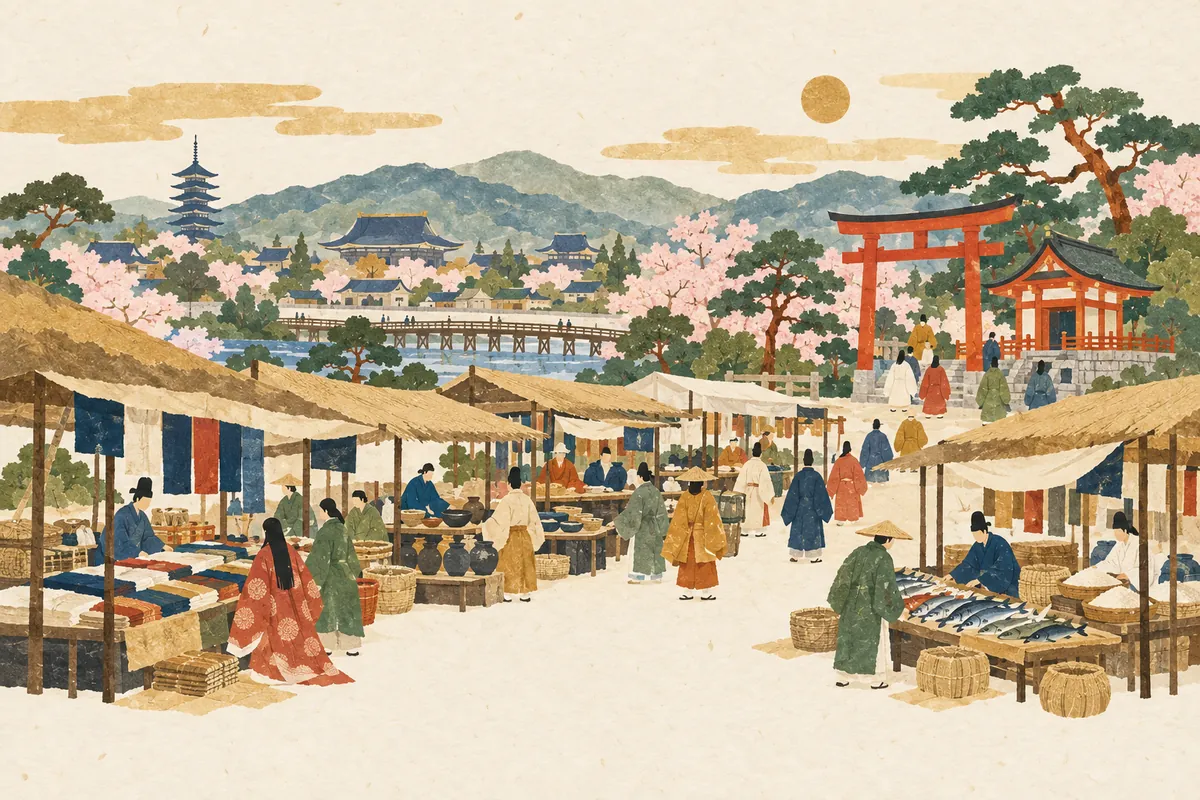
The name Toichi-chō comes from the opening, the year after the capital moved to Heian-kyō, of two ichiza (permanent markets), the Eastern Market and the Western Market, and from the otabisho of Ichihime Shrine that stood here.
Ichihime Shrine was founded in 795 (Enryaku 14) and, according to tradition, was established west of the Horikawa and north of Shichijō as the guardian deity of the capital's left and right (eastern and western) markets when the capital moved to Heian-kyō.
Within Heian-kyō, besides the Greater Imperial Palace (Daidairi), eastern and western markets were set up, each covering an area of twelve chō (blocks). In other words, as soon as the capital was founded, state-run permanent markets were placed in the east and the west.
Timeline of Ichihime Shrine and Toichi-chō
| Year | Event |
|---|---|
| 795 (Enryaku 14) | According to tradition, the shrine is established west of the Horikawa and north of Shichijō as guardian of the left and right markets |
| The year after the move to Heian-kyō | Two ichiza (permanent markets), the Eastern and Western Markets, are opened |
| 1591 (Tenshō 19) | In Toyotomi Hideyoshi's time, the shrine moves to its present site (Kawaramachi Gojō sagaru hitosujime nishi-iru) |
The Shrine Moved in Hideyoshi's Time and Still Protects Markets
The shrine moved to its present site in 1591 (Tenshō 19), in Toyotomi Hideyoshi's time. It still stands near Kawaramachi-Gojō and is worshiped as a shrine that protects women and markets.
The original site, west of the Horikawa and north of Shichijō, corresponds to the area around today's Nishi Hongan-ji. That is some distance from Toichi-chō, southwest of Gojō Ōhashi Bridge, so Toichi-chō can be described as a town named for its link with the otabisho of the market deity rather than as the site of a market itself.
The shrine's role as a deity of markets continues today. Every year the Kyoto Central Market Spring Festival is held in April and the Autumn Festival on December 11 at the Kyoto Central Wholesale Market, where there is a branch shrine. At the Nyonin Yakuyoke Matsuri (festival to ward off misfortune for women) around Setsubun in February, good-luck beans for warding off misfortune are scattered on Gojō Ōhashi Bridge. The shrine enshrines deities that ward off misfortune for women alone and has long been revered as a place of prayer.
- Read Toichi-chō (といちちょう): 都 is read to and 市 is read ichi
- The town name is said to come from Heian-kyō's markets and Ichihime Shrine's otabisho
- The shrine is near Kawaramachi-Gojō, a short walk from Gojō Ōhashi Bridge
- There is a branch shrine at the Central Wholesale Market, where market festivals are still held
Memories of the Heian Period in Nearby Town Names
Around Toichi-chō are other towns whose names preserve memories of the Heian period. The area around Honkaku-ji temple near Ichihime Shrine is said to be where Minamoto no Tōru, considered a model for Hikaru Genji in The Tale of Genji, had his Kawara-no-in Shiogama residence, and the area's name, Motoshiogama-chō (本塩竈町, もとしおがまちょう), is said to be a remnant of it. Motoshiogama-chō is in the same Shimogyō Shōsei Elementary School district as Toichi-chō.
If you walk here, head southwest from the west end of Gojō Ōhashi Bridge and visit Ichihime Shrine at Kawaramachi Gojō sagaru hitosujime nishi-iru and then Honkaku-ji; you can trace the places behind the town names within a short distance. It is a walk that lets you compare two very different "remnants of Heian-kyō": a market deity and the site of a Heian aristocrat's mansion.
Mini quiz for this entry
Check what you've read with 2 multiple-choice questions.
How is 都市町, a town southwest of Gojō Ōhashi Bridge in Shimogyō Ward, read?
Toichi-chō is said to take its name from a facility that once stood there. What was it?
Sources and verification
Content checked: October 11, 2026
Updated: October 11, 2026
References are in Japanese.