
Japanese皂莢町(さいかちちょう)
Saikachi-chō
Other spellings and names皀莢町
Key points
皂 and 皀 are variant forms that differ only in whether 七 or 匕 sits under 白
The saikachi is a pea-family tree whose pods were used for washing
Kyoto City has only one Saikachi-chō, in Kamigyō Ward, within the Nishijin Chūō Elementary School district
The saikachi is listed as near threatened in Kyoto Prefecture
Reading Saikachi-chō, and 皂莢 versus 皀莢
皂莢町 in Kamigyō Ward is read Saikachi-chō (さいかちちょう). It is also written 皀莢町: Kyoto City's school-district list of town names uses 皂莢町, while Keihan Railway's "Kyoto Tsū no Susume" uses 皀莢町. The reading of the plant name 皂莢 (saikachi) is used as it is in the town name.
Within Kyoto City there is only one town called Saikachi-chō, in Kamigyō Ward. It lies within the school districts of Nishijin Chūō Elementary School and Kamigyō Junior High School.
The characters 皂 and 皀 are variant forms of the same character (itaiji): the part under 白 is either 七 or 匕. 莢 means a bean pod, and the two characters 皂莢 together stand for the plant saikachi. Neither character turns up in everyday writing.
A town named for a large saikachi tree
Saikachi-chō, a town in Kamigyō Ward, takes its name from a large saikachi tree that once stood there. Keihan Railway's "Kyoto Tsū no Susume" lists 皀莢町 among Kyoto's hard-to-read names, alongside Kirarazaka (雲母坂) and Samegai-dōri, named after the famous Samegai well.
Other tree-based names include Nagitsuji in Yamashina Ward, where a large nagi tree is said to have stood, and Hiragino in Kita Ward, once thick with hiiragi (holly osmanthus); in both, the trees that grew there became the name.
The saikachi, a thorny tree of the legume family
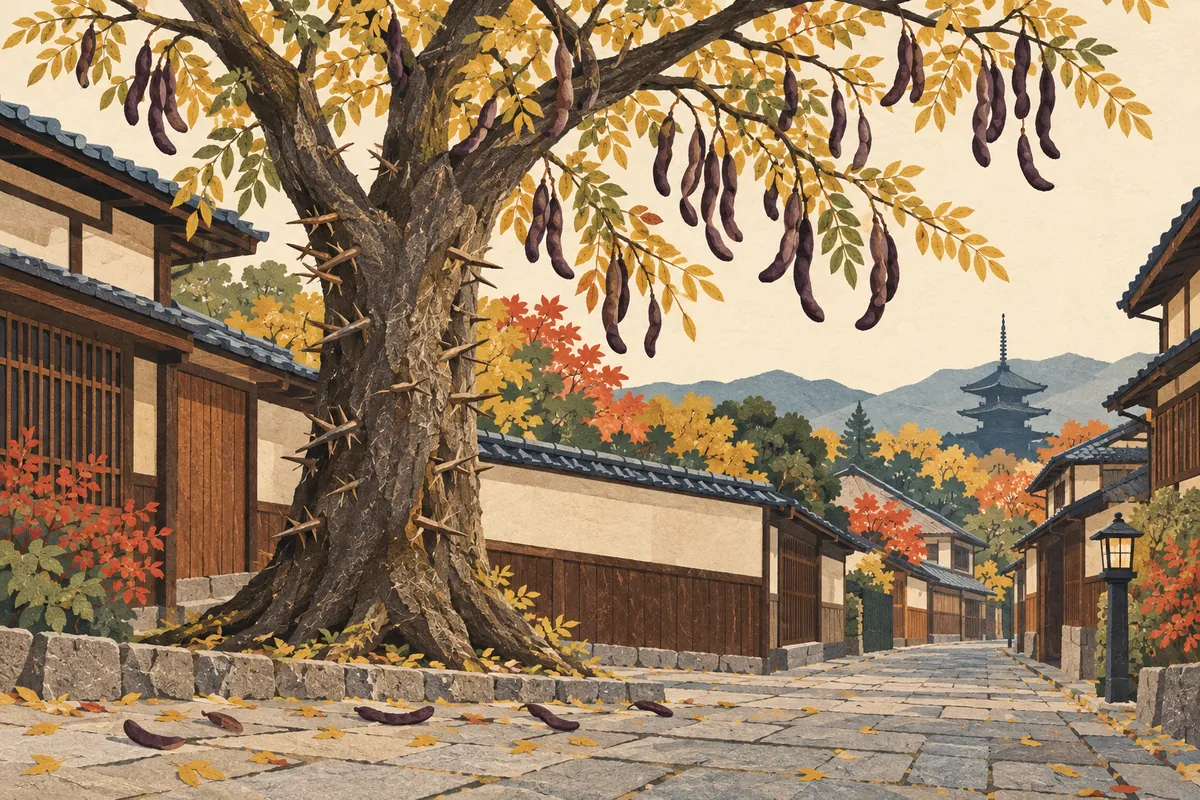
The saikachi (also called kawarafujinoki; scientific name Gleditsia japonica) is a deciduous tree of the pea family that grows by riverbanks and along water in open fields. Its trunk bears branched thorns, which are modified branches. In May and June it has yellow-green flowers, and it bears hairless, twisted pods 20–30 centimeters long that turn a deep purplish brown when ripe.
The pod walls contain saponin and were used as a detergent for washing clothes. The tree ranges widely, from Honshu, Shikoku, and Kyushu to the Korean Peninsula and mainland China, and large old trees remain in many places where it was used as a useful plant, but it is very rare in Kyoto Prefecture and is listed as near threatened in both the Kyoto Prefecture Red Data Book (in the 2002 and 2015 editions) and the Kinki regional Red Data Book. It is not on the Ministry of the Environment's Red List.
Within the prefecture it has been recorded in the Kyoto City area, the Nantan area, and the Chūtan area (where the trees may have been planted; the details are unclear). River development, logging, and road construction threaten its survival. Because most of the trees remaining in the prefecture are large old ones, the conservation measure is to leave them standing rather than cut them down.
Mini quiz for this entry
Saikachi-chō (皂莢町) in Kamigyō Ward is also written 皀莢町. How are the characters 皂 and 皀 related?
The saikachi tree behind the name Saikachi-chō has pods whose content was used for washing. What is that substance?
Sources and verification
Content checked: October 12, 2026
Updated: October 12, 2026
References are in Japanese.