
Japanese納所(のうそ)
Noso
Other spellings and namesNōso / Nōso-chō / Nōso gakku / Nōso village / 納所
In short
納所 is an area name in Fushimi Ward read Nōso (のうそ), and it survives in 12 town names such as Nōso Izumiya and Nōso Kitashirobori. Nōso means "a place where goods are delivered," and it is said to have arisen as a place to temporarily store goods being transshipped up the Yodo River to the capital. From the Muromachi period to Hideyoshi's time, the old Yodo Castle stood here.Key points in 30 seconds
Read Nōso (のうそ); an area next to Yodo in Fushimi Ward
Said to be a place name meaning "a place where goods are delivered"
Behind the name is the port of Yodo in the Kamakura and Muromachi periods
Town names such as Kitashirobori, Minamishirobori, and Yakushidō preserve the memory of the old Yodo Castle
Twelve Towns Read Nōso
Fushimi Ward has 12 towns whose names begin with 納所, and all are read Nōso. All 12 are in the attendance zones of Nōso Elementary School and Rakusui Junior High School. Besides Nōso-chō, the names that follow vary: Izumiya, Ōno, Kitashirobori, Myōtokuji, and more.
Besides the town names, the name is also used for the gakku (school district). The volunteer fire brigade unit of the Nōso gakku operates as the "Nōso Unit." There is also a "Nōso Village Road Origin Marker," a remnant of the former village, so walking around the area you can come across clues to the days when it was a village.
Town names in Fushimi Ward beginning with 納所
| Town name | Reading |
|---|---|
| 納所和泉屋 | Nōso Izumiya |
| 納所大野 | Nōso Ōno |
| 納所岸ノ下 | Nōso Kishinoshita |
| 納所北城堀 | Nōso Kitashirobori |
| 納所下野 | Nōso Shimono |
| 納所町 | Nōso-chō |
| 納所外島 | Nōso Tojima |
| 納所中河原 | Nōso Nakagawara |
| 納所星柳 | Nōso Hoshiyanagi |
| 納所南城堀 | Nōso Minamishirobori |
| 納所妙徳寺 | Nōso Myōtokuji |
| 納所薬師堂 | Nōso Yakushidō |
Why "a Place Where Goods Are Delivered"?
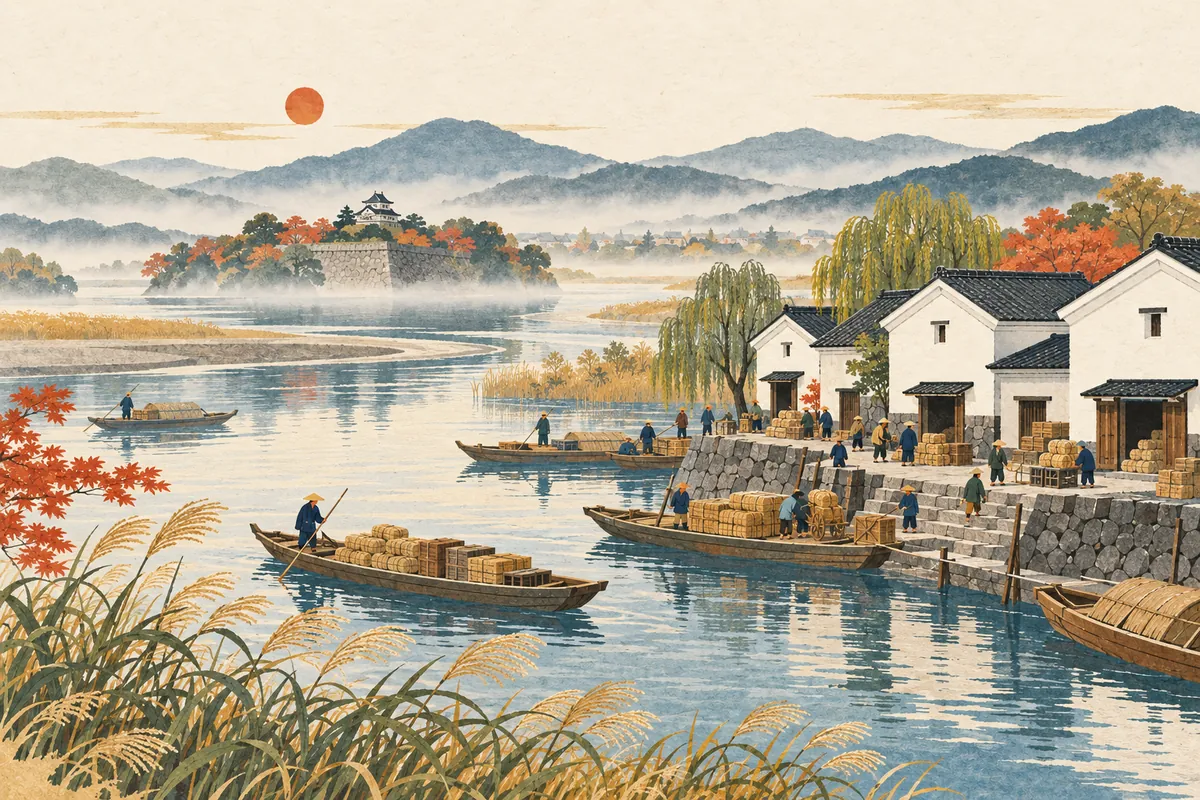
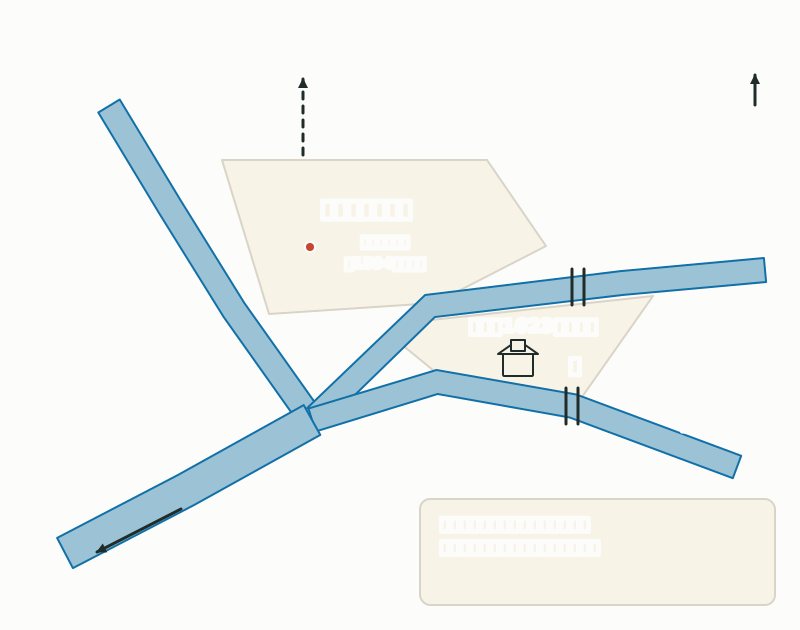
The Yodo and Nōso area is a delta where three rivers—the Katsura, Uji, and Kizu—meet, and in ancient times it was a key point for goods and people traveling to and from Heian-kyō. Yodo means a place where water stagnates, and Nōso means a place where goods are delivered.
Nōso is said to have arisen as a place for temporarily storing goods that were being sent up the Yodo River to the capital, for example while they were being transshipped.
The Port of Yodo and the Flow of Goods
In the Kamakura and Muromachi periods, the port of Yodo served as a logistics hub for Kyoto, and the origin of the place name Nōso is also said to lie here.
Yodo-no-tsu, the river port where the three rivers met, was a hub of transport and logistics for Kyoto from the Heian period. From around the 12th century there was a fish market on Nakajima, the island at the confluence, and the port developed as a landing point for seafood from the Seto Inland Sea, rice, salt, timber, and more. The area around Yodo and Nōso is low, about 10 meters above sea level, and all the rivers of the Kyoto Basin come together around here.
Yokoōji and Shimotoba supplemented the port of Yodo, and eventually a great transport artery formed: by the Yodo River to Fushimi, and by the Takase River to Kyoto. Later, flood-control works accompanying Hideyoshi's construction of Fushimi Castle and river improvements from the Meiji era onward greatly changed the landscape, and today the confluence of the three rivers has moved southwest of Yodo, to near the border with Osaka Prefecture.
The former confluence of three rivers, with Nōso and Yodo
The Old Yodo Castle at Nōso
In 1504 (Eishō 1), Yodo Castle (the old Yodo Castle) was established around Nōso, on the north bank of the former Uji River. Toyotomi Hideyoshi had his younger brother Hidenaga repair it and, in 1589 (Tenshō 17), gave it to Chacha (Yodo-dono) as a place to give birth. The names "Yodo no Kata" and "Yodo-dono" come from this castle.
This castle was demolished in 1594 (Bunroku 3) as part of the plan to build Fushimi Castle, and in 1623 (Genna 9) a new Yodo Castle was built on Nakajima at the confluence of the three rivers. The stone walls that survive today in Yodo Castle Ruins Park belong to this new Yodo Castle. The town names Kitashirobori ("north castle moat"), Minamishirobori ("south castle moat"), and Yakushidō in Nōso, and the stone marker for the site of the old Yodo Castle's Yakushidō, are memories of the earlier, older castle.
From the old Yodo Castle to the new Yodo Castle
| Year | Event |
|---|---|
| 1504 (Eishō 1) | Yodo Castle (the old Yodo Castle) is established at Nōso |
| 1589 (Tenshō 17) | Hideyoshi has Hidenaga repair it and gives it to Chacha (Yodo-dono) as a place to give birth |
| 1594 (Bunroku 3) | Demolished as part of the plan to build Fushimi Castle |
| 1623 (Genna 9) | Construction of a new Yodo Castle begins on Nakajima at the confluence of the three rivers |
| 1871 (Meiji 4) | Yodo Castle is abandoned when the Yodo domain is abolished |
From a Yodo Castle Town to Nōso, Fushimi Ward
Nōso-chō, one of the six towns of the Yodo castle town, and Nōso village in Kii District became Nōso, Fushimi Ward, when Fushimi Ward was created in 1931 (Shōwa 6). Town names that hint at the old Yodo Castle, such as Kitashirobori, Minamishirobori, and Yakushidō, also remain.
The waterway on the south side of Myōkyō-ji, a temple built in 1626 on part of the presumed site of the old Yodo Castle, is said to be a remnant of the old castle's moat. Myōkyō-ji was the scene of fierce fighting in the Battle of Toba–Fushimi in 1868, and holes left by cannonballs remain in its main hall. Along the Toba Kaidō (Senbon-dōri), place names called Ichiban-chō through Kuban-chō ("First Town" through "Ninth Town") survive, and these numbers are thought to have been assignments of duties such as those for the Joseon (Korean) diplomatic missions.
- Read Nōso (のうそ), not Nōsho (のうしょ)
- Means "a place where goods are delivered"; said to be where goods from the port of Yodo were temporarily stored
- The town names Kitashirobori, Minamishirobori, and Yakushidō are remnants of the old Yodo Castle
- The Yodo Castle of Yodo Castle Ruins Park is a separate, Edo-period castle, not the old Yodo Castle
Mini quiz for this entry
Check what you've read with 2 multiple-choice questions.
How is 納所, an area name next to Yodo in Fushimi Ward, read?
What is the place name Nōso (納所) said to mean?
Sources and verification
Content checked: October 11, 2026
Updated: October 11, 2026
References are in Japanese.