
Japanese間人(たいざ)
Taiza
Other spellings and namesTango-cho Taiza (丹後町間人) / Empress Hashiudo (間人皇后) / Empress Anahobe no Hashihito / Taiza crab (間人ガニ)
In short
間人, read Taiza (たいざ), is a place name in Tango-chō, Kyōtango City, facing the Sea of Japan. According to tradition, Empress Anahobe no Hashihito, mother of Prince Shōtoku, took refuge here to escape the conflict between the Soga and Mononobe clans, and the name came to be read taiza after her go-taiza (御退座, departure) when she left. A statue of the empress and the prince as mother and child still stands by the sea, and Taiza is a fishing town known for Taiza crab and its kenka yatai ("fighting floats").Key points in 30 seconds
丹後町間人 in Kyōtango City is read Tango-chō Taiza (たいざ)
Locally, the empress is called Hashiudo Kōgō (はしうどこうごう)
The reading is said to come from go-taiza (御退座, her departure); records of this date from the late Edo period
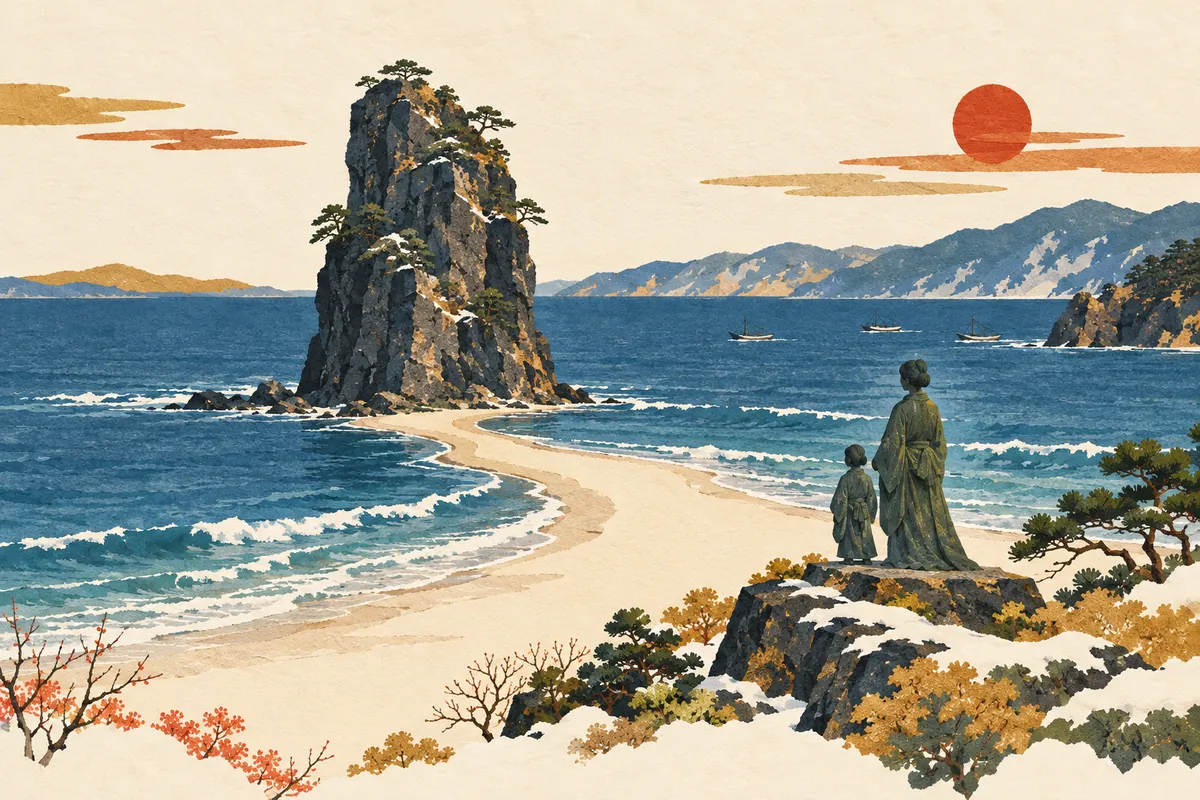
A statue of the empress and Prince Shōtoku stands beside Tateiwa rock at Nochigahama
Written 間人, Read Taiza
丹後町間人 is read Tango-chō Taiza (たいざ). The characters 間人 are the same as in the name of Empress Anahobe no Hashihito (穴穂部間人, あなほべのはしひと), consort of Emperor Yōmei, and locally the empress is called Hashiudo Kōgō (はしうどこうごう).
In other words, the same two characters 間人 are read taiza in the place name, and hashihito or hashiudo in the empress's name. No combination of the characters' usual readings produces taiza, so the quickest way to learn the reading is together with the legend of its origin.
Comparing the readings of 間人
| Usage | Reading |
|---|---|
| Place name (京丹後市丹後町間人, Kyōtango City) | Taiza (たいざ) |
| Name of the empress (穴穂部間人皇后) | Anahobe no Hashihito (あなほべのはしひと) |
| Local name for the empress (間人皇后) | Hashiudo Kōgō (はしうどこうごう) |
A Legend Tied to the Empress's "Go-Taiza"
The empress is said to have taken refuge here to escape the conflict between the Soga and Mononobe clans. When she returned to Yamato, she granted the village her name, but the villagers felt it was too awe-inspiring to say aloud, so it is said they decided to read it taiza after her go-taiza (御退座, departure).
Dictionaries of place names give an origin along the same lines: the empress stayed in "the village of Ōhama" to avoid the conflict and departed when it had subsided. Depending on the source, the conflict is called by various names, such as the Teibi Incident (丁未の乱/変) or the Mononobe Rebellion.
The legend appears in records from the late Edo period, and there are associated sites such as a well where she is said to have washed her feet. There are no contemporary historical records confirming that the empress actually visited, so it is best understood as the origin of the place name as handed down by tradition.
Where Can You See It Today? The Mother-and-Child Statue and Tateiwa
The clearest reminder of the legend is the statue of Empress Hashihito and her son by the sea. The bronze statue of the empress is 3.5 meters tall and that of Prince Shōtoku 1.5 meters, and they stand as if gazing out over the Sea of Japan. Behind them is a 5.5-meter stone pillar representing the Asuka period, its thick middle said to match the columns of Hōryū-ji in Nara.
The statue stands beside Tateiwa rock on Nochigahama beach. Tateiwa is a huge rock about 20 meters high at the mouth of the Takeno River, with well-developed vertical columnar joints. It was once a separate island but is said to have become connected to land by a sandbar (tombolo) formed from sand carried by the river.
Tateiwa has its own legend. When Prince Maroko, the empress's third son, went to subdue an ogre, he is said to have sealed the ogre inside this great rock in a single night, and on windy nights with high waves the ogre's crying is said to be heard. As with the place-name legend, stories about the empress's family overlap on this beach.
Taiza as a Fishing Town
Seafood, above all Taiza crab (Taiza-gani), shapes Kyōtango City's representative food culture and is also an important tourism resource. Some people may first learn how to read the place name through the name of the crab.
Taiza's float festival conveys the bustle and energy of a fishing town to the present day. Because the floats crash into each other in the afternoon of the main festival day, it is called "Taiza's kenka yatai" (fighting floats). Taiza's coast is also listed, along with the Sodeshi rice terraces, as one of the city's distinctive cultural landscapes.
If You Visit
The mother-and-child statue and Tateiwa are both in the Nochigahama area, so you can see them together. Tateiwa is a representative rock of the Kyōtango part of the San'in Kaigan Geopark, and paid geo-guide tours, which require a reservation, depart from the nearby roadside station Michi-no-Eki Tenki Tenki Tango. Tateiwa and Nochigahama Beach are about three minutes by car from the roadside station, and you can also walk there.
In summer, Tateiwa–Nochigahama Beach opens right beside Tateiwa. In 2026 it was open from July 11 to August 16. The beach has coarse sand grains and very clear water.
- Remember the difference: the place name is read taiza, while the empress's name is hashiudo (hashihito)
- The legend dates from records of the late Edo period and cannot be stated as historical fact
- The statue, Tateiwa, and Nochigahama can all be seen in one place
Mini quiz for this entry
Check what you've read with 2 multiple-choice questions.
How is 間人, a place name in Tango-chō, Kyōtango City, read?
In the story handed down about why 間人 is read Taiza, which action of the empress are the villagers said to have named it after?
Sources and verification
Content checked: October 11, 2026
Updated: October 11, 2026
References are in Japanese.