
Harikuyō (Memorial Service for Needles)
Other spellings and namesHarikuyō hōyō (針供養法要) / Hōrin-ji Harikuyō / Kotoyōka (事八日) / Needle memorial service
Key points
Twice a year at Hōrin-ji, on December 8 and February 8, both from 1 p.m.
At the December service, needles entrusted by the Imperial Household are also given a memorial service
Needles are brought on the day of the service; on other days they get an individual memorial service. Injection needles are not accepted
Hari Jinja in Iwakura, Sakyō Ward, also holds harikuyō every year on December 8 from 11:00
When and where: Hōrin-ji on December 8 and February 8
The best-known harikuyō in Kyoto is at Hōrin-ji, halfway up Mount Arashiyama. Its popular name is "Saga no Kokūzō-san," and its principal image, Kokūzō Bosatsu (Ākāśagarbha), is regarded as a buddha of wisdom and good fortune. The harikuyō service is held twice a year, on February 8 and December 8, both from 1 p.m. (as listed in the annual event schedule as of November 2026). The next one is on Tuesday, December 8, 2026, and the one after that on Monday, February 8, 2027.
The date of harikuyō varies by region: it is said to be often held on February 8 and December 8 in the Kantō region, and on December 8 in Kansai and Kyushu. Some places hold both, others only one, and Hōrin-ji holds it on both days.
A rite for letting needles rest: its origins and why konnyaku
Hōrin-ji's harikuyō is said to have begun on an emperor's order that needles used in the imperial household be given a memorial service. It is also said to go back to Emperor Seiwa in the Heian period building a hall in the temple grounds to hold used sewing needles. Even today, at the December harikuyō, needles entrusted by the Imperial Household are given a memorial service.
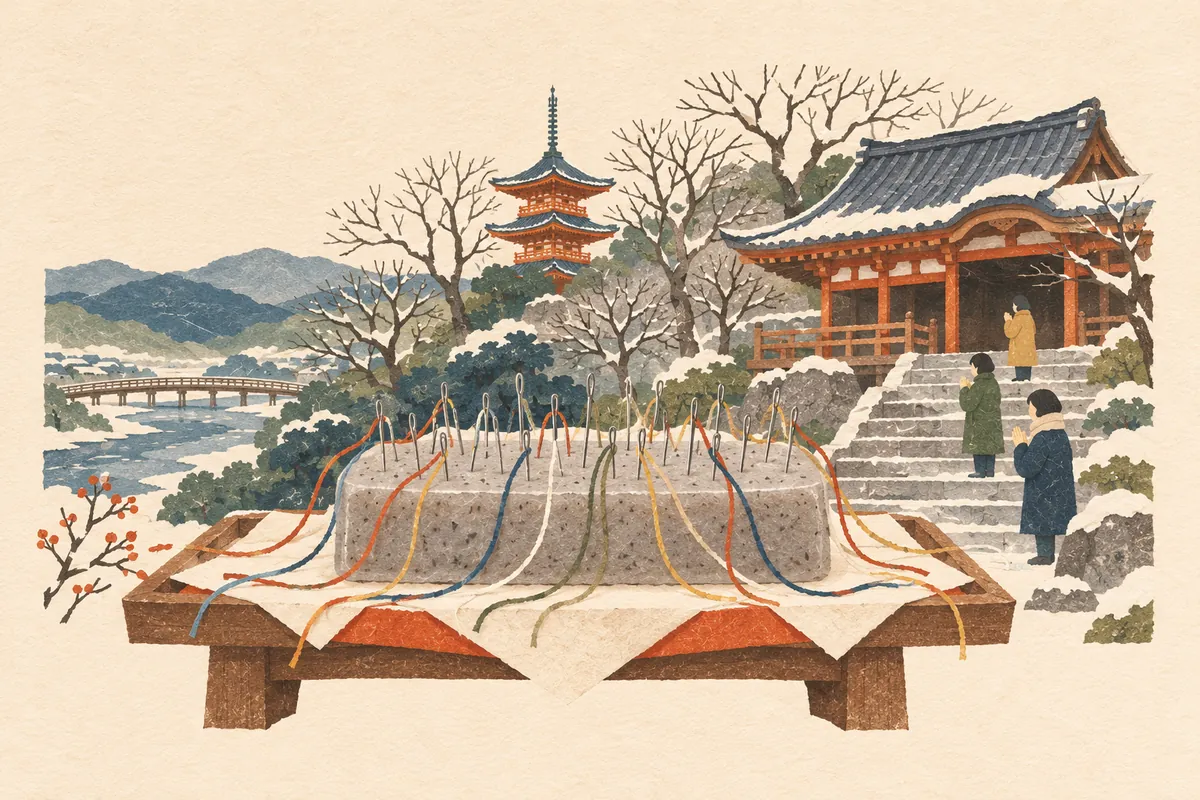
At the service, worshippers stick long needles threaded with five-colored thread into konnyaku (konjac jelly) offered on the altar. The idea is that needles, after years of pushing through stiff cloth, are finally allowed to rest in soft konnyaku, and people pray for progress in arts and crafts such as sewing and handicrafts and for harmony in the household.
Hōrin-ji's Kokūzō Bosatsu is explained as having vowed that those who wish to improve in the arts should chant its name. One explanation is that Jūsan-mairi and harikuyō grew out of this faith. Looking across Japan, there are many cases of old needles being placed at nearby shrines or halls dedicated to Awashima.
Kotoyōka and harikuyō
The events of February 8 and December 8 are together called "Kotoyōka." "Koto" is said to mean a small festival, and in many places there is a custom on these days of hanging a mekago (open-weave basket) on the tip of a pole and standing it by the eaves to keep away plague gods and other spirits. Harikuyō has also been held as one of the Kotoyōka events.
Which of the two days is called "Kotohajime" (the beginning of things) is reversed from place to place. In regions where thinking centers on the New Year, December 8 is Okotohajime and February 8 is Okotoosame (the ending of things), while in regions where it centers on the year's farm work, it is the other way around. For Kyoto's harikuyō, one explanation is that December 8 is Kotoosame, the day farm work ends, and February 8 is Kotohajime, the day farm work begins, and that both became harikuyō days because night needlework was put aside on them.
Needlework is thought to have been put aside because these were days for refraining from work and staying indoors. There is no settled explanation of why these unlucky days became linked with memorial services for needles, but a connection with Awashima faith is thought likely. Kyoto also has the custom of treating December 13 as "Kotohajime," the start of New Year preparations, which falls on a different date from Kotoyōka.
How to offer needles and take part
Bring used needles on the day the service is held. They are not taken in on other days; if you bring them on another day, they are given an individual memorial service. Injection needles and the like are not accepted.
At the February 2026 service, amazake (a sweet rice drink) was served. To reach the main hall you pass through the Sanmon gate and climb stone steps, so if you are going with a stroller, plan for the steps. Check the cost of the memorial service for needles with the temple before you go.
Hari Jinja in Iwakura, and Jūsan-mairi at Hōrin-ji
Hari Jinja (針神社) in Iwakura Hataeda-chō (いわくらはたえだちょう), Sakyō Ward, also holds a harikuyō ceremony every year on December 8 from 11:00. Hari Jinja is a subordinate shrine (massha) of Hataeda Hachimangū, enshrined to the left of the main shrine, and as a guardian deity of needles it is also worshipped by people who work with blades and metal goods. It is a 2-minute walk from the "Hataeda Hachimangū-mae" Kyoto Bus stop.
Hōrin-ji is also known as a temple for "Jūsan-mairi," in which children aged 13 by traditional reckoning (kazoedoshi) visit to receive wisdom. It is said to have begun when Emperor Seiwa, who took the throne as a young child, held a service of imperial prayer at Hōrin-ji at the age of 13 by traditional reckoning. The visiting periods are March 13 to May 13 in spring and October to November in autumn, and visitors write a single kanji character and dedicate it. The prayer fee is 5,000, 7,000, or 13,000 yen for prayers lasting one week, one month, or one year (as of November 2026). It is said that if you look back after the visit before you have finished crossing Togetsukyō Bridge, you will give back the wisdom you received.
Getting there
Hōrin-ji is in Arashiyama Kokūzōyama-chō, Nishikyō Ward, halfway up Mount Arashiyama just past the south end of Togetsukyō Bridge. It is about a 5-minute walk from Hankyū Arashiyama Station, or a 3-minute walk from the "Arashiyama Kōen" stop on city bus route 28. From the viewing platform called the "Butai" (stage), to the right of the main hall, you can see as far as Togetsukyō Bridge, Sagano, and the Higashiyama mountains.
Mini quiz for this entry
At the harikuyō (memorial service for needles) held at Hōrin-ji in Arashiyama on December 8 and February 8, what do worshippers stick long needles into, to let used needles rest?
Hari Jinja in Iwakura, Sakyō Ward, holds a harikuyō ceremony every year on December 8. Which shrine is it a subordinate shrine of?
Sources and verification
Content checked: November 8, 2026
Updated: November 8, 2026
References are in Japanese.
- 法輪寺「十三まいりなど法輪寺の行事・祭事」
- 法輪寺「法輪寺の歴史・由緒・御本尊」
- 法輪寺「嵐山 虚空蔵法輪寺」(歴史・見どころ・アクセス)
- 京都市観光協会 京都観光Navi「針供養【虚空蔵法輪寺】」(2026年2月8日の回)
- 京都市観光協会 京都観光Navi「法輪寺<西京区>」
- 京都市観光協会 京都観光Navi「春の十三まいり【虚空蔵法輪寺】」(2026年)
- 京都市観光協会 京都観光Navi「針神社」
- 京阪電気鉄道「京都ツウのススメ 第138回 京都と物の供養」(2019年10月)
- コトバンク「針供養」(デジタル大辞泉・日本大百科全書・改訂新版 世界大百科事典・ブリタニカ国際大百科事典ほか)
- コトバンク「事八日」(デジタル大辞泉・精選版 日本国語大辞典・日本大百科全書・ブリタニカ国際大百科事典)
- 京都市教育委員会「京都市通学区町名一覧 左京区」(令和4年4月1日現在)