
Japanese二帖半敷町(にじょうはんじきちょう)
Nijohanjiki-cho
Other spellings and namesNijōhanjiki-chō / Gojō-ji / Two and a half mats / 二帖半敷町
In short
二帖半敷町 is a town name in Shimogyō Ward, south of Shijō-Karasuma, read Nijōhanjiki-chō (にじょうはんじきちょう); it is also the address of Shijō Station on the subway. There are two theories about its origin: that a head priest divided Gojō-ji temple in half between two disciples, or that two brothers split a five-mat house. Both agree on one point: "five, split in half, makes two and a half mats."Key points in 30 seconds
Read Nijōhanjiki-chō (にじょうはんじきちょう)
Two theories explain the name as "Gojō (five / five mats) split in half makes two and a half mats"
A town in Shimogyō Ward that is also the address of Shijō Station on the Karasuma subway line
Counted among examples of "town names based on old tales"
Read Nijōhanjiki-chō, Home of Subway Shijō Station
二帖半敷町 is a town in Shimogyō Ward read Nijōhanjiki-chō (にじょうはんじきちょう). 帖 is read jō and 敷 is read jiki; it is not read as something like Nichōhanshiki.
The town lies south of Shijō-Karasuma, and its school zones are Rakuō Elementary School and Shimogyō Junior High School.
Surprisingly, the address of Shijō Station (K09) on the Karasuma subway line is "Nijōhanjiki-chō, Shimogyō Ward, Kyoto City." This hard-to-read town name is used in the address of a station that many people pass through every day.
Gojō Split in Half Becomes "Two and a Half Mats"
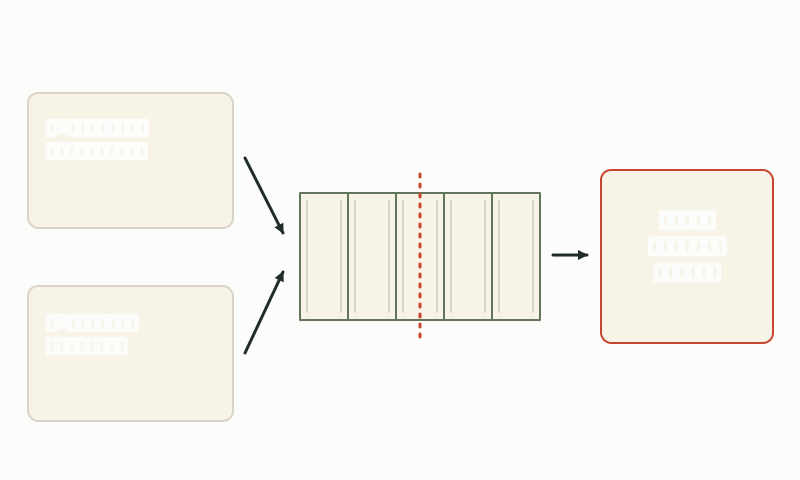
Nijōhanjiki-chō is a town name based on an old tale, and there are two theories about its origin. One says that a head priest gave half each of Gojō-ji (五条寺), a temple that once stood here, to two disciples, dividing Gojō in two. The other says that two brothers, townspeople living in this area, split a house of five tatami mats (gojō, 五帖) between them.
It is also said that Gojō (五条) was likened to gojō (五畳, "five mats"), which halved becomes nijō-han (二畳半, "two and a half mats"), and finally Nijōhanjiki (二帖半敷, "laid with two and a half mats"). Both theories agree that "five mats were split in half."
Halving "five" to get "two and a half mats"
Comparing the Two Theories
The two theories differ on whether what was divided was a temple or a house, and whether it was split between two disciples or two brothers. On the other hand, they share the same storyline: halving the number five produced "two and a half mats."
Which one is correct has not been settled. This dictionary, too, does not declare either to be the true origin, and introduces the name as one with two theories handed down.
Two theories about the origin of Nijōhanjiki-chō
| Gojō-ji temple theory | Five-mat house theory | |
|---|---|---|
| What was divided | Gojō-ji, a temple that stood here | A house the size of five tatami mats (gojō) |
| Who divided it, and for whom | A head priest, half each to two disciples | Two brothers among the townspeople |
| How it became the name | Gojō (五条) likened to gojō (五畳, five mats); half is two and a half mats | Five mats split in half make two and a half mats |
Similar "Town Names Based on Old Tales"
Kyoto's town names can be grouped into those named after people, old tales, temples and shrines, Hideyoshi, and so on. In addition, because merchants and craftspeople of the same trade gathered together in the Muromachi period, occupational town names such as Butsuguya-chō ("Buddhist altar goods shop town") and Sendō-chō ("boatman town") arose, and some names, like Naginataboko-chō, come from a symbol of the town.
Other "town names based on old tales" like Nijōhanjiki-chō include the following. 釘隠町 (Kugikakushi-chō) is in the same Rakuō Elementary School zone as Nijōhanjiki-chō, and 本塩竈町 (Motoshiogama-chō) is a town in Shimogyō Ward in the Shimogyō Shōsei Elementary School zone.
Once you know the origin of a town name, what was just a string of characters in an address starts to look like a small story passed down in that place.
- Kugikakushi-chō (釘隠町): said to be named after the mansion of a wealthy Edo-period family, where lavish kugikakushi (decorative metal fittings that hide nail heads) were used and became so famous that sightseers flocked to see them
- Motoshiogama-chō (本塩竈町): said to be named after the Kawara-in, the residence of Minamoto no Tōru, whose garden had a salt kiln modeled on the Shiogama coast in Mutsu, where nobles enjoyed the atmosphere of salt making
- Moto-Akuōji-chō (an example of a name based on a shrine): named after the Akuōji shrine that once stood there; explained in this dictionary's entry on Akuōji-chō
Walking Tip: South from Shijō-Karasuma
Nijōhanjiki-chō lies south of Shijō-Karasuma and is also the address of subway Shijō Station. After getting off at Shijō Station, come up to street level and walk south along Karasuma-dōri, looking for the characters 二帖半敷町 on the town-name signs on utility poles and buildings.
Shimogyō Ward also has Moto-Akuōji-chō (southeast of Shijō-Karasuma) and Akuōji-chō (north of Gojō-Karasuma), both named after the Akuōji shrine. The area around Karasuma-dōri from Shijō to Gojō is full of town names that become interesting once you know their origins.
Mini quiz for this entry
Check what you've read with 2 multiple-choice questions.
How is 二帖半敷町, a town just south of Shijō-Karasuma in Shimogyō Ward, read?
In the theory handed down about the origin of the name Nijōhanjiki-chō (二帖半敷町, "two and a half mats"), what was split in half?
Sources and verification
Content checked: October 11, 2026
Updated: October 11, 2026
References are in Japanese.