
Japanese御前通(おんまえどおり)
Onmae-dori
Other spellings and namesOnmae-dōri / Nishi-Ōmiya Ōji / Honganji's Onmae-dōri (Shōmen-dōri) / 御前通
In short
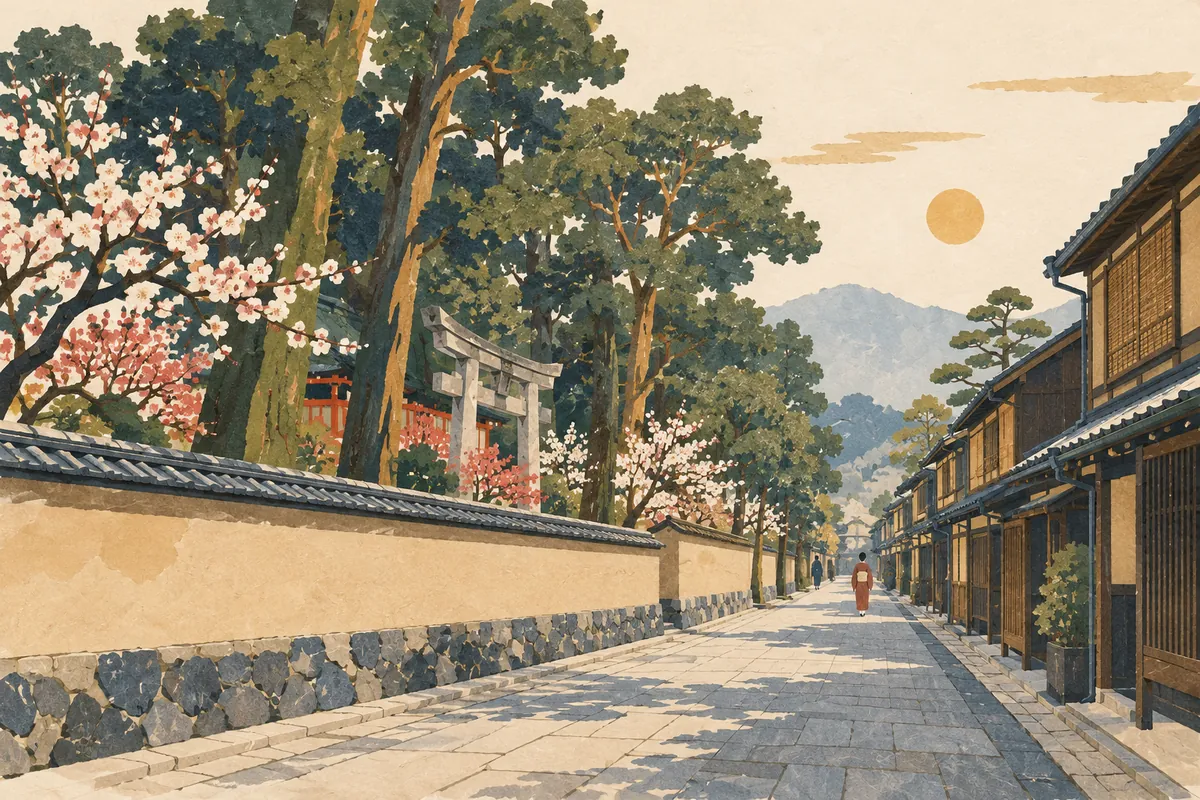
御前通 is a north–south street read Onmae-dōri (おんまえどおり), running about 7.2 km from Kitaōji-dōri in the north to beyond Kujō-dōri in the south. Its name is said to come from passing in front of (to the east of) Kitano Tenmangū. In Heian-kyō it corresponded to Nishi-Ōmiya Ōji, the avenue marking the western edge of the Greater Imperial Palace, and the "御前" that appears in the street-name song is a different road, Honganji's Onmae-dōri.Key points in 30 seconds
Read Onmae, not Gozen
Said to be named for passing in front of Kitano Tenmangū
Corresponds to Heian-kyō's Nishi-Ōmiya Ōji; about 7.2 km long
The 御前 in the lyric "花の御前北七条" is Honganji's Onmae-dōri (Shōmen-dōri), a different road
Onmae, Not Gozen
御前通 is read Onmae-dōri (おんまえどおり). From the kanji, you might be tempted to read it Gozen-dōri (ごぜんどおり), but as a street name it is Onmae.
Today's Onmae-dōri begins at Kitaōji-dōri in the north and extends about 7.2 km south to just past Kujō-dōri. The part in Kamigyō Ward runs from north of Kitano Tenmangū to Marutamachi-dōri.
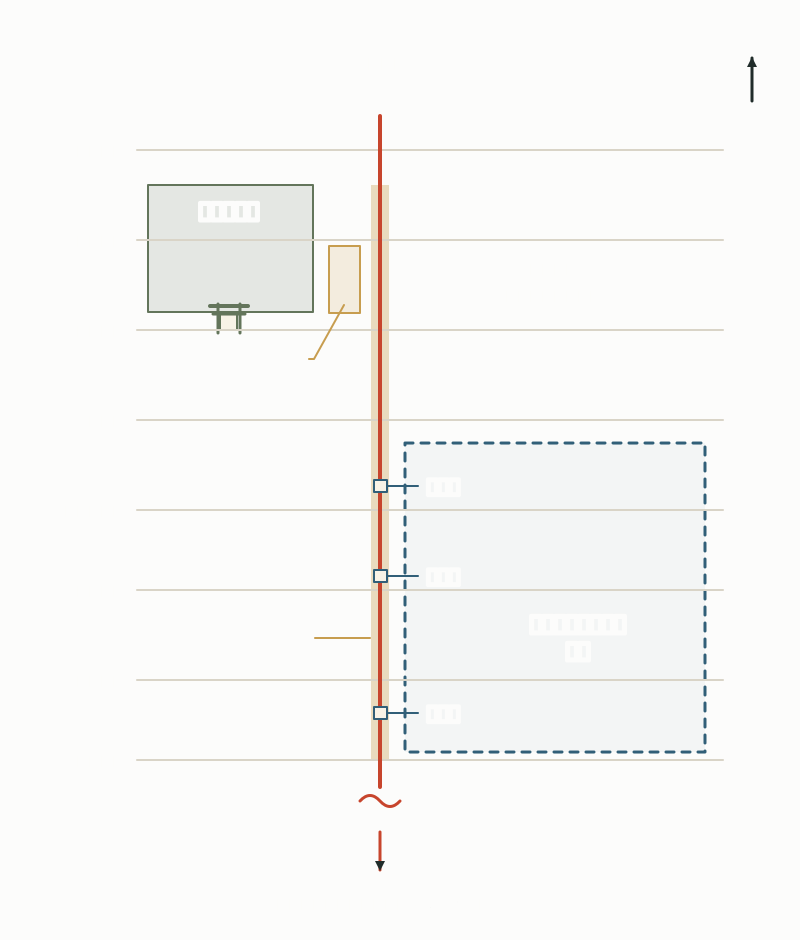
Onmae-dōri and the locations of Kitano Tenmangū and the Heian Palace
The Street in Front of Kitano Tenmangū
The name Onmae-dōri comes from passing in front of Kitano Tenmangū, known as the head shrine of all the Tenmangū and Tenjin shrines in Japan dedicated to Sugawara no Michizane. Because it passes in front of (to the east of) the shrine, it is called onmae, "the honorable front."
Onmae-dōri in Kamigyō Ward serves as an approach to Kitano Tenmangū, and some say that the Kamigyō section is the original Onmae-dōri.
The grounds of Kitano Tenmangū face Imadegawa-dōri to the south and spread north along the west side of the north–south Onmae-dōri. On the east side of Onmae-dōri lived the miyaji who served the shrine, and onmyōji (yin-yang diviners) are said to have lived there too. The area adjoins Kamishichiken; in 1707 (Hōei 4) there were six teahouses, and until the Meiji Restoration it was land belonging to Kitano Tenmangū.
Between the approach inside the grounds and Onmae-dōri lies the Ukon no Baba, where Toyotomi Hideyoshi held a grand tea gathering (the Grand Kitano Tea Ceremony) on October 1, 1587 (Tenshō 15). A stone monument marking the "Site of the Grand Kitano Tea Ceremony" stands there, and the Taikō Well also survives.
Heian-kyō's Nishi-Ōmiya Ōji
In Heian-kyō, Onmae-dōri corresponded to Nishi-Ōmiya Ōji in the western half of the capital (Ukyō), and it is a remnant of an avenue eight jō (about 24 meters) wide that marked the western edge of the Greater Imperial Palace. However, the avenue originally ran only south of Ichijō Ōji, and it fell into disuse in the mid-Heian period. The area around today's Kitano Tenmangū was the northern outskirts of the capital, known as the Kitano Forest.
The east side of Onmae-dōri corresponded to the Heian Palace (the Greater Imperial Palace), where the Jōsaimon, Inpumon, and Sōhekimon gates stood in order from the north. Nishi-Ōmiya Ōji fell into disuse early, but the Kamigyō section revived as Onmae-dōri. South of around Marutamachi-dōri, the land had become fields and thickets, but as the city spread from the Meiji era onward, the street extended south and was revived to beyond Kujō-dōri.
How It Differs from the Other "Onmae-dōri"
There was once another road called Onmae-dōri. In the east–west part of the street-name song handed down since the Edo period, there is the lyric "花の御前北七条": 花 is Hanayamachi, 北 is Kitakōji, and next comes Shichijō, and this 御前 refers to Honganji's Onmae-dōri.
Honganji's Onmae-dōri, also called Shōmen-dōri, was the road leading to the Great Buddha of Hōkō-ji in Higashiyama and to the Higashi and Nishi Honganji temples. That name is now forgotten, and some say that the Kitano Onmae-dōri is the true Onmae-dōri. If you take the 御前 in the song to be the Kitano Onmae-dōri, the locations won't match at all, so be careful.
The two "Onmae-dōri" streets
| Kitano's Onmae-dōri | Honganji's Onmae-dōri | |
|---|---|---|
| Direction | North–south street | East–west street (appears in the east–west part of the street-name song) |
| Origin of the name | Passes in front of (east of) Kitano Tenmangū | Leads to Honganji |
| Name today | Onmae-dōri | Also called Shōmen-dōri |
If You Walk It
The area around the Kamigyō Police Station, across Imadegawa-dōri, was also originally part of Kitano Tenmangū's grounds, where the first torii gate stood. The grounds were reportedly divided when Imadegawa-dōri was newly built to carry the city tram. Near Onmae-dōri there was once Kitano Station, the terminus of the Keifuku Electric Railroad's Kitano Line; when Imadegawa-dōri was built, the section up to Nishiōji-dōri was abandoned, and today's Kitano-Hakubaichō Station became the terminus.
South of Imadegawa-dōri, Onmae-dōri keeps its old route, dotted with many temples, such as Jōkōan, known for its Anzan Jizō (Jizō for safe childbirth), and Ekō-in, where the painter Nagasawa Rosetsu is buried. At Dōko-ji, north of Myōshinji-michi, the row of Japanese black pines along the approach and the Chinese parasol tree in front of the main hall have been chosen as "trees that are the pride of Kamigyō Ward residents."
- Read Onmae-dōri (おんまえどおり)
- Kitano Tenmangū lies on the west side of Onmae-dōri; the east side was a town in front of the shrine
- The Kamigyō section runs from north of Kitano Tenmangū to Marutamachi-dōri
- The "花の御前" in the street-name song is Honganji's Onmae-dōri (Shōmen-dōri)
Mini quiz for this entry
Check what you've read with 2 multiple-choice questions.
Onmae-dōri (御前通) is said to be named for running past the front of which shrine?
How is 御前通, a north–south street in western Kyoto, read?
Sources and verification
Content checked: October 11, 2026
Updated: October 11, 2026
References are in Japanese.