
Cultural Property Fire Prevention Day and Kyoto
Key points
January 26 was chosen because the Kondō was damaged by fire that day and January–February is the most fire-prone time of year
The July "Summer Cultural Property Fire Prevention Campaign" is Kyoto City's own, started after the Kinkaku fire of 1950
Arson is the most common cause of fires on the premises of cultural properties in the city
The Kyoto City Citizens' Disaster Prevention Center is free, and children can try things such as evacuating through smoke
The fire at Hōryū-ji's Kondō and January 26
On January 26, 1949 (Shōwa 24), the Kondō of Hōryū-ji in Ikaruga Town, Nara Prefecture, caught fire, and its wall paintings were damaged. Public demand grew for protecting cultural properties from disasters, and the following year, 1950 (Shōwa 25), the Law for the Protection of Cultural Properties was enacted. When repairs to the Kondō were completed in November 1954 (Shōwa 29), the then Commission for Protection of Cultural Properties (now the Agency for Cultural Affairs) and the National Fire Defense Headquarters (now the Fire and Disaster Management Agency) established January 26 as "Cultural Property Fire Prevention Day" in 1955 (Shōwa 30), both because it was the date of the fire and because January and February are the time of year when fires are most likely.
Since then, every year around January 26, the Agency for Cultural Affairs, the Fire and Disaster Management Agency, boards of education, fire stations, owners of cultural properties, and local residents have worked together to hold fire drills and other activities across Japan. January 2026 (Reiwa 8) was the 72nd.
The January and July fire prevention campaigns
The Kyoto City Fire Department designates the week centered on Cultural Property Fire Prevention Day as the "Cultural Property Fire Prevention Campaign," and, prompted by the fire at Rokuon-ji (Kinkaku) on July 2, 1950 (Shōwa 25), it also holds Kyoto City's own "Summer Cultural Property Fire Prevention Campaign" in July. During these periods there are on-site inspections of temples and shrines, fire prevention guidance in Preservation Districts for Groups of Traditional Buildings and around World Heritage sites, and instruction for temple and shrine staff on using fire hydrants and water cannons, and temple and shrine staff, neighborhood residents, the volunteer fire corps (shōbōdan), and fire brigades train together.
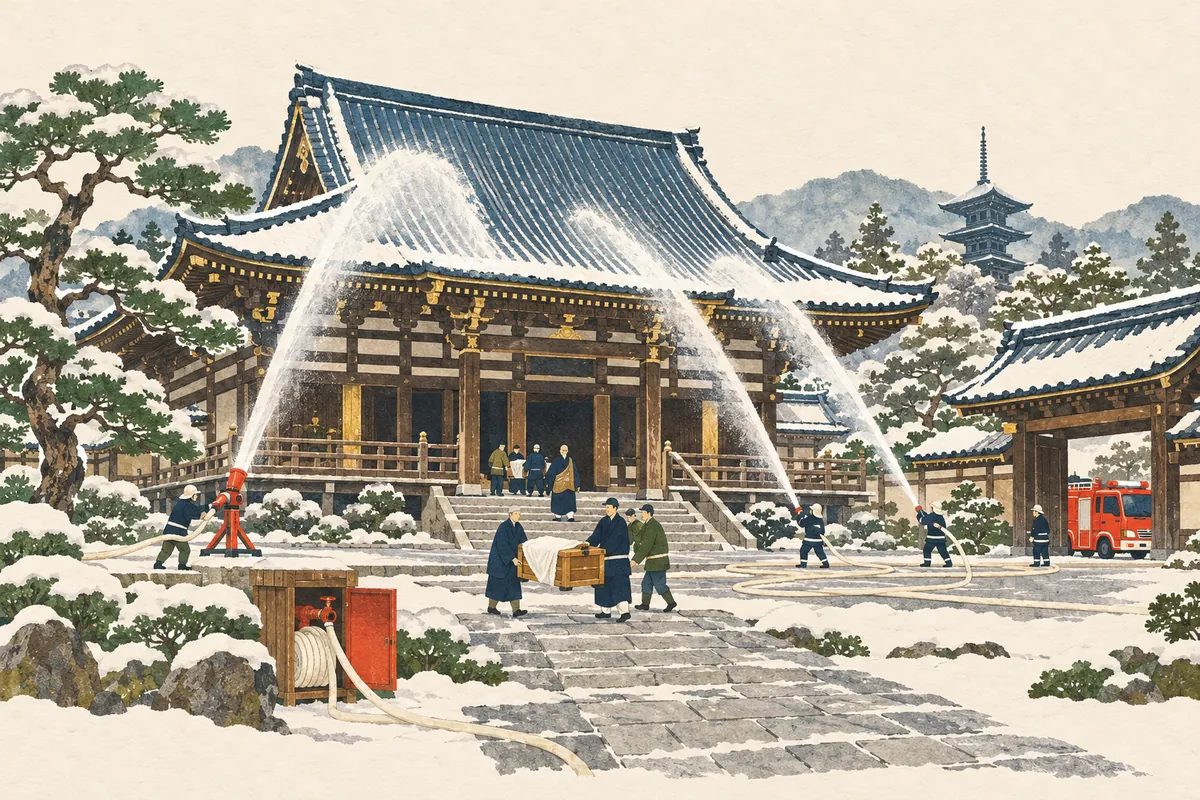
The drill at Nanzen-ji on January 23, 2026 (Reiwa 8) assumed that a fire had broken out in the woods near the temple's main residence (honbō). It involved reporting and initial firefighting by the temple's in-house fire brigade, carrying out cultural properties, information gathering by a fire department helicopter, and simultaneous water spraying by the volunteer fire corps and the fire station. In addition, safety inspections of the electrical equipment in buildings housing cultural properties have continued since 1976 (Shōwa 51).
Fires affecting Kyoto's cultural properties
Cultural properties in Kyoto, too, have suffered many fires. Before the war, two National Treasures at Daigo-ji, the Godaidō (1932) and the sutra repository (1939), burned, and in July 1950 (Shōwa 25) the Kinkaku of Rokuon-ji (a National Treasure) and a National Treasure wooden seated statue were destroyed by arson. Today's Kinkaku is a building reconstructed in 1955 (Shōwa 30).
From 1948 (Shōwa 23), when the Kyoto City Fire Department was founded, to the end of March 2025 (Reiwa 7), there were 177 fires on the premises of "specified cultural property facilities" designated by the fire chief. Arson was the most common cause, with 72 (41%), followed by cigarettes with 16 and children playing with fire with 12.
Major cultural property fires in Kyoto City since 1962
| Year | Event |
|---|---|
| July 1962 (Shōwa 37) | Mibu-dera's main hall and its Important Cultural Property seated Jizō Bosatsu and wooden standing Four Heavenly Kings are destroyed by fire |
| January 1976 (Shōwa 51) | The main sanctuary and other buildings of Heian Shrine are destroyed by fire |
| April 1993 (Heisei 5) | Parts of buildings such as Ninna-ji's Kondō and Mieidō burn. In the same month, part of Sanzen-in's Ōjō Gokuraku-in (Important Cultural Property) and Shōren-in's Kōbuntei tea house also burn |
| May 2000 (Heisei 12) | Jakkō-in's main hall burns, and its Important Cultural Property standing Jizō Bosatsu is also damaged |
How cultural properties are protected from fire
According to the Kyoto City Fire Department's "Annual Report and Records 2025," the department designates 1,090 temples, shrines, and other sites associated with cultural properties designated or registered by the national, prefectural, or city government as "specified cultural property facilities" and gives them fire prevention guidance. At the 307 temples, shrines, and other sites that have National Treasures or Important Cultural Properties, 525 places are designated as zones where smoking and bonfires are prohibited.
The human side of preparedness is the "Cultural Property Citizens' Rescue System." It began in fiscal 2000 (Heisei 12), 50 years after the Law for the Protection of Cultural Properties was enacted, and temple and shrine staff and local residents discuss and decide on action plans for reporting a fire, initial firefighting, carrying out cultural properties, and so on. The same report counts 238 temples, shrines, and other sites in the city where the system is in place. "Cultural Property Safety Cards," recording where Buddhist statues and other objects are kept and how many people are needed to carry them out, have also been made and are shared with the fire brigades.
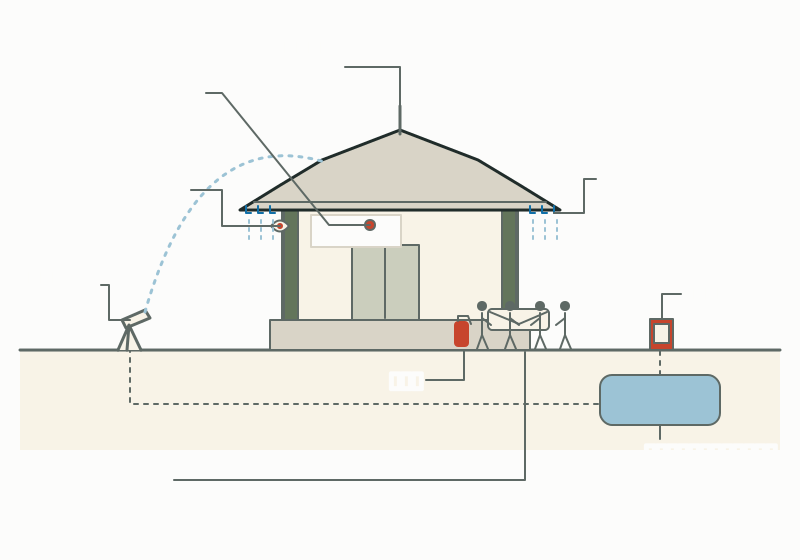
The equipment includes automatic fire alarm systems, fire hydrants, water cannons, roof drenchers, flame sensors, and lightning protection, and the installation of earthquake-resistant water tanks is also encouraged so that water can be used even in a major disaster such as an earthquake. In the Kiyomizu area of Higashiyama Ward, two earthquake-resistant fire cisterns of the 1,500 m³ class and 43 citizens' fire hydrants that anyone can use were in place by the end of fiscal 2011 (Heisei 23).
Main Fire Protection Equipment in Temple and Shrine Grounds (Schematic Diagram)
Faith in fire protection and memories of great fires
Kyoto has been through many great fires, among them, in the Edo period, the great fire of 1708 (Hōei 5) and the Great Tenmei Fire, the largest fire in the city's history, which broke out on the 30th day of the 1st month of Tenmei 8 (1788, lunar calendar). Here the Atago faith in protection against fire (hibuse) spread from early times. A typical custom is putting up Atago Shrine's "Hi-no-yōjin" charm in the kitchen, and in many areas volunteer fire corps still receive the charms and distribute them to the households of their district.
Watching the drills and the citizens' Disaster Prevention Center
The drills are held mainly in the grounds of temples and shrines. The dates and places are announced each year by the Kyoto City Fire Department, and drills may be canceled because of weather or disasters, so contact the fire station in charge for details. Even on ordinary days, in and around the Sannenzaka Preservation District for Groups of Traditional Buildings, you can see citizens' fire hydrants made with cedar wood to suit the townscape.
To learn about fire prevention with children, visit the Kyoto City Citizens' Disaster Prevention Center in Nishikujō Sugata-chō, Minami Ward. Admission is free, and you can try a video experience, an earthquake experience, a strong wind experience, and an evacuation experience making your way through smoke; the firefighting experience, in which you put out a fire with an extinguisher and other equipment, is for third-grade elementary school students and older. It is open 9:00–17:00 and closed on Mondays (except holidays and some other days), the 2nd Tuesday of the month, and over the New Year holidays (as of October 2026). It is an 8-minute walk west from Kintetsu Jūjō Station, or right by the "Shimin Bōsai Center-mae" city bus stop.
Mini quiz for this entry
Every July, the Kyoto City Fire Department holds the "Summer Cultural Property Fire Prevention Campaign." Which fire prompted it?
Of the fires on the premises of Kyoto's specified cultural property facilities from 1948 (Shōwa 23) to the end of March 2025 (Reiwa 7), what was the most common cause after arson?
Sources and verification
Content checked: October 19, 2026
Updated: October 19, 2026
References are in Japanese.
- 文化庁「文化財防火デー」
- 消防庁「「第72回文化財防火デー」の実施」(令和8年1月19日)
- 京都市消防局「令和8年 文化財防火運動の実施~みんなで文化財を火災からまもろう~」
- 京都市消防局「令和8年 文化財防火運動の実施」報道発表資料(訂正後の別紙)
- 京都市消防局「令和8年 夏の文化財防火運動の実施~みんなで文化財を火災からまもろう~」
- 京都市消防局「令和8年 夏の文化財防火運動の実施」報道発表資料
- 京都市消防局「特定文化財対象物に対する電気設備安全点検の実施」(令和8年10月9日)
- 京都市消防局「事業概要(平成30年)文化財を災害から守るまちづくり・ひとづくり」
- 京都市消防局「年報と記録2025 事業概要」
- 京都市消防局「年報と記録2025 統計」(京都市内の主な文化財火災〈年表〉、特定文化財対象物の火災発生状況)
- 京都府・京都市「文化財所有者のための防災対策マニュアル(簡略版)防火・防犯対策編」
- 京都府・京都市「文化財所有者のための防災対策マニュアル(簡略版)地震対策編」
- 京都市観光協会 京都観光Navi「鹿苑寺(金閣寺)」
- 観光庁 地域観光資源の多言語解説文データベース「旧本尊と新本尊(寂光院)」
- 京都市「京都遺産 世代を越えて受け継がれる火の信仰と祭り」
- 京都市「都市史23 宝永の大火」
- 京都市「都市史24 天明の大火」
- 京都市市民防災センター「ご利用案内」
- 京都市市民防災センター「体験施設のご案内」