
Japaneseどんつき(どん突き)
Dontsuki
Other spellings and namesドンツキ / Donzuki / Dontsuki dosu (どんつきどす)
In short
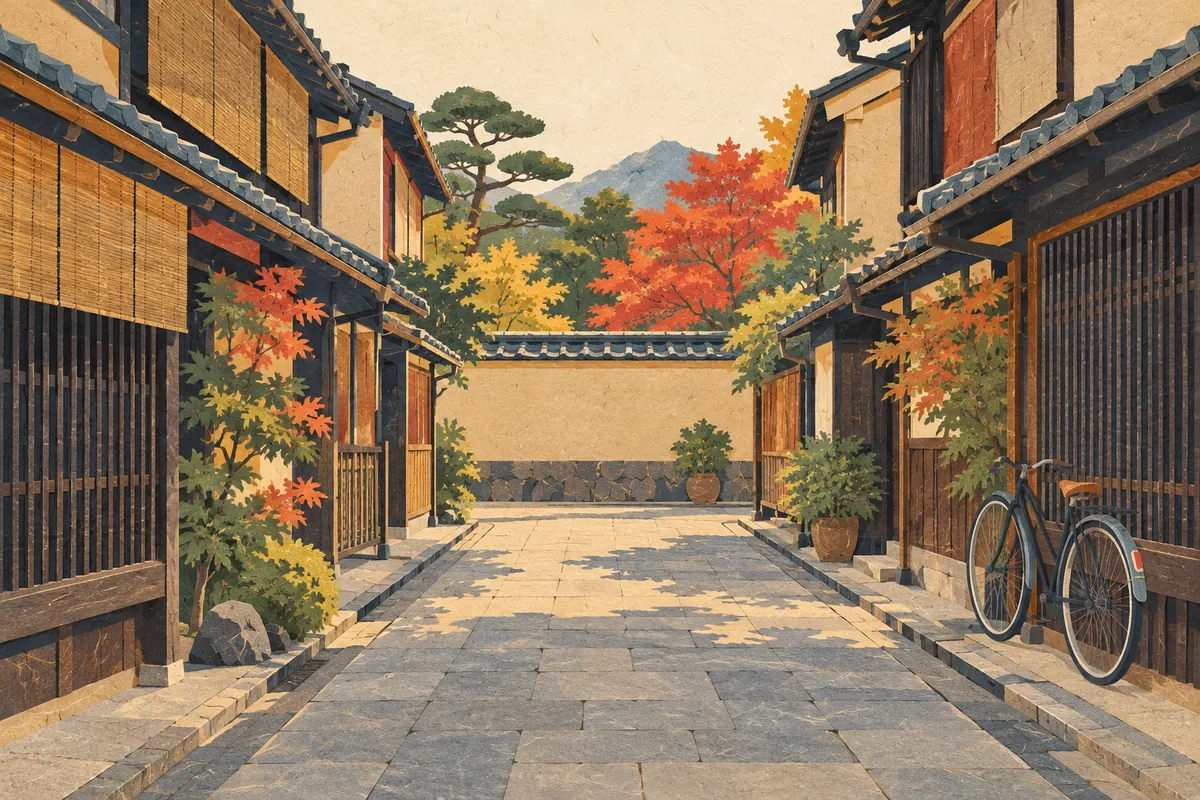
Dontsuki (どんつき) is a word for the place where a road or the like comes to an end—that is, a dead end or the point where a road meets something head-on. It is said to be used mainly in the Kansai region, and in Kyoto dialect people also say dontsuki dosu (どんつきどす, "it's at the end of the road").Key points in 30 seconds
Meaning: "a place where a road or the like comes to a dead end; the end of the road"
Formed with an emphatic don, like donzumari and donjiri
Said to be used mainly in the Kansai region
Yasaka Shrine stands at the eastern dontsuki of Shijō-dōri
Dontsuki means the end of the road
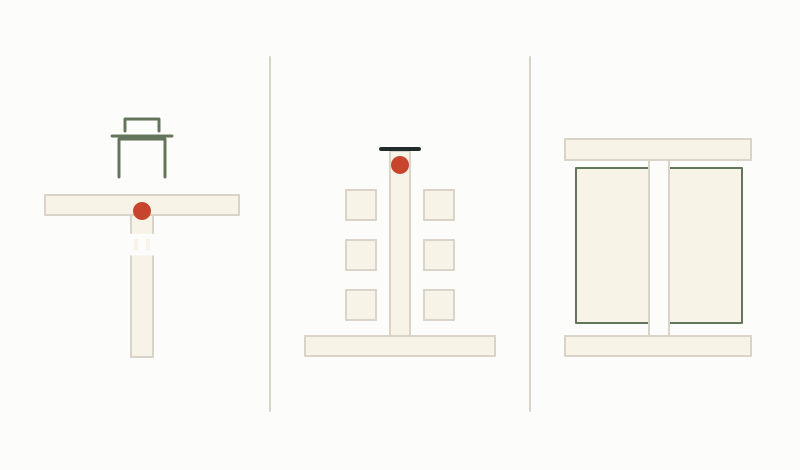
Dontsuki (どんつき, also written どん突き) refers to the place where a road or the like comes to a dead end—the point where it meets something head-on. It is where you walk straight ahead and the road simply ends.
Kyoto dialect used with visitors also has the phrase どんつきどす (dontsuki dosu), equivalent to standard Japanese 突き当りです (tsukiatari desu, "it's at the end of the road"). You may hear this in reply when you ask for directions.
Where exactly is the "dontsuki"?
What does "don" mean?
Don is a prefix that attaches to nouns to emphasize them as "the very thing," used in words such as donjiri (the very last), donzoko (rock bottom), and donzumari (the very end). It is also explained as a stronger form of the prefix do.
The don of donzumari (どん詰まり) is the same prefix, and the word means "a dead end of a road" or "the very end of something." No explanation clearly showing the etymology of dontsuki could be confirmed, but it is easy to remember as a word built much like donzumari.
Is it a word only used in Kyoto?
Dontsuki is said to be a word meaning a dead end used mainly in the Kansai region (in Mukōjima, Tokyo, there is even a group that bears the name, the Dontsuki Association). It is also introduced as Kyoto dialect, but it seems better to think of it as a word widely used in Kansai rather than one unique to Kyoto.
Incidentally, a children's dictionary that introduces 25 selected Kyō-kotoba (Kyoto dialect) words does not include dontsuki. It does include direction words such as agaru and sagaru (going north, going south), but dontsuki can be said to be treated as an everyday Kansai word that also appears in standard Japanese dictionaries, rather than as Kyō-kotoba.
Dontsuki in the streets of Kyoto
Even in central Kyoto, which looks like a checkerboard grid, there are places where a street ends by running into a temple, shrine, or the like. Yasaka Shrine stands at the eastern end of Shijō-dōri; walk east along Shijō-dōri and you will see its West Tower Gate (Nishi-rōmon) at the dontsuki.
Conversely, there are also names that record a road cutting through something. In Toyotomi Hideyoshi's redevelopment of the city, a north–south road was built cutting right through the grounds of Gojō Tenjin Shrine, and people called it Tenshi-tsukinuke-dōri (天使突抜通). The name still survives in town names in Shimogyō Ward.
The dontsuki of alleys, and disaster preparedness
Many alleys that lead off a street come to a dead end at the back. In the Rokuhara school district of Higashiyama Ward, when names are given to narrow lanes, an effort is being made to distinguish roji (路地) = fukuroji (dead-end lane) from kōji (小路) = evacuation possible in two directions, so that even on an unfamiliar lane people can tell whether they can escape (as of 2017).
In an alley with no through route, if the entrance is blocked by fire or a collapsed house, the people living at the back cannot evacuate. A dead-end alley is a quiet place to live, but it is also a place where you need to think about escape routes in case of emergency.
How it differs from similar words
Dontsuki refers to the very place where a road ends. It refers to something slightly different from fukuroji (袋路), which describes the layout of a dead-end lane, or zushi (辻子), a narrow lane you can pass through. Even if you are told "dontsuki" when getting directions, the word alone does not tell you whether the road splits left and right beyond that point or is a fukuroji you cannot pass through, so it is reassuring to check it against a map.
Words for where a road "ends" or "goes through"
| Word | Meaning |
|---|---|
| どんつき (dontsuki, どん突き) | A place where a road or the like comes to a dead end; the end of the road |
| どんづまり (donzumari, どん詰まり) | A dead end of a road; the very end of something |
| 袋路 (fukuroji) | A dead-end lane. Kyoto City treats it as a disaster-prevention issue |
| 突抜 (tsukinuke; Tenshi-tsukinuke) | The name of a road built cutting through the grounds of Gojō Tenjin Shrine |
Mini quiz for this entry
Check what you've read with 2 multiple-choice questions.
You ask for directions and are told, "Soko no donzuki dosu." What does donzuki (どん突き) mean?
Which shrine stands "at the eastern end of Shijō-dōri"—that is, at the donzuki of Shijō-dōri?
Sources and verification
Content checked: October 11, 2026
Updated: October 11, 2026
References are in Japanese.