
The "Mikaeri Amida" of Eikandō (Zenrin-ji)
Other spellings and names見返り阿弥陀
Key points
Formal name: Shōju Raikōzan Muryōju-in Zenrin-ji, now the head temple of the Seizan Zenrin-ji school of Jōdo Buddhism
The popular name is read "Eikandō," while the monk it is named after is read "Yōkan"
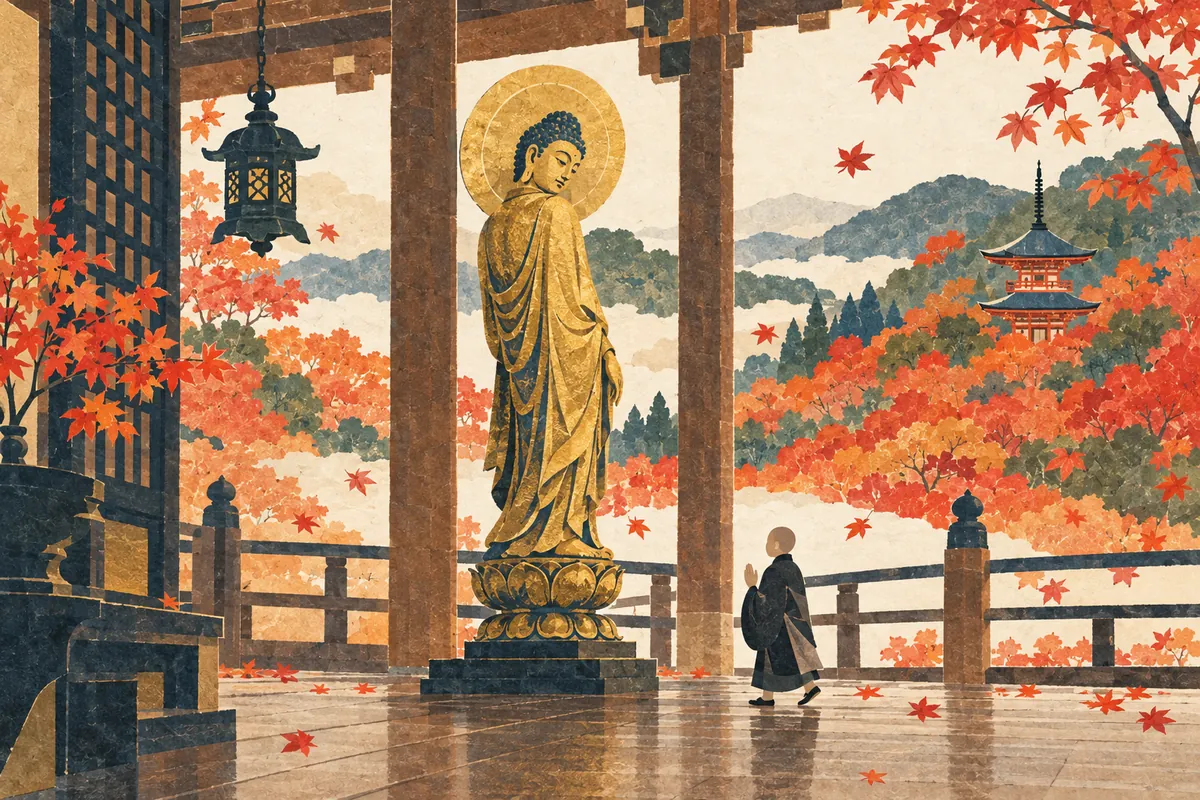
The principal image is a standing Amida looking back to the left (Important Cultural Property, 77 cm tall)
Most of the temple's treasures are deposited with museums; part of them is shown at the temple in the autumn treasures exhibition
The formal name is Zenrin-ji
Eikandō is a popular name; the temple's formal name is Shōju Raikōzan Muryōju-in Zenrin-ji. In 853 (Ninju 3), Shinjō, a disciple of Kūkai (Kōbō Daishi), bought the mountain villa of Fujiwara no Sekio as the temple site, and in 863 (Jōgan 5) the temple received an imperial name plaque reading "Zenrin-ji" from Emperor Seiwa, which fixed its name.
Shinjō was a Shingon monk, and Zenrin-ji began as a training place for Shingon Esoteric Buddhism. After the seventh head monk, Yōkan, came in 1072 (Enkyū 4), the Pure Land teachings of the Nara Sanron school grew stronger, and around the time of Jōhen in the early Kamakura period it became a Jōdo (Pure Land) temple. It then continued as a temple of the Seizan branch of Jōdo Buddhism, which follows the line of Shōkū, a leading disciple of Hōnen, and in 1919 (Taishō 8) it separated as the Seizan Zenrin-ji school, of which it is now the head temple.
In 1264 (Bun'ei 1), the Retired Emperor Go-Saga built a detached palace, Zenrinji-den, in the southern part of Zenrin-ji's land, and in 1291 (Shōō 4) the Cloistered Emperor Kameyama made this palace into a temple, founding Nanzen-ji. The entire temple was damaged in the Ōnin War, and its halls were rebuilt from around 1472 (Bunmei 4) to around 1497 (Meiō 6).
"Eikandō" and "Yōkan"
The popular name is read "Eikandō," but the temple reads the name of the seventh head monk it is named after (1033–1111) as "Yōkan." The same characters are read differently for the temple's name and for the monk's name.
Yōkan became known as a scholar-monk of the Sanron school, but he gave up his position to live in seclusion at Zenrin-ji. Tradition holds that from the age of 18 he chanted the nenbutsu (the name of Amida) 10,000 times a day as a daily practice, and later 60,000 times. In 1097 (Jōtoku 1) he built the Yakuō-in within the temple and set up a place to treat the sick, and grew the "Hiden-bai" plum trees, whose fruit from the grounds was given to the poor. The temple's land at the time stretched along the Higashiyama hills from Awataguchi in the south to Shishigatani in the north.
The principal image, Mikaeri Amida
The temple's legend tells that at dawn on the 15th day of the 2nd month of Eihō 2 (1082, lunar calendar), while Yōkan was performing gyōdō, walking around a statue of Amida while chanting the nenbutsu, Amida stepped down from the altar, led Yōkan, looked back over its left shoulder, and called out, "Yōkan, ososhi" ("Yōkan, you are slow").
Its national designation name is "Wooden Standing Statue of Amida Nyorai (Mikaeri Amida)," and it is an Important Cultural Property. Its head is turned to the left, its body leans slightly to the left, and it stands with the left knee lightly bent and the tip of the left foot slightly forward, a pose unlike that of ordinary Amida statues. It is estimated to be a work of the latter half of the 12th century and is the oldest known sculpture of a looking-back Amida in Japan. It is 77 cm tall.
The Amidadō, where the principal image is enshrined, was moved here from Naniwa (Osaka) in 1607 (Keichō 12).
Zenrin-ji's cultural properties
The national cultural properties owned by Zenrin-ji are 2 National Treasures and 16 Important Cultural Properties. Apart from the principal image, most of them are deposited with or kept in national and public museums, and what you can see on an ordinary visit are sliding-door paintings such as "Bamboo and Tigers." Among the buildings, the Amidadō, Shakadō, ossuary hall (Nōkotsudō), bell tower, Chokushimon (Imperial Messenger Gate), and Chūmon (Middle Gate) in the grounds became Kyoto Prefecture Designated Cultural Properties in 2005 (Heisei 17).
National Treasures and Important Cultural Properties owned by Zenrin-ji (Eikandō)
| Name (designated name) | Type | Period | Designation |
|---|---|---|---|
| Amida Coming over the Mountain (Yamagoshi Amida-zu), color on silk | Painting | Kamakura | National Treasure (February 19, 1957) |
| Gilt-bronze kei (chime) with lotus design | Craft | Heian | National Treasure (March 31, 1953) |
| Wooden standing statue of Amida Nyorai (Mikaeri Amida) | Sculpture | Heian | Important Cultural Property (June 7, 1999) |
| Amida Nyorai descending to welcome the dead (raigō), color on silk | Painting | Kamakura | Important Cultural Property (May 27, 1907) |
| Sixteen Arhats, color on silk (16 scrolls) | Painting | Kamakura | Important Cultural Property (May 27, 1907) |
| Death of the Buddha (Nirvana), color on silk | Painting | Nanboku-chō | Important Cultural Property (April 15, 1903) |
| Shaka Nyorai and Ten Great Disciples, color on silk (3 scrolls) | Painting | Goryeo to Kamakura | Important Cultural Property (March 27, 1901) |
| Shaka Triad, light color on paper (attributed to Kanō Motonobu) | Painting | Muromachi | Important Cultural Property (August 1, 1898) |
| Origins of the Yūzū Nenbutsu, color on paper (attributed to Tosa Mitsunobu, 2 scrolls) | Painting | Muromachi | Important Cultural Property (April 7, 1900) |
| Amida and the Twenty-Five Bodhisattvas Descending, gold and color on silk | Painting | Nanboku-chō | Important Cultural Property (April 23, 1908) |
| Painted doors of the Twenty-Five Bodhisattvas Descending (doors of the Zendō Daishi shrine cabinet, 12 panels) | Painting | Nanboku-chō | Important Cultural Property (April 23, 1908) |
| The Ten Realms, color on silk (2 scrolls) | Painting | Kamakura | Important Cultural Property (April 23, 1908) |
| Yakushi Nyorai, color on silk | Painting | Kamakura | Important Cultural Property (April 23, 1908) |
| Shaka and the Sixteen Benevolent Deities, color on silk | Painting | Kamakura | Important Cultural Property (April 23, 1908) |
| Waves, ink on paper (12 scrolls) | Painting | Momoyama | Important Cultural Property (April 23, 1908) |
| Origins of the Taima Mandala, ink on paper | Calligraphy and books | Kamakura (1262) | Important Cultural Property (May 24, 1916) |
| Taima Mandala, color on silk | Painting | Kamakura (1302) | Important Cultural Property (February 8, 1958) |
| Yūzū Nenbutsu fund-raising register (3rd month of Bun'an 4, on paper with gold and silver underpainting) | Historical document | Muromachi (1447) | Important Cultural Property (June 22, 2001) |
"Eikandō of the maples" and the Autumn Temple Treasures exhibition
Eikandō has long been called "Momiji no Eikandō" (Eikandō of the Maples), a famous spot for autumn leaves, and every autumn it holds the "Autumn Temple Treasures Exhibition," showing part of its treasures. In 2026 (Reiwa 8) it runs from November 11 to December 6, with Pure Land art handed down at the temple on display, including the Twenty-Five Bodhisattvas Descending, the Ten Realms, and the Origins of the Taima Mandala (all Important Cultural Properties).
From November 20 to December 6 there are also evening illuminations (reception 17:30–20:30), when you can visit the Amidadō and the garden. The treasures exhibition and the illuminations admit visitors separately, so you cannot visit both in a row. During this period the Garyūrō corridor is closed to passage, the Senbutsudō hall is closed, and private cars cannot enter.
Getting to Eikandō and admission
Eikandō is at 48 Eikandō-chō, Sakyō Ward. From JR Kyoto Station or Keihan Sanjō Station, take City Bus Route 5 to "Nanzenji-Eikandō-michi" and walk about 3 minutes. It is about a 15-minute walk from Keage Station on the Tōzai subway line, or about an 8-minute walk from the "Higashi Tennōchō" stop if you take City Bus Route 204 or 93 from Keihan Jingū-Marutamachi Station.
Outside the period of the autumn treasures exhibition, it is open every day of the year. Reception is 9:00–16:00 (gates close at 17:00), the same during the exhibition (as of October 2026). You can visit the halls and the garden, and also worship the principal image in the Amidadō. Photography of the cultural properties inside the halls is prohibited.
- Regular season (from April 1, 2026): 1,000 yen for adults, 800 yen for university and vocational school students, 600 yen for junior high and high school students, and 200 yen for elementary school students. Discounts with a disability certificate
- During the Autumn Temple Treasures Exhibition: 1,500 yen for adults, 1,000 yen for university and vocational school students, and 800 yen for junior high and high school students (the fee table has no category for elementary school students)
- Illuminations: 1,000 yen for junior high school students and older
Mini quiz for this entry
Yōkan, the monk after whom Eikandō is named, grew plum trees whose fruit from the temple grounds was given to the poor. What were they called?
In what pose does Eikandō's principal image, the "Mikaeri Amida" (Important Cultural Property), stand?
Sources and verification
Content checked: October 22, 2026
Updated: October 22, 2026
References are in Japanese.
- 文化庁「国指定文化財等データベース 木造阿弥陀如来立像(見返り阿弥陀)」
- 文化庁「国指定文化財等データベース 絹本著色山越阿弥陀図」
- 文化庁「国指定文化財等データベース 金銅蓮花文磬」
- 文化庁「国指定文化財等データベース 融通念仏勧進帳」
- 文化庁「国指定文化財等データベース」(国宝・重要文化財〈美術工芸品〉、所有者「禅林寺」で検索)
- 永観堂禅林寺「永観堂のご紹介」
- 永観堂禅林寺「歴史年表」
- 永観堂禅林寺「みかえり阿弥陀」
- 永観堂禅林寺「寺宝一覧」
- 永観堂禅林寺「拝観のご案内」
- 永観堂禅林寺「お知らせ」(拝観料改定、令和8年度秋の寺宝展・ライトアップ)
- 永観堂禅林寺「永観堂への経路」
- 永観堂禅林寺「永観堂パンフレット」
- 京都市観光協会「京都観光Navi 禅林寺(永観堂)」