
Japaneseかんにん
Kannin
Other spellings and namesKannin e / 堪忍 / カンニン / かんにんえ
Key points
Means "sorry" or "forgive me"
Used in forms such as kannin na, kannin e, and kannin shitokure yasu na
The original meaning of 堪忍 is to endure, to bear patiently
An example of 堪忍 appears in the diary Chūyūki in 1108
What kannin means, with examples
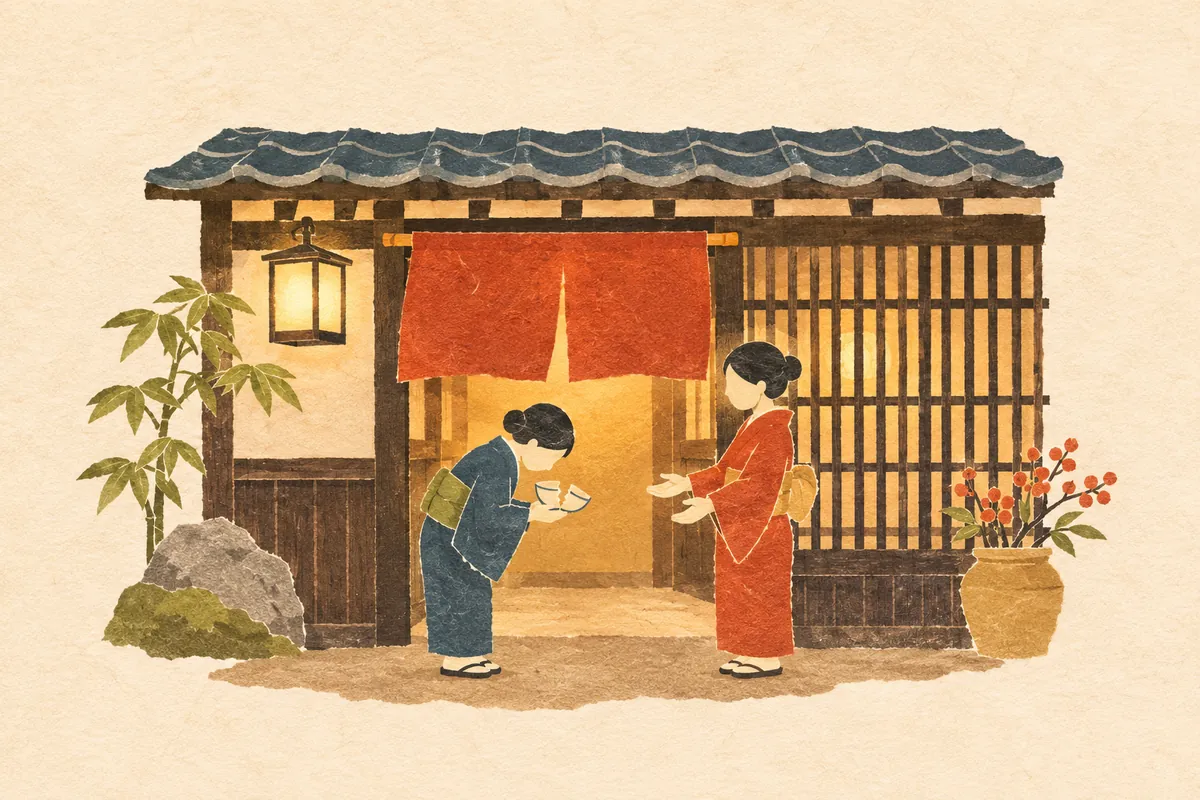
In Kyō-kotoba, kannin means "sorry." The example 迷惑かけてカンニンな。 ("Meiwaku kakete kannin na") is a way of apologizing: "Sorry for causing you trouble." Kannin e is also used to mean "Sorry; please forgive me."
- 迷惑かけてカンニンな。 ("Meiwaku kakete kannin na"): "Sorry for causing you trouble."
- かんにんえ ("Kannin e"): "Sorry. Please forgive me."
- 堪忍しとくれやすな ("Kannin shitokure yasu na"): "I'm so sorry." -shitokure yasu is a polite way of asking, equivalent to "please do ..." (mitokure yasu means "please take a look").
- かんにんしとぉくれやす ("Kannin shitōkure yasu"): "Please let it pass; please forgive me."
The original meaning of 堪忍
堪忍 (kannin) is a Sino-Japanese word for patiently enduring a hard situation, holding on, and putting up with something. An early example appears in the diary Chūyūki (ちゅうゆうき) in 1108, which says that the north wind blew hard, snow swirled, and the cold cut to the bone and could not be endured (kannin). The Taiheiki of the late 14th century also has a use meaning that someone thought they would not be able to bear even a single day in Kyoto.
Another meaning is holding back one's anger and forgiving someone's wrong. There is an example in a record of 1489, and in the kyōgen play Buaku (ぶあく), from the late Muromachi to early Edo period, a character says that he has forgiven as much as he could, but this time he cannot hold back.
In Buddhism, it was also used to translate the Sanskrit sahā (shaba, 娑婆): the world in which one must endure hardship, that is, this world.
How kannin became a word of apology
From 堪忍, meaning to endure, came the Kyō-kotoba kannin and kannin e, used to mean "sorry" and "please forgive me."
Using 堪忍 to ask for forgiveness is not unique to Kyoto. The ninjōbon (romance novel) Shunshoku Umegoyomi (しゅんしょくうめごよみ) of 1832–33 has the dialogue 堪忍しておくんなさいナ ("Kannin shite okunnasai na," "Please forgive me"), and standard Japanese also has phrases like warukatta, kannin shite kure ("I was wrong; forgive me"). In late Edo-period sharebon (books about the pleasure quarters), there is also the form kani, changed from kannin, as in the line あれさ、かにしておくんなんし ("Oh, please forgive me").
Similar words, and gomen'yasu, which is easy to confuse
Kanben (勘弁) also means forgiving someone's wrong, as in kondo dake wa kanben shite yaru ("I'll let you off just this once"). In the sense of forgiving someone's wrong, dictionaries list kannin and kanben as paraphrases of each other.
The meaning "to endure" also survives in kanninbukuro (堪忍袋, "the bag of patience"), a word that likens one's capacity for patience to a bag. A zappai (popular comic verse) of 1713 has a line ending …切れる縁 ("…a bond that breaks").
A word that is easy to confuse is gomen'yasu. It contains the same sound as gomen ("sorry"), but ゴメンヤス is a greeting used when visiting someone, equivalent to gomen kudasai ("Hello, is anyone home?"), and it is also used on parting, as in hona, gomen'yasu ("Well, I'll be going now"). It is not a word of apology; the Kyō-kotoba word for apologizing is kannin.
Mini quiz for this entry
In Buddhism, 堪忍 was also used to translate a Sanskrit word for the world in which one must endure hardship. Which word is the phonetic rendering of that Sanskrit word?
Sources and verification
Content checked: November 8, 2026
Updated: November 8, 2026
References are in Japanese.