
Japaneseほっこり
Hokkori
Other spellings and namesHokkori suru / ほっこりする / ホッコリスル
Key points
In Kyō-kotoba it means "to feel relieved; to feel fatigue setting in"
Example: 用事が終わって、ホッコリシたわ。 ("My errands are done; I'm relieved, and a bit tired.")
An example meaning "looking warm" appears in the Katakoto of 1650
In the Edo period, steamed sweet potatoes were also called hokkori
What hokkori suru means, with examples
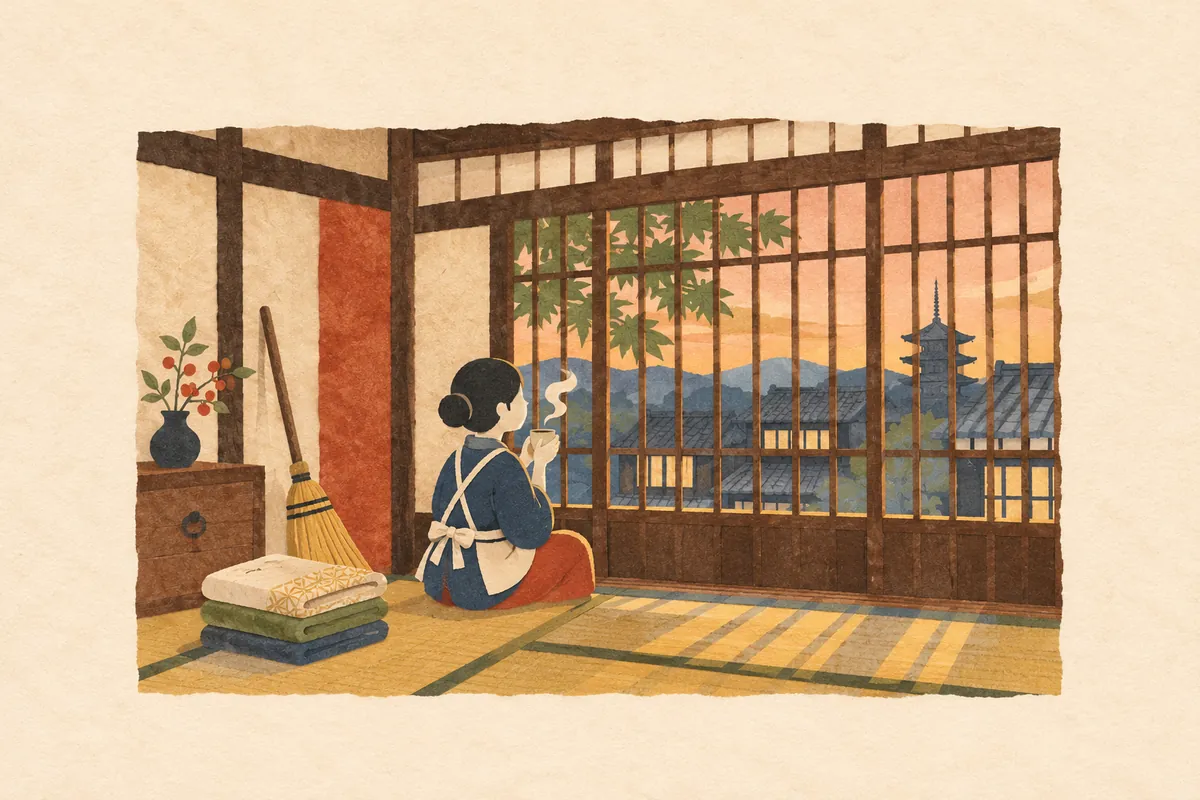
In Kyō-kotoba, hokkori suru means to feel relieved and to feel tiredness setting in. The example 用事が終わって、ホッコリシたわ。 ("Yōji ga owatte, hokkori shita wa") expresses the feeling "My errands are done; I'm relieved, and a bit tired."
It is said when you have got one errand or task out of the way and are tired enough to want a breather. People also say hokkori shita ("I'm hokkori") when they feel relieved that something is over, or when they are worn out more in spirit than in body.
The meanings of hokkori, with examples
| Usage | Meaning | Example |
|---|---|---|
| Kyō-kotoba hokkori suru | To feel relieved; to feel fatigue setting in | 用事が終わって、ホッコリシたわ。 ("My errands are done; I'm relieved, and a bit tired.") |
| Hokkori as widely used across Japan | Looking warm and cozy | ほっこりと暖かい綿入れ ("a cozily warm padded jacket") / 心がほっこりする話 ("a heartwarming story") |
| Edo-period ukiyozōshi (1783) | To be fed up; to be at one's wits' end | イヤモ世話なもので、ほっこり致しました ("Iya mo sewa na mono de, hokkori itashimashita": "Oh, what a bother it was; I'm fed up with it.") |
How it differs from hokkori elsewhere in Japan, and similar words
The hokkori heard all over Japan describes feeling relieved and warm inside, as in kokoro ga hokkori suru hanashi ("a heartwarming story"). The Kyō-kotoba hokkori shita sounds the same but means "I'm a little tired." When someone says hokkori shita wa in the Kyō-kotoba sense, the conversation makes sense if you take it to mean not that their heart was warmed but that they have just finished a job and are catching their breath.
Hokkori in the sense of a warm feeling is also said to have come into wide use across Japan through TV programs and the like. Its use to describe something that looks warm, however, dates back to the 17th century, and it is a separate use from the Kyō-kotoba sense of "tired."
To say plainly that you are tired, there is also shindoi nen ("I'm tired"). Hokkori shita includes, along with the tiredness, the relief of having finished something.
Is ho "fire"? Hokkori in the Edo period
An example describing something that looks warm appears in the Katakoto of 1650, a book in which Yasuhara Teishitsu (やすはらていしつ) collected the accents and dialect words of Kyoto at the time and set them beside the correct forms. It treats hokkori as a word meaning "to warm up" and suggests that ho is probably hi (火, "fire"). This is not a settled theory of the word's origin.
In Edo-period writings, the range of meanings widens. An example describing a bright, glossy color appears in the haikai collection Shinzō Inu Tsukuba-shū of 1643, earlier than the Katakoto. There are also examples describing plumpness (in a kyōka comic poem of 1734) and the soft, fluffy texture of steamed potatoes, and an ukiyozōshi (popular fiction) of 1732 has an example meaning to feel refreshed, when one's spirits lift or when a job or a worry is settled. An ukiyozōshi of 1783 also has an example meaning fed up or at one's wits' end: イヤモ世話なもので、ほっこり致しました ("Oh, what a bother it was; I'm fed up with it").
Sweet potatoes were hokkori too
As a noun, hokkori meant steamed sweet potatoes. Tōkaidōchū Hizakurige (1802–09) has the line ほっこり買ふて喰てござるも ("buying hokkori and eating them"). It is also said that in Osaka there were steamed-potato sellers who walked around at night carrying their wares and calling out "Hokkori, hokkori!"
Mini quiz for this entry
In the Kyō-kotoba sentence "Yōji ga owatte, hokkori shita wa" (用事が終わって、ほっこりしたわ。), which is closest to the meaning of hokkori shita?
The Katakoto, a 1650 collection of Kyoto accents and dialect words, suggests what the ho in hokkori, meaning "to warm up," probably is. Which?
Sources and verification
Content checked: November 8, 2026
Updated: November 8, 2026
References are in Japanese.