
Japanese木幡(こはた)
Kohata / Kowata
Other spellings and namesKowata / こわた / 許波多 / 木旗 / 強田
Key points
Addresses and the JR Nara Line station are Kohata (こはた); the Keihan Uji Line station (KH74) is Kowata (こわた)
In the songs of the Kojiki it is written with the characters 許波多 (kohata)
Fujiwara no Mototsune made it the burial ground of the Northern House of the Fujiwara clan; today it is managed by the Imperial Household Agency as the Uji Mausoleums
Kohata Shrine, listed in the Engishiki, exists at two sites: Kohata and neighboring Gokashō
The reading: Kohata for addresses and JR, Kowata for Keihan
木幡 is a place name in Uji City, and as an address it is read Kohata (こはた). Kohata Station on the JR Nara Line is also read こはた (Kohata in romanized letters).
The station 木幡 on the Keihan Uji Line, by contrast, is read こわた (Kowata). JR and Keihan each have a station named 木幡, and the reading differs by railway company. As a place name, too, it is sometimes called Kowata.
Readings of 木幡
| Name | Spelling | Reading |
|---|---|---|
| Address | 宇治市木幡 | こはた (Kohata) |
| JR Nara Line station | 木幡 | こはた (Kohata) |
| Keihan Uji Line station | 木幡 (KH74) | こわた (Kowata) |
| Shrine | 許波多神社 | こはたじんじゃ (Kohata Jinja) |
Where is it? Northern Uji City, between Rokujizō and Ōbaku
Kohata is in northern Uji City, on the right bank of the Uji River, with the Ōbaku Hills behind it to the east. Kowata Station on the Keihan Uji Line (23 Kohata Nishinaka, Uji City) is between Rokujizō (KH73) and Ōbaku (KH75). The JR Nara Line also passes through Kohata and has its own Kohata Station.
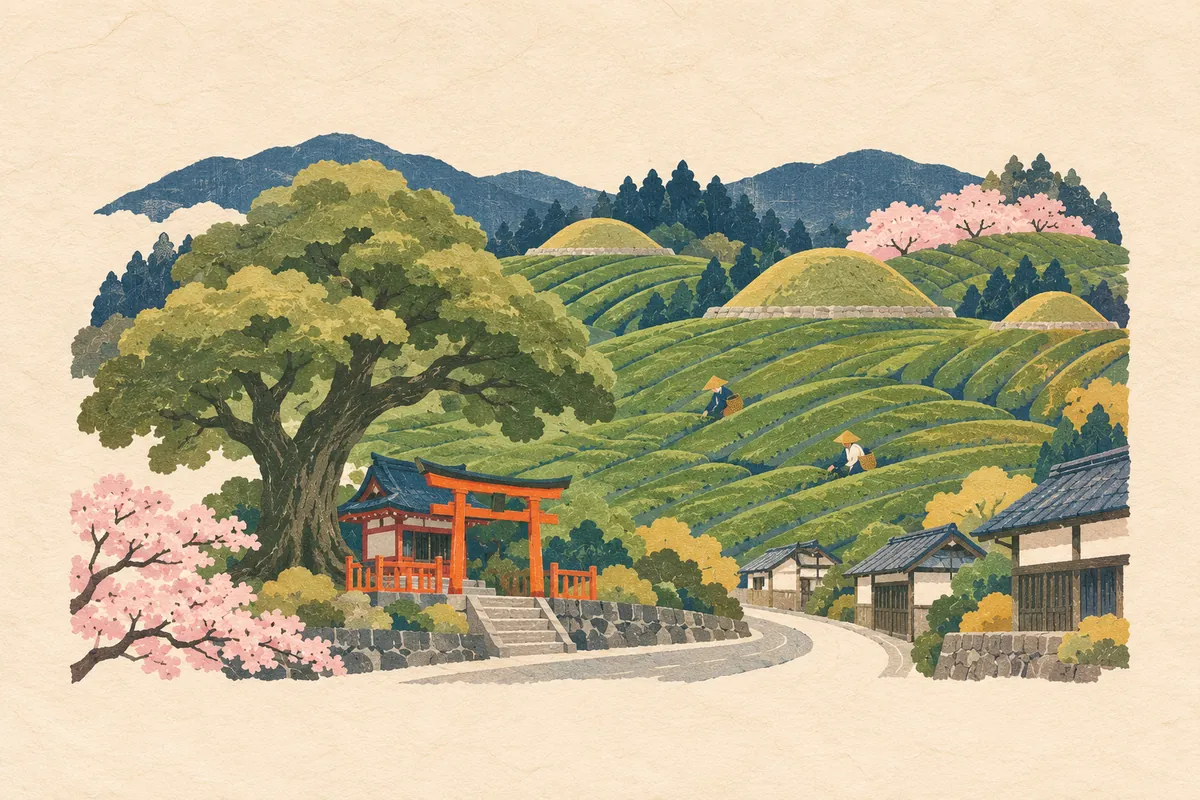
Tea gardens were laid out on the slopes of the hills, and from around the Edo period the area became known as one of the leading producers of Uji tea. Many households here dealt in tea, but the land has been turning into residential neighborhoods.
Old spellings, and the once wide extent of Kohata
Kohata is a place name that appears in records from early times. In the songs of the Kojiki it appears written 許波多, and there is also a story that Emperor Ōjin met the woman who would become his consort here. In the Man'yōshū it is written 木旗 and 強田, and there are poems about the mountain of Kohata in Yamashina; it was also an utamakura, a place celebrated in waka poetry.
Ancient Kohata referred to a wide area stretching from Uji District to Kii District in Yamashiro Province, and is said to have extended as far as the Fukakusa area of today's Fushimi Ward, Kyoto City. It was a key point on the Hokurikudō road heading from the Uji River crossing toward Mount Ōsaka, and it is presumed that there was a facility keeping post horses. In the late Heian period the name came to refer only to the area within Uji District, and in the Edo period Kohata Village was formed and its extent became fixed.
In the Heian period, villas were also built at Kohata, such as Fujiwara no Morozane's Kyōgoku-dono and Fujiwara no Motofusa's Matsu-dono. In the Edo period, Kohata was a patchwork of land held directly by the shogunate, land of hatamoto (direct vassals of the shogun), and land of the court noble Ano and Hashimoto families.
Kohata Shrine and the Fujiwara burial ground
Kohata Shrine (許波多神社, こはたじんじゃ) stands at two sites: Kohata Higashinaka in Uji City and neighboring Gokashō Furukawa. Before the Meiji era both were called Yanagi Daimyōjin, and both are recognized as the Kohata Shrine listed as a Myōjin Taisha (a major shrine of eminent deities) under Uji District in the register of deities of the Engishiki. The shrine in Kohata Higashinaka is on the east side of the old Nara Kaidō, and a surviving fragment of the Yamashiro no Kuni Fudoki mentions it as the shrine of Kohata.
The two shrines are said to have originally been a single shrine on Mount Yanagi in eastern Gokashō that split at some point. It is said that before the Jinshin War, Prince Ōama (later Emperor Tenmu) visited and planted the willow branch he had been using as a whip, and it sprouted, so the place came to be called Yanagiyama ("willow mountain") and the shrine Yanagi Daimyōjin.
Burial mounds of the 5th and 6th centuries are scattered along the hills of Kohata. In the Heian period, the regent Fujiwara no Mototsune made this area the burial ground of the Northern House of the Fujiwara clan, and later regents and chancellors, as well as Fujiwara daughters who had entered the imperial court as consorts, were buried here. In 1005 (Kankō 2), Fujiwara no Michinaga built Jōmyō-ji (the Kohata Sanmaidō) as the family temple. In the modern era these graves became imperial tomb grounds, and today the Imperial Household Agency manages them under the name Uji Mausoleums (Uji-ryō).
Mini quiz for this entry
木幡 is a place name in Uji City. How is it read as the name of the Keihan Uji Line station?
In the Heian period, which regent made Kohata in today's Uji City the burial ground of the Northern House of the Fujiwara clan?
In Uji City, shrines named Kohata Shrine (許波多神社) stand in Kohata and in one other place. Where?
Sources and verification
Content checked: November 8, 2026
Updated: November 8, 2026
References are in Japanese.