
Japanese伏見城・桃山町正宗(ふしみじょう・ももやまちょうまさむね)
Fushimi Castle and "Momoyama-chō Masamune"
Key points
Fushimi Castle was built in two places, Shigetsu and Kohatayama
Excavation in Momoyama Fukushima Dayū Nishi-machi turned up tiles with the Satake crest, not that of the Fukushima family named in the town
桃山町永井久太郎 (Momoyama-chō Nagai Kyūtarō) combines the names of two people, Nagai Ukon and Hori Kyūtarō
"Momoyama" (Peach Hill) is thought to refer to the peaches that grew thickly on the abandoned castle site, and the Azuchi-Momoyama period takes its name from this place
Two Fushimi Castles, at Shigetsu and Kohatayama
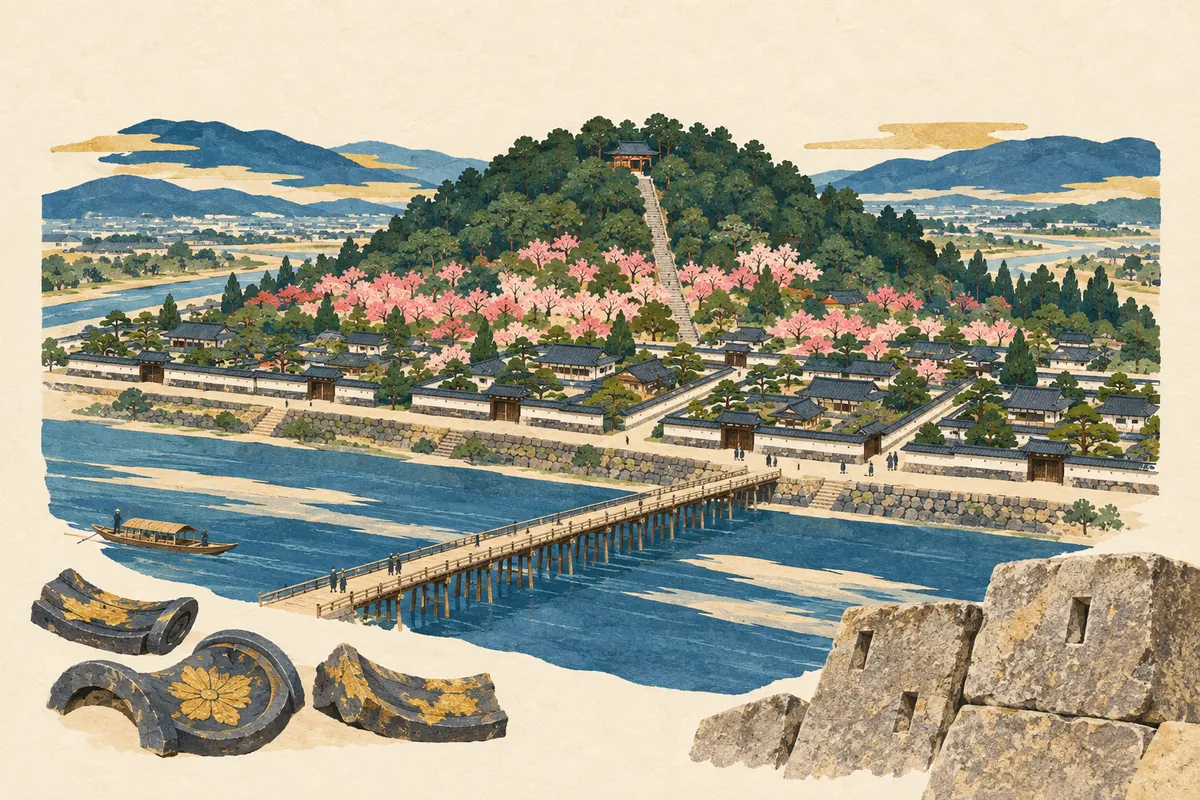
Fushimi Castle began as a retirement residence that Hideyoshi started building in 1592 (Bunroku 1) on the hill of Shigetsu (指月), overlooking the Uji River. The site is today's Momoyama-chō Taichōrō (桃山町泰長老) in Fushimi Ward, the area of the Kangetsukyō housing complex, and when Hideyori was born the following year it was turned into a full-fledged castle (Shigetsu Castle).
Shigetsu Castle collapsed in the great earthquake of the intercalary 7th month of 1596 (Keichō 1), and the castle was moved northeast to Kohatayama (木幡山; also called Fushimiyama). The keep and palaces were completed in the 5th month of 1597 (Keichō 2), and Hideyoshi died in this castle on the 18th day of the 8th month of the following year. After the castle fell in 1600 (Keichō 5) in a prelude to the Battle of Sekigahara, Tokugawa Ieyasu rebuilt it from the following year, and three generations of shoguns, Ieyasu, Hidetada, and Iemitsu, received their appointments as shogun here. The castle was abandoned in 1623 (Genna 9).
Daimyo residences live on in town names
When the castle moved to Kohatayama, samurai residences and town districts were laid out, mainly on the west side of the castle town, and daimyo from all over Japan built residences there. With the castle's abandonment the daimyo residences also lost their purpose, but many town names using daimyo names, official titles, and province names remained on their sites, and Fushimi has an unusually large number of town names that include people's names. Fushimi Ward has 68 town names beginning with "Momoyama" (桃山).
Around the Jurakudai, which Hideyoshi built in central Kyoto, there are also town names that are remnants of daimyo residences, such as 如水町 (Josui-chō, after Kuroda Josui) and 浮田町 (Ukita-chō, after Ukita Hideie).
The Fushimi Castle Site and Main Town Names from Daimyo Residences
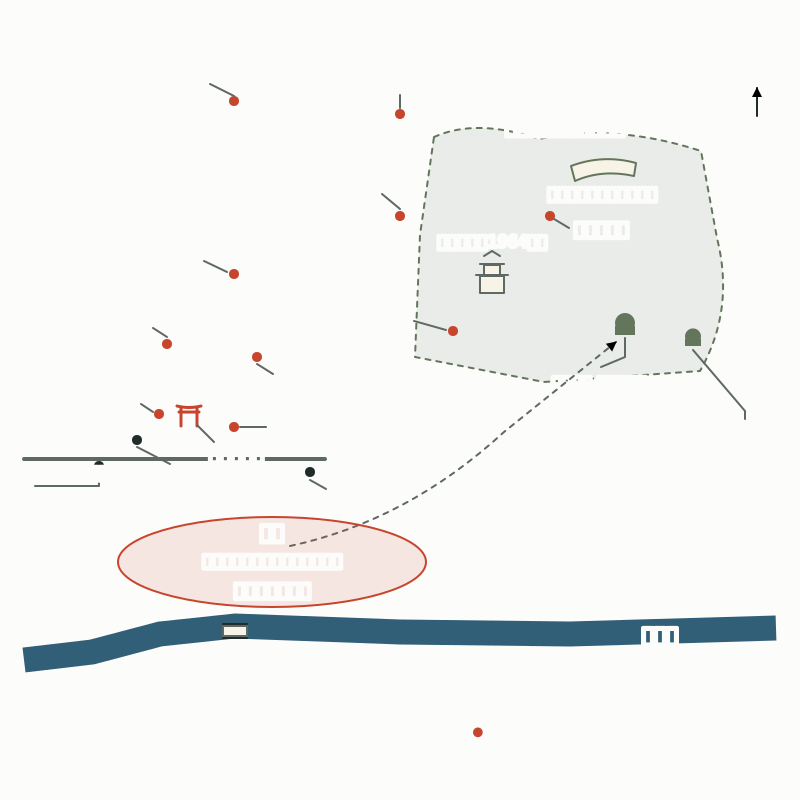
Main Fushimi town names from daimyo residences
| Town name | Reading | Associated daimyo | How the name is formed |
|---|---|---|---|
| 桃山町正宗 | Momoyama-chō Masamune (ももやまちょうまさむね) | Date Masamune (伊達政宗) | A daimyo's given name, though the town name is written 正宗, not 政宗 |
| 桃山最上町 | Momoyama Mogami-chō (ももやまもがみちょう) | Mogami Yoshiaki | A daimyo's family name |
| 桃山毛利長門東町・西町 | Momoyama Mōri Nagato Higashi-machi / Nishi-machi (ももやまもうりながとひがしまち・にしまち) | The Mōri clan | Family name + the province name 長門 (Nagato) |
| 桃山福島太夫北町・西町・南町 | Momoyama Fukushima Dayū Kita-machi, etc. (ももやまふくしまだゆうきたまち など) | The Fukushima family (Fukushima Masanori's official title was 左衛門大夫, Saemon-no-taifu) | Family name + the title 大夫 (also written 太夫, here read dayū) |
| 桃山羽柴長吉東町・中町・西町 | Momoyama Hashiba Chōkichi Higashi-machi, etc. (ももやまはしばちょうきちひがしまち など) | 羽柴長吉 (Hashiba Chōkichi) | A person's name; in the town names, 長吉 is read "Chōkichi" |
| 桃山町永井久太郎 | Momoyama-chō Nagai Kyūtarō (ももやまちょうながいきゅうたろう) | Nagai Ukon and Hori Kyūtarō | The names of two people combined |
| 桃山町金森出雲 | Momoyama-chō Kanamori Izumo (ももやまちょうかなもりいづも) | Kanamori Izumo (presumed site of his residence) | Family name + the province name 出雲 (Izumo) |
| 桃山町治部少丸 | Momoyama-chō Jibushōmaru (ももやまちょうじぶしょうまる) | Ishida Mitsunari (whose title was 治部少輔, Jibu-no-shō) | Official title + 丸 (maru), a term for a castle enclosure |
Residence sites and other castle-town place names
Areas within a castle were called maru (丸), and old maps show the 大蔵丸 (Ōkuramaru, the enclosure of Natsuka Masaie) and the 徳善丸 (Tokuzenmaru, the enclosure of Maeda Gen'i). Jibu Pond (治部池, Jibu-ike) on the south side of the mock keep is part of the former inner moat, and Ishida Mitsunari's residence is said to have stood in this area.
The daimyo in a town name does not necessarily match the owner of the residence revealed by excavation. In an excavation in Momoyama Fukushima Dayū Nishi-machi, many tiles bearing the Satake clan crest, "a five-ribbed fan with a moon disc" (gohonbone ōgi ni tsukimaru), were found, and the site is thought to have been the residence of Satake Yoshinobu, lord of the 540,000-koku Hitachi domain. The owners of residences sometimes changed between the Toyotomi and Tokugawa periods, and research comparing excavation results with old maps continues.
Fushimi place names connected with daimyo of the castle town also include Chūshojima (中書島), which by tradition comes from 中書 (chūsho), the Chinese-style name for the title Nakatsukasa-no-taifu (中務大輔) held by Wakisaka. On the other hand, some town names arose from life in the castle town, such as Shumoku-machi (撞木町), said to be named after the shape of its pleasure quarter, and Ginza-chō (銀座町), where Ieyasu set up a silver mint (ginza).
"Momoyama," from peach trees planted after the castle was abandoned
Before the castle was built, this hill was called Fushimiyama or Kohatayama. After the castle was abandoned, peach and plum trees were planted on the site and grew thickly, and by the mid-Edo period the hill was crowded with people viewing the peach blossoms and is said to have come to be called "Momoyama" (桃山, "Peach Hill"). The "Momoyama" in the name of the Azuchi-Momoyama period also refers to this place in Fushimi.
The site of the main enclosure is Emperor Meiji's mausoleum
The Fushimi Momoyama Mausoleum of Emperor Meiji, who died on July 30, 1912 (Meiji 45), was built around the site of Fushimi Castle's main enclosure (honmaru). To the east is the Fushimi Momoyama East Mausoleum of Empress Dowager Shōken, on the site of the Nagoya-maru enclosure. The heart of the castle is imperial mausoleum land managed by the Imperial Household Agency, and apart from the approach it cannot be entered. Because of this it has escaped large-scale development, and the site preserves much of its appearance from around the time the castle was abandoned.
What excavations have found
No castle buildings remain above ground, but excavations are gradually revealing traces of the castle and the daimyo residences.
- Shigetsu Castle: gold-leaf tiles found throughout the estimated area. A 2019 (Reiwa 1) excavation estimated the moat to be more than 30 m wide, larger than the inner moat of Nijō Castle (25 m wide)
- Momoyama Chikuzendai-chō (the presumed site of Maeda Toshiie's residence) and Tōryō-chō (the presumed residence of Yamaguchi Suruga-no-kami): gold-leaf tiles found in quantity
- Momoyama-chō Nagai Kyūtarō: from a layer of ground leveled after a fire, a storage box's worth of burnt, blackened rice, including some pieces shaped like rice balls (onigiri)
- Momoyama Kōsetsu-chō: part of a stone wall found in 1977 (Shōwa 52) was moved to Momoyama Higashi Elementary School and is a Kyoto City registered historic site
Where to see traces of Fushimi Castle
Walk east along Ōtesuji from Fushimi-Momoyama Station on the Keihan Main Line or Momoyamagoryō-mae Station on the Kintetsu Kyoto Line to reach Gokōnomiya Shrine (Gokōnomiya Monzen-chō, Fushimi Ward). Its front gate (Important Cultural Property), said to have been moved from the main gate (Ōtemon) of Fushimi Castle, stands there, and gold-leaf tiles from Fushimi Castle are kept in the grounds. Emperor Meiji's mausoleum is on a hill about 1.5 km east of Fushimi-Momoyama Station and can also be reached on foot from Momoyama Station on the JR Nara Line. Along the south side of the approach lie leftover stones from Fushimi Castle's stone walls, where you can see yaana (wedge holes) made to split the stone. To reach the front of the mausoleum, you climb 230 stone steps.
The mock keep was built in 1964 (Shōwa 39) together with an amusement park (later Fushimi Momoyama Castle Castleland), and it stands in a different place from the original keep. It was kept after the amusement park closed in 2003 (Heisei 15), and today it can be seen from outside as a facility of Kyoto City's Fushimi Momoyama Castle Sports Park (Momoyama-chō Ōkura). The interior is not open to the public. Fushimi Kitabori Park, just to the north, is the site of a moat about 15 m deep, and you can walk along the bottom of the moat.
Walking around town, you will also find parks named after daimyo, such as Ii Kamon (井伊掃部) Children's Park, Nagaoka Children's Park, Kanamori Izumo Children's Park, and Matsudaira Chikuzen Park.
Mini quiz for this entry
Which Fushimi Ward town name comes from Tokugawa Ieyasu setting up a mint for silver coins there?
What stands today on the site of the main enclosure (honmaru) of Fushimi Castle, built on Kohatayama?
In 1592 (Bunroku 1), Toyotomi Hideyoshi began building a retirement residence, the forerunner of Fushimi Castle, on the hill of Shigetsu. Which present-day town is that area?
Sources and verification
Content checked: October 18, 2026
Updated: October 18, 2026
References are in Japanese.
- 京都市「都市史20 伏見城」
- 京都市文化財保護課「伏見城跡・指月城跡 現地説明会資料(令和元年9月23日)」
- 京都市・京都市埋蔵文化財研究所「京都歴史散策マップ9 伏見 桃山」
- 京都市埋蔵文化財研究所「第214回京都市考古資料館文化財講座 伏見城の発掘調査」
- 京都市埋蔵文化財研究所・京都市考古資料館(リーフレット京都No.199、伏見桃山城キャッスルランド跡地の伏見城北曲輪の調査)
- 京都市埋蔵文化財研究所「伏見城跡発掘調査現地説明会資料(2007年11月10日)」
- 京都市文化財保護課「京都市内の埋蔵文化財発掘調査速報 No.025 伏見城跡」
- 京都市教育委員会「京都市通学区町名一覧(伏見区)」
- 財務省 広報誌「ファイナンス」令和7年12月号「路線価でひもとく街の歴史 第70回 京都市伏見区」
- 京都市「都市史18 聚楽第と御土居」
- 京都市伏見区役所「伏見区民史跡・名所めぐり」スポット一覧
- 京都市伏見区役所「ふしみ昔紀行 駅ものがたり(中書島駅)」
- 京都市「いしぶみデータベース HU027 伏見城石垣」
- 京都市文化市民局「伏見桃山城運動公園、伏見北堀公園地域体育館、伏見公園 指定管理者募集要項」
- 京阪グループ「京都ツウのススメ 第167回 京の城下町 伏見」
- 京阪グループ(伏見区の山手の散策案内)
- コトバンク「石田三成」(「デジタル版 日本人名大辞典+Plus」ほか)
- コトバンク「福島正則」(「改訂新版 世界大百科事典」ほか)