
Traces of the Battle of Toba-Fushimi
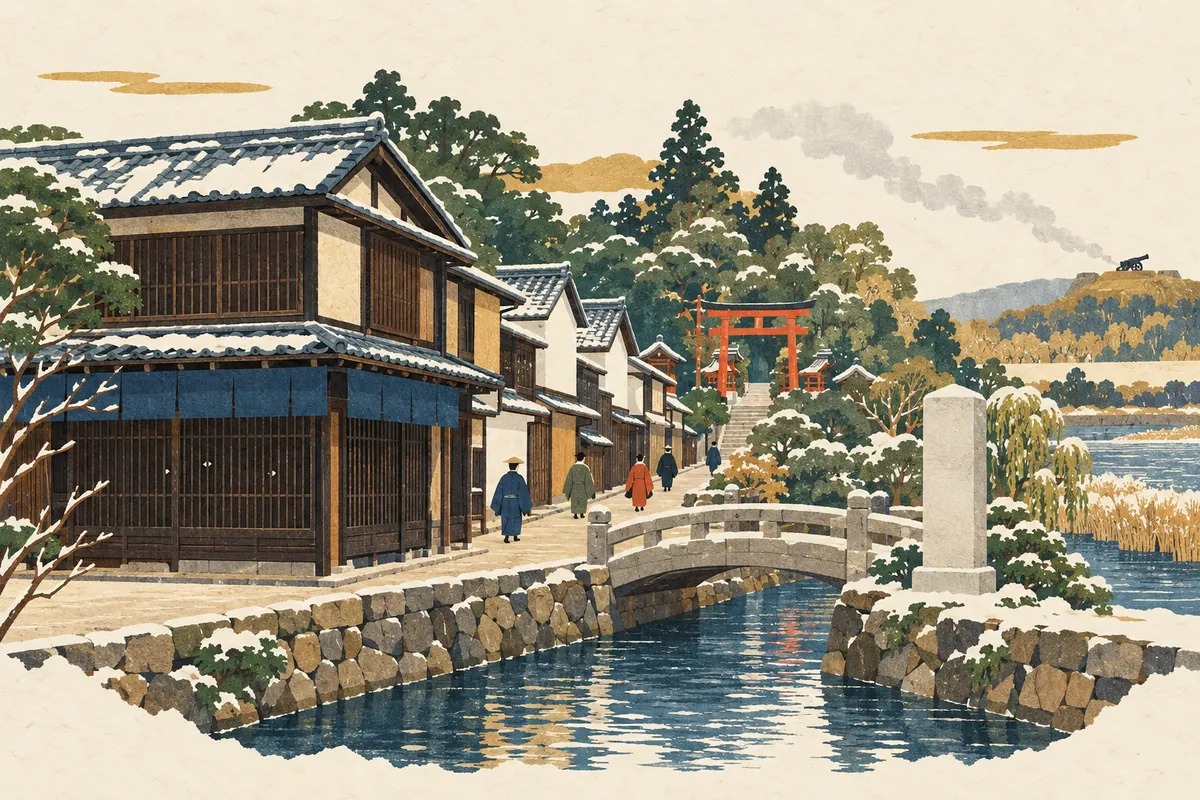
Key points
The former shogunate's army had more troops, but it was pushed back by the better-equipped government side and, with Yodo closing its gates and Tsu switching sides, was routed on the 6th
Clashes at Toba near Koeda Bridge, and at Fushimi between Gokōnomiya Shrine (Satsuma) and the Fushimi Magistrate's Office (Aizu, the Shinsengumi, and others)
In Fushimi you can walk from Keihan Chūshojima Station to Teradaya, Uosaburō, the magistrate's office site, and Gokōnomiya
Fifteen monuments to the former shogunate's war dead, erected in 1907, remain at Fushimi, Toba, and Yodo
The battle that began on the 3rd day of the first month of 1868 (Keiō 4)
After the return of political power to the emperor (Taisei Hōkan), Tokugawa Yoshinobu, who was at Osaka Castle, decided to march on Kyoto to strike at Satsuma, and on the 3rd day of the first month of 1868 (Keiō 4) the main force of the former shogunate's army split between the Toba Kaidō and Fushimi Kaidō roads and headed for Kyoto. It was met by the new government army, centered on Satsuma and Chōshū. The former shogunate's forces, about 15,000, outnumbered the new government army's roughly 4,000 to 6,000, but the better-equipped new government army pushed them back.
On the following day, the 4th, the new government army received the imperial brocade banner (nishiki no mihata) from the court and became the "imperial army" (kangun), and on the 5th fierce fighting continued at Yodo. Partly because the Yodo domain shut its castle gates and the Tsu domain changed sides, the former shogunate's army was routed on the 6th, and Yoshinobu returned to Edo by sea. The civil war that began here and lasted until the Battle of Hakodate Goryōkaku the following year is called the Boshin War.
Koeda Bridge and Jōnangū in Toba
The former shogunate's army advancing north along the Toba Kaidō (today's Senbon-dōri) faced the new government army, which had taken up positions around Takeda and Jōnangū Shrine, at Koeda Bridge over the Kamo River. After a standoff over whether they would be let through, Satsuma's cannon opened fire and the battle began. There are two theories on where the cannon stood: on the approach to Jōnangū or on "Aki no Yama," a small hill in Toba Rikyū Ato Park. According to Jōnangū's own history, the victorious Satsuma forces later visited the shrine to give thanks.
Sites of the Battle of Toba-Fushimi
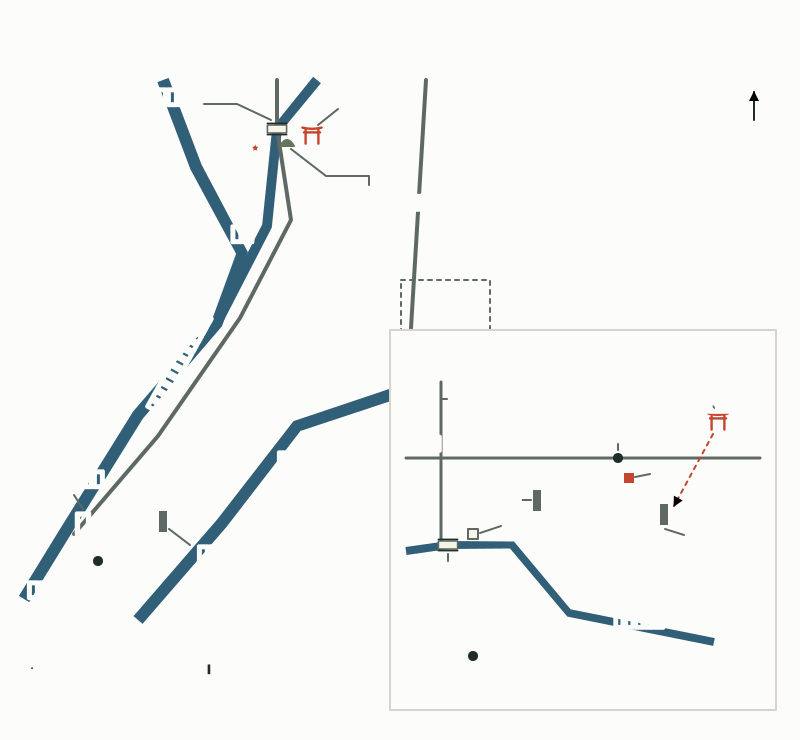
Gokōnomiya and the magistrate's office in Fushimi
In Fushimi, on the evening before, an advance force of about 200 Aizu domain troops had landed by boat at Kyōbashi and made Fushimi Midō (today's Higashi Hongan-ji Fushimi Betsuin) their quarters. About 1,500 former shogunate troops, mainly from Aizu and including the Shinsengumi and others, entered the Fushimi Magistrate's Office and other places, while about 800 Satsuma soldiers set up camp centered on Gokōnomiya Shrine, facing them. On the evening of the 3rd, prompted by the sound of cannon fire from the Toba direction, Satsuma's cannon on high ground east of Gokōnomiya fired on the magistrate's office, and the battle began in Fushimi as well.
The magistrate's office burned down, and the former shogunate's army retreated toward Yodo. Houses were set on fire during the retreat, and many homes around Kyōbashi burned. The halls of Gokōnomiya escaped the flames. At the restaurant Uosaburō on Kyōmachi-dōri, bullet marks remain in the front lattice from the fighting between former shogunate troops who sallied out from the magistrate's office and new government troops deployed along Ōtesuji. It is also said that the restaurant escaped the fire because it had served as a kitchen for the Satsuma domain.
The Shinsengumi fought at the Fushimi Magistrate's Office
After the Proclamation of the Restoration of Imperial Rule, the Shinsengumi had moved to the Fushimi Magistrate's Office. On the 18th day of the 12th month of the previous year, Kondō Isami had been shot near Sumizome on his way back from Nijō Castle and had withdrawn to Osaka, so Hijikata Toshizō led the unit in the Battle of Toba-Fushimi. The Shinsengumi fought at the magistrate's office, was defeated, and retreated toward Yodo.
Monuments to the war dead at Yodo and Senryōmatsu
The fighting moved toward Yodo, and on the 4th a cannonball crashed into the main hall of Myōkyō-ji in Nōso. Senryōmatsu, on the embankment of the Uji River, became a scene of fierce fighting, and a monument marking a burial site of the Eastern army's war dead and a memorial stand there. The memorial is inscribed as dedicated to the spirits of the samurai of Aizu and Kuwana and the members of the Shinsengumi and the Mimawarigumi.
In 1907, the Kyoto Jūshichinichi-kai, an association of people indebted to the Tokugawa family, erected 3 memorial monuments (shōkonhi) and 12 burial-site monuments for the war dead of the former shogunate (Eastern) army at Fushimi, Toba, Yodo, and elsewhere. All 15 still stand at or near their original sites.
Teradaya and the battle
Teradaya, a boat inn in Fushimi, was the scene of the Teradaya Incident of 1862 (Bunkyū 2), a melee between radicals of the Satsuma domain and fellow retainers sent to subdue them, and of the attack on Sakamoto Ryōma by officers of the Fushimi Magistrate's Office in the first month of 1866 (Keiō 2). The Teradaya building is thought to have burned in this battle, and the Teradaya of that time stood on the site just to the east, which is now a park.
Walking Fushimi from Chūshojima and the monuments at Toba and Yodo
You can walk around Fushimi from Chūshojima Station on the Keihan Main Line. As a rough guide, it takes about 5 minutes to Teradaya, about 12 minutes from there to Uosaburō, about 3 minutes on to the monument at the Fushimi Magistrate's Office site, and about 6 minutes to Gokōnomiya Shrine.
Koeda Bridge and Toba Rikyū Ato Park at Toba are about 45 minutes on foot from the western side of the town of Fushimi. Jōnangū is about 3 minutes from the park, and the "Jōnangū" city bus stop is also nearby. Most of the monuments are outdoors along roads or in parks, so even with children you can see them from outside as you go around.
Main traces of the Battle of Toba-Fushimi (as of October 2026)
| Name | What remains | Location | How to see it |
|---|---|---|---|
| Koeda Bridge and Toba Rikyū Ato Park | At the east end of Koeda Bridge, Kyoto City's stone marker "Toba-Fushimi Battlefield" (1968). On "Aki no Yama" in the park, the "Toba-Fushimi Battlefield Monument" (1912) and a monument marking where the battle began (1998) | Nakajima Akinoyama-chō and Nakajima Goshonouchi-chō, Fushimi Ward (Senbon-dōri) | Stone monuments along the road and in the park |
| Jōnangū Shrine | The approach, one of the places where the cannon is thought to have stood | 7 Nakajima Tobarikyū-chō, Fushimi Ward | Worship in the grounds |
| Gokōnomiya Shrine | A "Meiji Restoration Fushimi Battlefield" monument marking the Meiji centennial | 174 Gokōnomiya Monzen-chō, Fushimi Ward | Stone monument in the grounds |
| Fushimi Magistrate's Office site | A Kyoto City stone marker (1968) | Nishibugyō-chō, Fushimi Ward (in the Tōryō housing complex) | Stone marker in the housing complex |
| Uosaburō | A restaurant founded in 1764. Bullet marks in the front lattice | Kyōmachi 3-chōme, Fushimi Ward (1-minute walk from Keihan Fushimi-Momoyama Station) | A restaurant in business; view the lattice from the street (closed Tuesdays and some other days) |
| Aizu domain encampment site (Fushimi Midō) | Stone monument from 2009 | Ōsaka-machi, Fushimi Ward (in front of Higashi Hongan-ji Fushimi Betsuin) | Stone monument along the road |
| Site of the fierce fighting at Fushimi-guchi | Stone monument from 2009 | Minamihama-chō, Fushimi Ward (east side of the north end of Kyōbashi) | Stone monument along the road |
| Senryōmatsu monuments | A monument marking the burial site of the Eastern army's war dead (1907) and a memorial (1970) | Nōso Shimono, Fushimi Ward (next to Kyoto Racecourse) | Outdoor stone monuments |
| Myōkyō-ji | The preserved cannonball | Nōso Kitashirohori, Fushimi Ward (north of Keihan Yodo Station) | Check with the temple about visiting |
Mini quiz for this entry
On the 3rd day of the first month of 1868, the new government army clashed with the former shogunate's army at Koeda Bridge on the Toba Kaidō. Around which place had the new government army taken up its positions?
Which statement about Teradaya, the boat inn in Fushimi, is correct?
Sources and verification
Content checked: October 18, 2026
Updated: October 18, 2026
References are in Japanese.
- 京都市「いしぶみデータベース HU059 鳥羽伏見の戦勃発の地小枝橋」
- 京都市「いしぶみデータベース HU024 鳥羽伏見戦跡碑」
- 京都市「いしぶみデータベース HU025 鳥羽伏見戦跡」
- 京都市「いしぶみデータベース HU007 明治維新伏見の戦跡」
- 京都市「いしぶみデータベース HU038 伏見奉行所跡」
- 京都市「いしぶみデータベース HU028 維新戦跡」
- 京都市「いしぶみデータベース HU158 会津藩駐屯地跡」
- 京都市「いしぶみデータベース HU156 伏見口の戦い激戦地跡」
- 京都市「いしぶみデータベース HU153 近藤勇遭難の地」
- 京都市「いしぶみデータベース HU183 戊辰役東軍戦死者慰霊碑」
- 京都市「いしぶみデータベース HU032 戊辰役東軍戦死者埋骨地」
- 京都市「いしぶみデータベース HU131 淀古城址・戊辰戦争砲弾跡」
- 京都市「いしぶみデータベース HU002 戊辰役東軍戦死者碑」
- 京都市「いしぶみデータベース HU040 寺田屋」
- 京都市歴史資料館「寺田屋関係資料9種と若干のコメント(2008年10月)」
- 京都市伏見区役所「伏見区民史跡・名所めぐり」スポット一覧
- 京都市観光協会 京都観光Navi「坂本龍馬と歩く京のまち:伏見界わい」
- 京都市・京都市埋蔵文化財研究所「京都歴史散策マップ9 伏見 桃山」
- 城南宮「ご祭神と歴史」
- 御香宮神社「神社由緒」
- 魚三楼「魚三楼の伝統」
- 魚三楼「店舗情報」
- コトバンク「鳥羽伏見の戦」(「山川 日本史小辞典 改訂新版」「改訂新版 世界大百科事典」ほか)
- コトバンク「鳥羽伏見の戦い」(「日本大百科全書(ニッポニカ)」ほか)