
Japanese水無月(みなづき)
Minazuki
Other spellings and namesMinazuki wagashi / みな月 / Nagoshi no Harae sweet / Nagoshi no Harae
In short
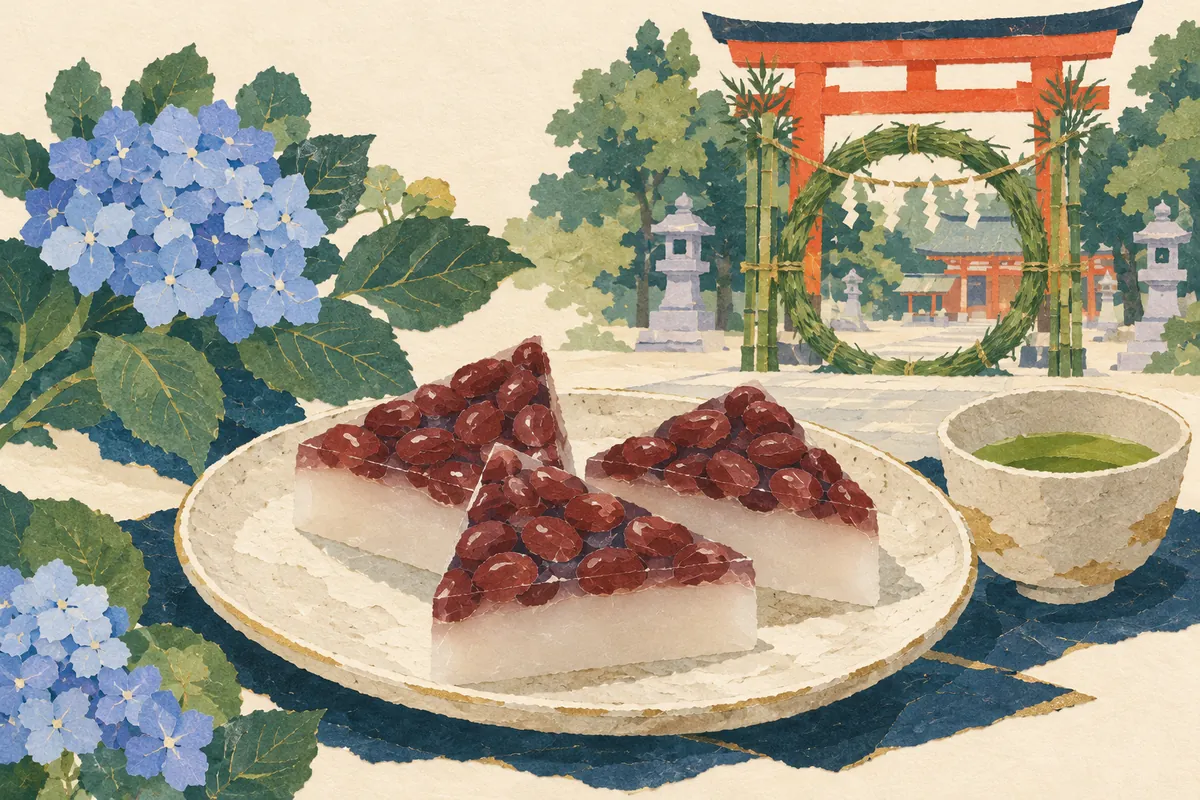
Minazuki (水無月) is a Kyoto wagashi made of white uirō (a steamed rice-flour cake) topped with azuki beans and cut into triangles. In Kyoto it is customary to eat it at the Nagoshi no Harae (summer purification) on June 30, to cleanse the impurities of the past half year and pray for good health for the rest of the year. The triangle is said to represent ice that drives away the summer heat, and the red of the azuki beans to ward off evil.Key points in 30 seconds
A wagashi of white uirō topped with azuki beans and cut into triangles
A seasonal sweet eaten at the Nagoshi no Harae on June 30
The triangle is said to mean ice, and the red of the azuki beans to ward off evil
One of Kyoto Prefecture's designated "Kyōmono Traditional Foods"
What kind of sweet is minazuki?
Minazuki is a local sweet traditionally eaten throughout Kyoto Prefecture. Its main ingredients are uirō and azuki beans, and it is sold as white uirō topped with azuki beans and cut into triangles. It is made by pouring uirō batter into a steamer, steaming it, arranging large dainagon azuki beans or amanattō (candied beans) on top, and steaming it again.
Around June, minazuki appears in wagashi shops and supermarkets, and most people buy ready-made ones to eat. In recent years, new flavors have been sold besides plain white uirō, such as matcha, brown sugar, and chestnut. Kyoto Prefecture designates minazuki as a "Kyōmono Traditional Food" and sets standards for it, such as being made entirely by hand and using hand-carved wooden molds.
Minazuki and the Nagoshi no Harae on June 30
Minazuki is eaten on June 30, the halfway point of the year. On this day in Kyoto, shrines everywhere hold the Nagoshi no Harae (なごしのはらえ), a purification that cleanses the sins and impurities of the half year from January to June, and minazuki is what people eat on this occasion to cast off sins and pray for good health.
At the Nagoshi no Harae, large rings made of chigaya (cogon grass) are set up at many temples and shrines, and people perform chinowa kuguri, passing through the ring to cleanse away the impurities of the past half year and pray for good health in the next. The chinowa ring is said to be based on the legend of Somin Shōrai (蘇民将来), who kindly gave lodging to a traveling god and in return received a grass ring to ward off epidemics.
The meaning of the triangle and the azuki beans
The triangular shape of minazuki is said to imitate ice that drives away the summer heat, and the red color of the azuki beans to carry the meaning of warding off evil. It is, in other words, a sweet of triangular uirō representing a shard of ice, topped with red azuki beans to keep evil away.
The reason given for imitating ice is a story about ice at the imperial court. In the Heian period, people at court beat the summer heat by eating ice stored in a himuro (icehouse) in what is now the Nishigamo district of Kita Ward. Ice was a luxury that ordinary people almost never had a chance to eat, and it is said that they came to eat minazuki, shaped like ice, in its place.
Since when has it had its present form? Accounts differ
Explanations of how minazuki began vary. One is that, inspired by the ice of the Heian-period court, ordinary people came to eat minazuki shaped like ice—something that "is said" to have happened.
Another explanation traces minazuki to the court custom of eating icehouse ice to beat the heat, but adds that the custom of eating a sweet in its present form—triangular uirō topped with red azuki beans—is said to date from the Meiji era or later. In this view, the story behind the custom is old, but the sweet as we know it is relatively new. This dictionary does not settle on either one and presents both explanations side by side.
Where to eat it, and visiting the Nagoshi no Harae
From the start of June, minazuki is widely sold at wagashi shops and supermarkets in Kyoto. The Nagoshi no Harae is held at many shrines in Kyoto City; in 2026 it took place at Kitano Tenmangū, Jōnan-gū, Kamigamo Shrine, Yasaka Shrine, Fushimi Inari Taisha, and elsewhere. At Manzoku Inari Shrine in 2026, a "Minazuki Festival" was also held at the same time, where visitors could compare the minazuki of different confectioners in the city.
At Kamigamo Shrine, the Nagoshi Ōharae ceremony is held at the Hashidono on the night of June 30, and hitogata (paper figures) entrusted with the sins and impurities of parishioners and worshippers are floated down the Nara no Ogawa stream as a purification. A Nagoshi market is held on the shrine grounds, and the Kyoto Prefecture tofu and fried tofu trade association serves Nagoshi tofu to visitors.
Main Nagoshi no Harae events in 2026
| Shrine | Dates and details |
|---|---|
| Kitano Tenmangū | Large chinowa ring set up at the Rōmon gate on June 25; Ōharae from 16:00 on June 30 |
| Jōnan-gū | Chinowa kuguri and hitogata floating from June 25 to 30; Nagoshi no Harae at 15:00 on June 30 |
| Kamigamo Shrine | Nagoshi rites from 10:00 on June 30; Nagoshi Ōharae ceremony from 20:00 |
| Yasaka Shrine | Ōharae ceremony from 15:00 on June 30; large chinowa ring set up on the grounds |
| Fushimi Inari Taisha | "Minazuki no Ōharae" ceremony from 15:00 on June 30; everyone passes through the chinowa ring after the ceremony |
Mini quiz for this entry
Check what you've read with 2 multiple-choice questions.
What does the triangular shape of minazuki—a wagashi eaten at the Nagoshi no Harae purification on June 30—represent?
In which present-day district was the himuro (ice house) that stored the ice eaten by people at the Heian-period court to beat the summer heat?
Sources and verification
Content checked: October 11, 2026
Updated: October 11, 2026
References are in Japanese.