
Saihō-ji (Koke-dera, the Moss Temple): Visits by Advance Application and Ōgonchi Pond
Other spellings and namesKoke-dera (苔寺) / Moss Temple / Saihō-ji (西芳寺) / Kōinzan Saihō-ji (洪隠山西芳寺) / Saihō-ji Garden
Key points
Apply online (from 2 months before to the day before) or by return postcard (postmarked between 2 months and 1 month before), up to 2 people per application
Children aged 12 and under can come along only on the "Children's Days" held a few times a year; as of October 2026, the next one is Sunday, December 13
The garden became a Historic Site and Place of Scenic Beauty in 1923 and a Special Place of Scenic Beauty in 1952. There are said to be more than 120 kinds of moss
About 3 minutes on foot from the "Kokedera Suzumushidera" Kyoto Bus stop. Suzumushi-dera (Kegon-ji) is just to the northeast
How do you reserve? Applying for the Nichinichi Sanpai
Ordinary visits are called "Nichinichi Sanpai" (日々参拝, daily worship), and you cannot go through the gate without applying. There are two ways to apply, online or by return postcard (ōfuku hagaki), and each application covers up to 2 people. If 3 or more people are going, apply with separate accounts or postcards; visits by groups of 5 or more are not accepted.
Online, you register an account, choose a date and time, and pay the worship donation (myōgaryō) by credit card. A system fee is charged in addition to the donation. Cancellation is free up to 4 days before; from 3 days before to the day before, a 50% cancellation fee applies, and on the day itself 100%; the date and time cannot be changed. With a return postcard, you cannot request a time; as a rule you are given a morning slot (around 10:00–12:00), and the reply postcard serves as your admission card on the day.
How to apply for the Nichinichi Sanpai at Saihō-ji (as of October 2026)
| Item | Online | Return postcard |
|---|---|---|
| Application period | From 2 months before the visit until 23:59 the day before | Postmarked between 2 months and 1 month before the desired date |
| Worship donation | 4,000 yen or more, by credit card when applying | 4,000 yen or more, in cash at the reception on the day |
| Number of people | Up to 2 per application | Up to 2 per application |
| Age | 13 or older on the day of the visit | 13 or older on the day of the visit |
| Time | Choose the date and time when applying | As a rule, morning (around 10:00–12:00) |
Can children go? Age 13 and up, and the "Children's Day"
The Nichinichi Sanpai is limited to people aged 13 or older on the day of the visit, and children aged 12 and under, including infants, cannot come along. The only time you can bring children is the "Children's Day" (Okosama no Hi) held a few times a year. As of October 2026, the next one is Sunday, December 13: visitors gather at 11:40, the gate opens at 11:45, and it closes at 13:15 (about 60 minutes).
On Children's Day, too, visitors copy a sutra in the main hall before going out into the garden. For each adult aged 13 or older who applies, the worship donation is waived for one child aged 12 or under, and children are given sutra-copying paper and a postcard. If you like, the temple will mail the postcard you write in the grounds. Applying requires registering an account, and applications are accepted from 2 months before to the day before. There are steps and gravel paths in the grounds, and visits in a wheelchair are not possible.
On the day: sutra copying in the main hall, then the garden
The visit begins with sutra copying in the main hall, the Sairaidō (西来堂), followed by viewing the garden (about 60 minutes in all). The sutra you copy is the Enmei Jikku Kannon-gyō (延命十句観音経), a short sutra of 49 characters that takes about 15 minutes. It has been used since 2019; before that it was the Heart Sutra (Hannya Shingyō). You can take your finished copy home or offer it to the principal image. Viewing the garden alone is not accepted.
You may take photos in the garden, but tripods and selfie sticks cannot be used, and photography inside the buildings is not allowed. Eating is not allowed in the grounds, and the only things you may bring in are drinks with lids.
The dry landscape of the upper tier is normally closed and cannot be entered on the Nichinichi Sanpai. It is shown on some "Oriori Sanpai" (折々参拝, occasional worship) visits with limited dates and numbers; as of October 2026, the remaining session of "Japan's Oldest Dry Landscape Garden with a Temple Staff Member" (10 people, worship donation of 8,000 yen or more, ages 13 and up) is on Saturday, December 12.
The two-tier garden and Ōgonchi Pond
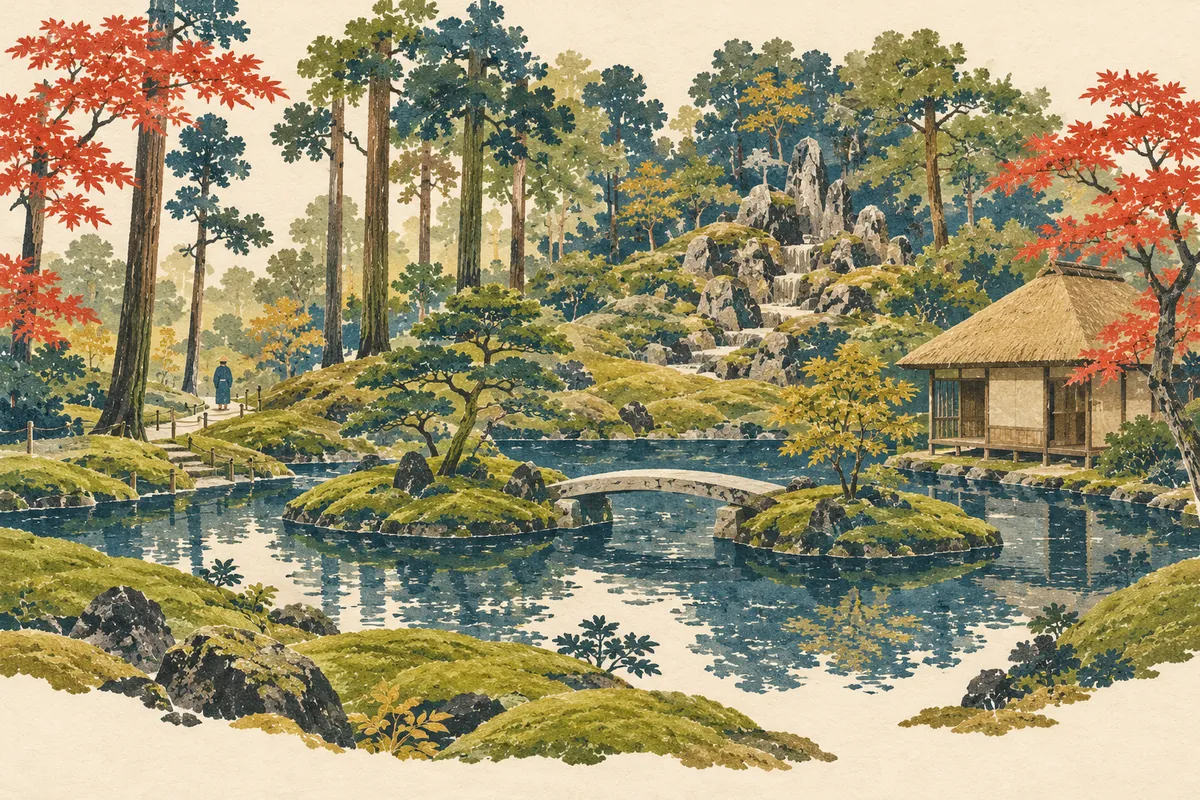
The garden is divided into an upper and a lower tier. The lower tier is a pond stroll garden centered on Ōgonchi Pond (黄金池), said to be shaped like the character 心 (kokoro, heart), and two large islands, Asahi-ga-shima and Yūhi-ga-shima, float in the pond. The upper tier is a dry landscape of stones arranged on the slope of Kōinzan (洪隠山); it consists of a waterfall arrangement in three levels, upper, middle, and lower, and is said to be the oldest dry landscape stone arrangement in Japan, built by Musō Soseki (夢窓疎石) in 1339.
The moss covering the whole garden is said to include more than 120 kinds, and it is said to have taken more than 100 years, including periods of neglect, for the garden to become mossy. Under the name "Saihō-ji Garden," it was designated a national Historic Site and Place of Scenic Beauty on March 7, 1923 (Taishō 12), and became a Special Place of Scenic Beauty on March 29, 1952 (Shōwa 27). The tea room Shōnan-tei (湘南亭) in the grounds is a Momoyama-period building and was designated an Important Cultural Property in 1907 (Meiji 40). Saihō-ji is also one of the 17 component sites of the "Historic Monuments of Ancient Kyoto," inscribed as a World Heritage Site in 1994 (Heisei 6).
From Gyōki's founding to Musō Soseki's revival
Saihō-ji is said to have been founded by Gyōki in 731 (Tenpyō 3), and at first it was a temple of the Hossō school written 西方寺. At the beginning of the Kamakura period it welcomed Hōnen and became a Jōdo-shū (Pure Land) temple, and in 1339 (Ryakuō 2; Engen 4 in the era names of the Southern Court), Musō Soseki is said to have revived it as a Zen temple at the invitation of Fujiwara no Chikahide, chief priest of Matsuo Taisha. The temple's name was changed to 西芳寺, with the same pronunciation, and it became a Rinzai temple.
Ashikaga Yoshimitsu and Yoshimasa also practiced zazen here, and it is said to have become the model for the gardens of Kinkaku and Ginkaku. The buildings burned in the Ōnin–Bunmei War, and in the Edo period the temple was repeatedly hit by floods of the Saihōji River. The garden was opened to the general public in 1928 (Shōwa 3), but to avoid traffic problems caused by cars and damage to the moss, the temple switched to the present advance-application system in 1977 (Shōwa 52). It will mark the 1,300th anniversary of its founding in 2031.
Where can you see it now? / Getting there
Saihō-ji is at 56 Matsuo Jingatani-chō, Nishikyō Ward. You cannot enter the garden without applying, and there is no area you can see for free. There is no parking lot either, so go by public transportation.
- Kyoto Bus: from Kyoto Station, take route 73 for about 60 minutes to "Kokedera Suzumushidera," then walk about 3 minutes
- City bus: about 10 minutes on foot from "Suzumushidera Kokedera-michi"
- Train: about 15 minutes on foot from Kamikatsura Station on the Hankyu Arashiyama Line
- Taxi: you cannot get in or out in front of the gate; use the "Saihō-ji pick-up and drop-off point" about 100 m before it
- Nearby temples and shrines: Suzumushi-dera (Kegon-ji) is just northeast of Saihō-ji, and Matsuo Taisha is about 1 km to the north
Mini quiz for this entry
Ōgonchi Pond, at the center of the lower garden of Saihō-ji, is said to be shaped like a certain kanji character. Which one?
The sutra copied on a visit to Saihō-ji was changed to a short sutra in 2019. Which sutra is copied now?
Sources and verification
Content checked: October 29, 2026
Updated: October 29, 2026
References are in Japanese.
- 西芳寺「西芳寺|苔寺」(参拝について・主要アクセス方法)
- 西芳寺「『往復はがき』による参拝申込のご案内」
- 一般社団法人西芳会「日々参拝」
- 一般社団法人西芳会「日々参拝 オンライン(本サイト)による参拝申込のご案内」
- 一般社団法人西芳会「お子さまの日」
- 一般社団法人西芳会「寺務員とめぐる日本最古の枯山水」
- 一般社団法人西芳会「よくあるご質問」
- 一般社団法人西芳会「写経で心をととのえる」
- 一般社団法人西芳会「見所とその由緒を知る」
- 一般社団法人西芳会「波乱と悠久の歴史」
- 文化庁「国指定文化財等データベース 西芳寺庭園」
- 文化庁「国指定文化財等データベース 西芳寺湘南亭(本家)」
- 文化庁「国指定文化財等データベース 古都京都の文化財」(世界遺産)
- 文化庁「世界遺産一覧」