
Japanese八幡(やわた)
Yawata
Other spellings and namesYawata City / 八幡市
Key points
The city is Yawata-shi (やわたし); the shrine and the Keihan station are Iwashimizu Hachimangū (いわしみずはちまんぐう)
The place name was once written Yahata, and a 1292 (Shōō 5) document shows the form やワた (yawata)
The Keihan station opened as Yawata Station, became Yawatashi Station in 1977, and Iwashimizu-hachimangū Station on October 1, 2019
Of the towns named 八幡町 in Kyoto City, the one in Kamigyō Ward is Yahata-chō, and those in Shimogyō and Fushimi wards are Yawata-chō
Yawata for the city, Hachiman for the shrine
八幡市 is read Yawata-shi (やわたし). It is a city in Kyoto Prefecture midway between Kyoto and Osaka, and on November 1, 1977 (Shōwa 52), it gained city status, becoming the 11th city in the prefecture.
Many town names in the city's addresses begin with 八幡, and here too it is read Yawata, as in 八幡高坊 (Yawata-Takabō, やわたたかぼう) and 八幡女郎花 (Yawata-Ominaeshi, やわたおみなえし). Iwashimizu Hachimangū's address is also Yawata-Takabō, Yawata City.
Iwashimizu Hachimangū itself, on the other hand, is read いわしみずはちまんぐう. The same characters 八幡 are read Yawata in the place name and Hachiman in the shrine's name, and locally the shrine is called Yawata no Hachiman-san ("the Hachiman of Yawata").
Why Yawata? The old reading was Yahata
Iwashimizu Hachimangū is said to have begun in 859 (Jōgan 1), when Gyōkyō, a monk of Daian-ji in Nara, brought the deity of Usa Hachimangū in Buzen Province to Mount Otokoyama (some accounts date the enshrinement on Otokoyama to 860, Jōgan 2). When Iwashimizu Hachimangū-ji took shape in the early Heian period, a shrine town grew up around it.
The place name 八幡 is said to come from "Hirohata no Yahata no Ōkami," a title of Emperor Ōjin, who is regarded as the enshrined deity. In the past it was read Yahata; a document of 1292 (Shōō 5) writes it やワた, and in a letter of 1589 (Tenshō 17) it was already the same Yawata (やわた) as today.
The Otokoyama Kōkoroku records that the local people still call the land Yahata as in the old days, and also notes a theory that calling it Hachiman, the Sino-Japanese reading of the characters, began with Hachiman Tarō Yoshiie. The enshrined Hachiman deity, too, has the readings Yahata no kami and Yawata no kami besides Hachimanjin.
The Keihan station name: from Yawata to Iwashimizu-hachimangū
The Keihan Main Line station opened on April 15, 1910, as Yawata Station, and after the names Iwashimizu-hachimangū-mae and Yawatachō, it became Yawatashi Station when the city was formed in 1977 (Shōwa 52).
On October 1, 2019, it was renamed Iwashimizu-hachimangū Station (いわしみずはちまんぐう). The renaming was meant to show that it is the nearest station to Iwashimizu Hachimangū, a National Treasure, and to promote tourist attractions in the area. On the same day, the cable car's popular name changed from Otokoyama Cable to Iwashimizu-hachimangū Sandō Cable; its lower station, Yawatashi, became Cable Hachimangū-guchi (はちまんぐうぐち), and the summit station, Otokoyama Sanjō, became Cable Hachimangū Sanjō (はちまんぐうさんじょう). With this, the name Yawatashi disappeared from Keihan station names.
How the Keihan Main Line station name changed
| When | Station name |
|---|---|
| April 15, 1910 (opening) | 八幡 (Yawata) |
| Later | 石清水八幡宮前 (Iwashimizu-hachimangū-mae), 八幡町 (Yawatachō) |
| 1977 (when the city was formed) | 八幡市 (やわたし, Yawatashi) |
| From October 1, 2019 | 石清水八幡宮 (いわしみずはちまんぐう, Iwashimizu-hachimangū) |
Iwashimizu Hachimangū's National Treasure main shrine, and how to get there
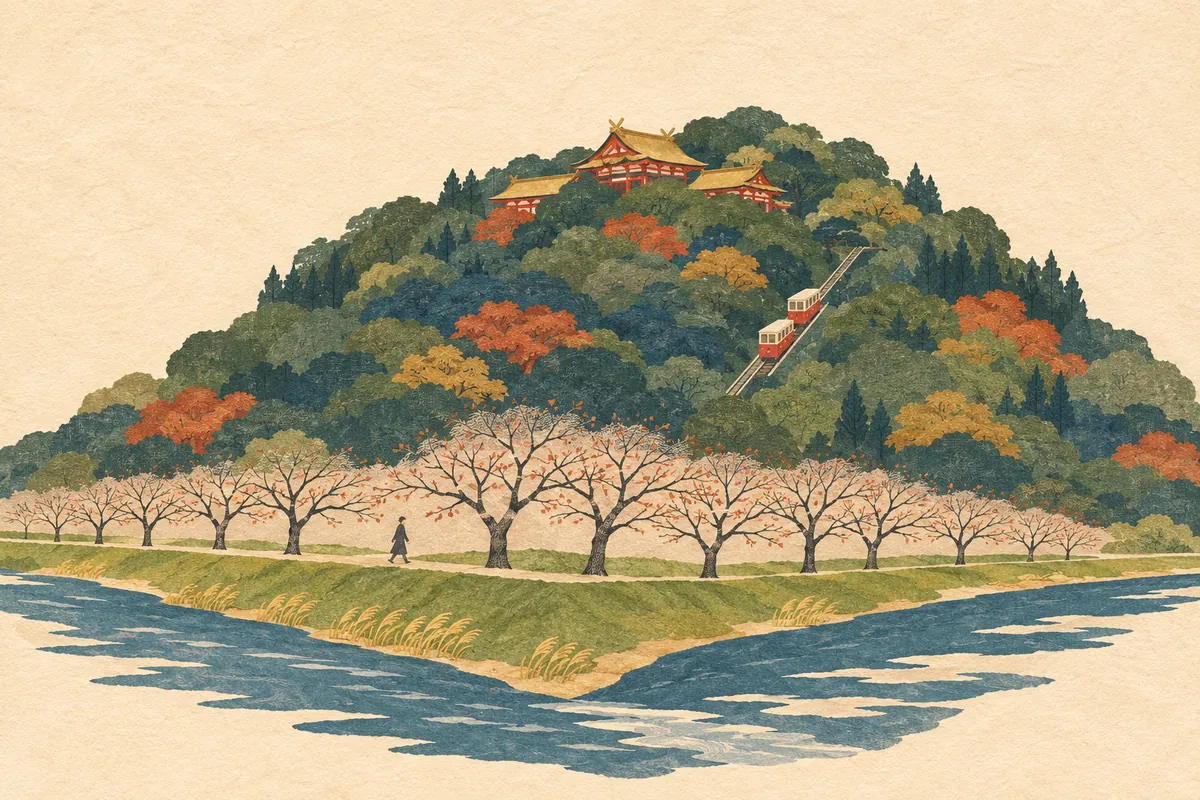
Iwashimizu Hachimangū stands on the summit of Mount Otokoyama, and on February 9, 2016 (Heisei 28), its 10 main shrine buildings, together with 3 attached munafuda (ridge tags), were designated a National Treasure. The main hall is said to be the oldest and largest surviving main hall in the Hachiman-zukuri style.
At Iwashimizu-hachimangū Station on the Keihan Main Line, change to the Sandō Cable; from Cable Hachimangū Sanjō Station it is about a 5-minute walk. The gates are open from 6 a.m. to 6 p.m., with different hours during the New Year period (as of November 2026).
In Kyoto City, each 八幡 town has its own reading
Town names in Kyoto City that contain 八幡 also differ in reading from town to town (readings of town names as of Reiwa 6–7, 2024–2025).
- 八幡町 (Kamigyō Ward): やはたちょう (Yahata-chō)
- 八幡町 (Shimogyō Ward), 八幡町 (Fushimi Ward): やわたちょう (Yawata-chō)
- 西七条八幡町 (Shimogyō Ward): にししちじょうやわたちょう (Nishi-Shichijō-Yawata-chō)
- 御所八幡町 (Kamigyō and Nakagyō wards): ごしょはちまんちょう (Gosho-Hachiman-chō)
- 真弓八幡町 (Kita Ward): まゆみはちまんちょう (Mayumi-Hachiman-chō)
Mini quiz for this entry
Which town name in Kyoto City reads 八幡 as Yahata?
Sources and verification
Content checked: November 8, 2026
Updated: November 8, 2026
References are in Japanese.
- 八幡市「国宝:石清水八幡宮(いわしみずはちまんぐう)」
- 八幡市「八幡市のあらまし」
- 八幡市「八幡市のあゆみ」
- 八幡市「想い出写真館(2)石清水八幡宮駅(旧:八幡市駅)」
- 八幡市「STORY 02 解説編」
- 日本郵便 郵便番号検索「京都府八幡市」
- 京阪電気鉄道・京阪ホールディングス「「八幡市」→「石清水八幡宮」「深草」→「龍谷大前深草」2019年10月1日(火)より京阪線2駅の駅名を変更します」
- 京阪電気鉄道・京阪ホールディングス「鋼索線の車両デザインを一新します~通称は「石清水八幡宮参道ケーブル」に変更~」
- 石清水八幡宮「石清水八幡宮について」
- 石清水八幡宮「アクセス」
- コトバンク(日本歴史地名大系ほか)「八幡市」
- コトバンク(デジタル大辞泉ほか)「八幡神」
- 京都市教育委員会「京都市通学区町名一覧」(各区の町名と読み仮名)