
Aburimochi
Other spellings and names炙り餅 / Aburi mochi / Imamiya Shrine aburimochi
Key points
Two shops on the approach in front of Imamiya Shrine's east gate: Ichiwa on the north side, Kazariya on the south
Ichiwa is said to have been founded in 1000 (Chōhō 2)
Ichiwa's building was the first certified under Kyoto City's "Buildings and Gardens That Color Kyoto" program
Both open 10:00–17:00; closed Wednesdays (the next day if Wednesday is the 1st, the 15th, or a holiday; as of November 2026)
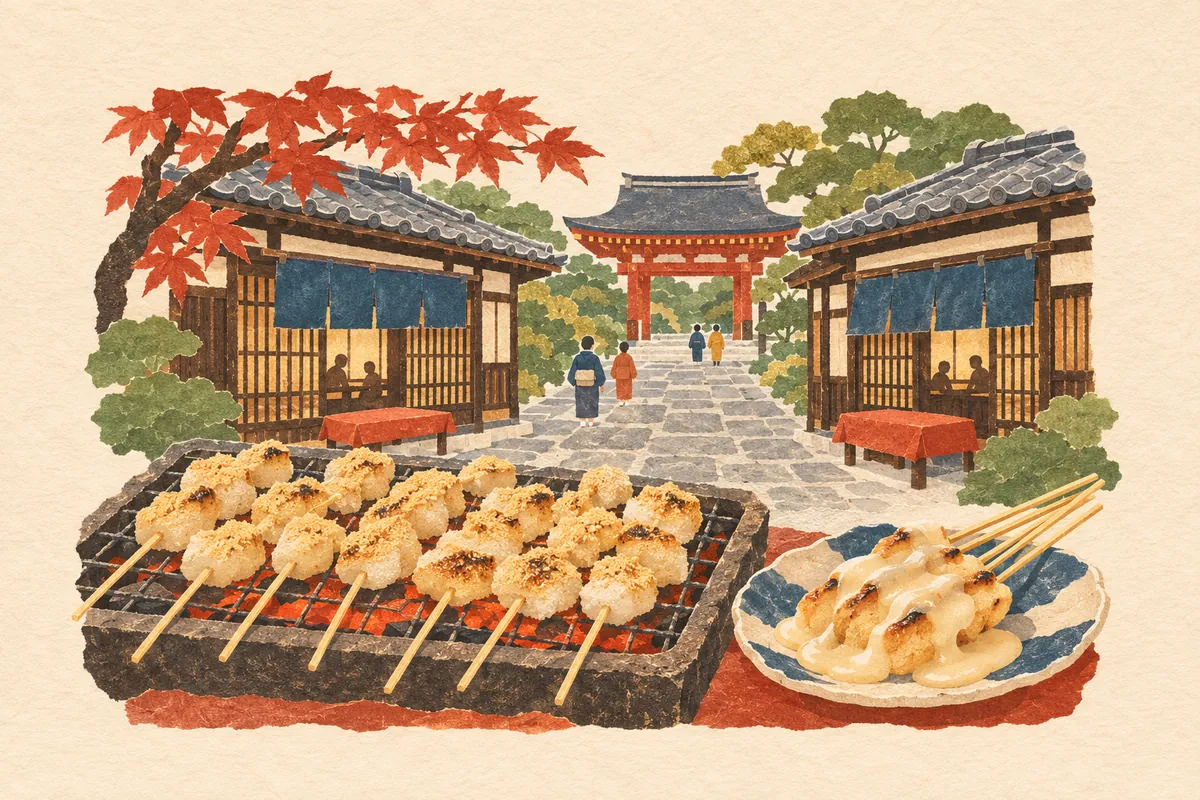
Small mochi grilled on bamboo skewers
Aburimochi is a mochi sweet made by skewering small pieces of mochi on thin bamboo sticks, grilling them over charcoal, and eating them dipped in white miso sauce. How the glutinous rice is cooked, how the skewers are made, how the mochi is grilled, and the flavor of the white miso sauce are handed down at each shop in its own way.
Igushi, sacred bamboo sticks offered to the shrine, are said to have been used as the skewers. Because aburimochi is made from mochi offered to the plague deities and skewers of offered bamboo, it is said to have spread among worshippers as something that brings blessings.
Imamiya Shrine and the faith of calming plague deities
Imamiya Shrine (Murasakino Imamiya-chō, Kita Ward) stands on a site where, tradition holds, a shrine to plague deities (ekijin) existed even before Heian-kyō was built. In 994 (Shōryaku 5), to calm an epidemic spreading through the capital, the plague deities were moved to Mount Funaoka and the Murasakino Goryōe (a rite to appease angry spirits) was held; in 1001 (Chōhō 3), a sanctuary was set up at the present site and the Goryōe was held again. The name "Imamiya" ("new shrine") comes from this new shrine.
Aburimochi is said to have possibly begun with the mochi offered before the deities at this Goryōe. West of the main shrine is the Ekijinja, an auxiliary shrine (sessha) where plague deities are said to have been enshrined since before the main shrine.
The Yasurai Matsuri, held on the second Sunday of April each year around cherry blossom time, is also a festival to calm plague deities. It prays for the calming of epidemics and for peace, and it is designated a national Important Intangible Folk Cultural Property as "Yasurai-bana." Aburimochi, too, is said to have been handed down in connection with the shrine's faith in calming plague deities.
The two shops in front of the east gate: Ichiwa and Kazariya
On the stone-paved approach outside Imamiya Shrine's east gate, Ichiwa (Ichimonjiya Wasuke, いちもんじやわすけ) on the north side and Kazariya on the south side face each other. Both sell only aburimochi.
Ichiwa is a teahouse said to have been founded in 1000 (Chōhō 2). The oldest parts of the building are said to be about 400 years old, and the east wing, the middle shop, and the west wing line the street. When the ground-floor wooden doors are thrown open, the shop front opens wide onto the street, and the second floor has a row of windows with railings, a look typical of a teahouse before a shrine gate. It was the first building certified under Kyoto City's "Buildings and Gardens That Color Kyoto" (Kyōto o Irodoru Tatemono ya Teien) program and is also designated a Landscape Important Building.
In December 2020, Guinness World Records recognized Ichiwa as the oldest confectionery shop still in business. This record also gives its founding as around the year 1000.
Aburimochi shops in front of the east gate (as of November 2026)
| Shop | Position on the approach | Address | Hours | Closed |
|---|---|---|---|---|
| Ichiwa (Ichimonjiya Wasuke) | North side | 69 Murasakino Imamiya-chō, Kita Ward | 10:00–17:00 | Wednesdays (the next day if Wednesday falls on the 1st, the 15th, or a holiday), year-end |
| Kazariya | South side | 96 Murasakino Imamiya-chō, Kita Ward | 10:00–17:00 | Wednesdays (the next day if Wednesday falls on the 1st, the 15th, or a holiday), year-end |
Getting there
Imamiya Shrine is right by the "Imamiya Jinja-mae" city bus stop, and about a 7-minute walk from the "Funaokayama" city bus stop. The two shops are right in front of the east gate, about a 1-minute walk from "Imamiya Jinja-mae."
The grounds are open for worship at any time, and the shrine office is open 9:00–17:00 (as of November 2026). Across Imamiya-dōri to the south lie the grounds of Daitoku-ji, which you can walk around together with its sub-temples (tatchū).
Mini quiz for this entry
Aburimochi is sold in front of the east gate of Imamiya Shrine. What is the sauce for the charcoal-grilled mochi based on?
The origins of Imamiya Shrine are said to be connected with the beginnings of aburimochi. What rite was held in 994 (Shōryaku 5) to calm an epidemic?
Ichiwa (Ichimonjiya Wasuke) sells aburimochi in front of Imamiya Shrine's east gate. About how old are the oldest parts of its building said to be?
Sources and verification
Content checked: November 8, 2026
Updated: November 8, 2026
References are in Japanese.