
Yatsuhashi
Other spellings and names八つ橋 / 八ッ橋 / Nama yatsuhashi (生八ツ橋) / 生八つ橋
Key points
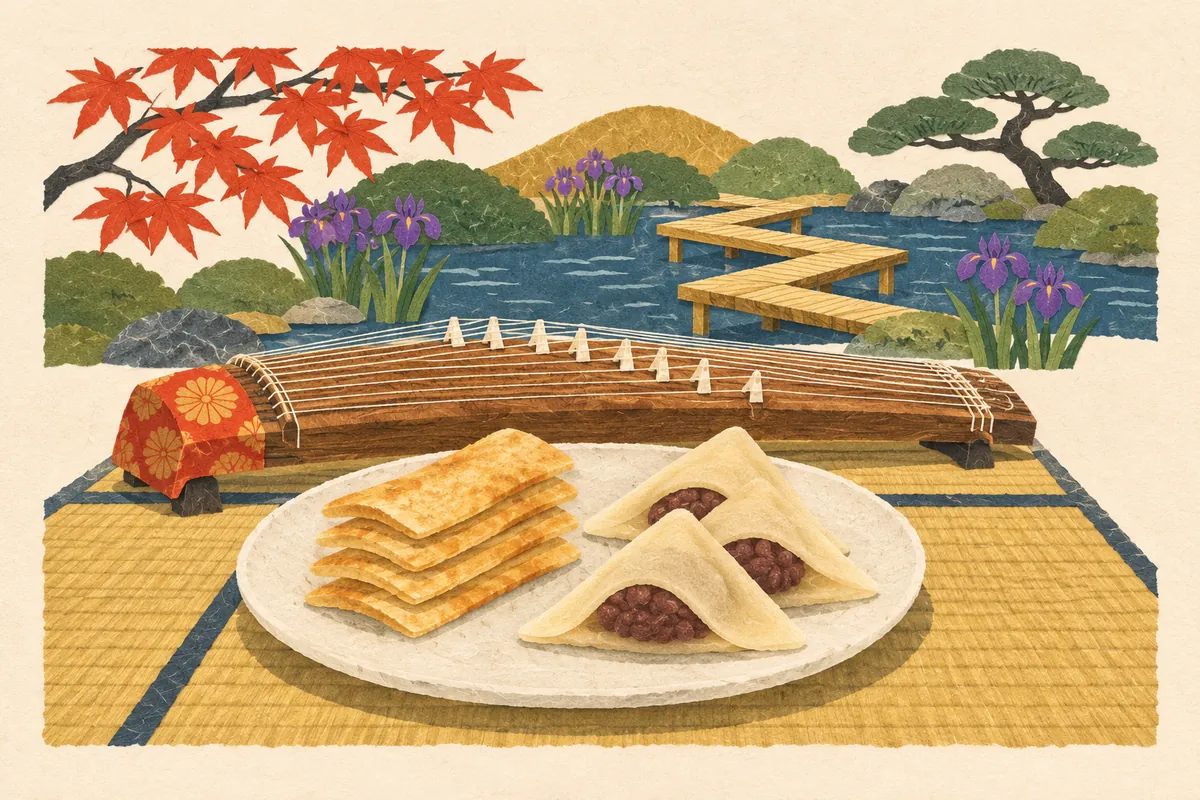
Made of rice flour, sugar, and nikki (cinnamon); baked strips with a curve
Nama yatsuhashi, eaten unbaked, is said to have spread after World War II
Yatsuhashi Kengyō's grave is at Jōkō-in, within Konkai Kōmyō-ji in Kurodani
Ranked second among recommended wagashi in residents' opinions collected by Kyoto City in 2013
Baked yatsuhashi and nama yatsuhashi
Yatsuhashi is a kind of hard-baked senbei. A dough of rice flour with sugar and nikki (cinnamon) added is steamed, rolled thin, cut into strips, and baked on an iron plate. During baking, each strip is pressed against a round rod to give it a curve meant to resemble a koto (Japanese zither), so it ends up bowed like an arch. Because it contains little moisture, it is classed as higashi (dry confectionery).
Nama yatsuhashi is a soft sweet made by cutting the yatsuhashi dough without baking it. It is said to have spread after World War II, and some accounts say it was created in the 1960s. Nama yatsuhashi wrapped around anko (sweet bean paste) and many other flavors have been made, and one shop says it has sold nama yatsuhashi filled with tsubuan (chunky bean paste) since 1947 (Shōwa 22). In residents' opinions on "recommended obanzai and wagashi" collected by Kyoto City in 2013, the top wagashi were minazuki in first place, yatsuhashi in second, and hanabira-mochi in third.
Baked yatsuhashi and nama yatsuhashi
| Point of comparison | Baked yatsuhashi (hard-baked) | Nama yatsuhashi |
|---|---|---|
| Dough | Rice flour, sugar, and nikki, steamed and kneaded | The same dough, used without baking |
| Shape | Cut into strips, baked, and curved | Rolled thin and cut; some are wrapped around anko |
| Category | Higashi (dry confectionery) | Namagashi (moist confectionery) |
| Origins | Said to date from the Edo period (the year differs from shop to shop) | After World War II (some accounts say the 1960s) |
Where the name comes from: Yatsuhashi Kengyō and the Yatsuhashi of Mikawa
There are two theories about the origin of the name Yatsuhashi (literally "eight bridges"), and neither has been settled.
- That a hard-baked senbei finished in the shape of a koto was named "Yatsuhashi" in memory of Yatsuhashi Kengyō (八橋検校), known as the founder of sōkyoku (koto music)
- That its shape resembles the plank bridges of Yatsuhashi in Mikawa Province (now Chiryū City, Aichi Prefecture), which appear in the "Azuma kudari" (journey to the east) episode of The Tales of Ise
Yatsuhashi Kengyō and Kurodani
Yatsuhashi Kengyō (kengyō is a title of rank) was a koto musician said to have been born in 1614 (Keichō 19). He composed works such as "Rokudan no Shirabe," trained many students in Kyoto, and died in 1685 (Jōkyō 2). His grave is at Jōkō-in, within Konkai Kōmyō-ji (known as Kurodani-san) in Sakyō Ward. A story is told that the Kengyō, who always took care to be thrifty, gathered rice that would otherwise have been washed away, ground it into flour, and made hard-baked senbei.
On the anniversary of his death, June 12, the yatsuhashi shops each hold a memorial service for the Kengyō.
Why head shops are in Shōgoin
Two of the long-established yatsuhashi makers have their head shops near Kyoto Kumano Shrine in Shōgoin, Sakyō Ward. This area lies on the approach to Konkai Kōmyō-ji in Kurodani, and the traditions of the shops headquartered in Shōgoin also begin with teahouses here.
One shop says that in 1689 (Genroku 2), four years after the Kengyō died, a teahouse in the Shōgoin woods, on the Kurodani approach where people kept coming to visit his grave, started selling a koto-shaped dry sweet under the name "Yatsuhashi." Another says it began as a teahouse in front of Kumano Shrine in the Shōgoin woods that served white rice-flour mochi to travelers, that a bridge-shaped senbei was born in Genroku 2, and that the recipe was handed down by a monk of a temple in Yatsuhashi Village in Mikawa Province. Yet another shop gives its founding as 1805 (Bunka 2), saying it began with a hard-baked senbei the Kengyō taught at a teahouse in Gion.
Yatsuhashi became known throughout Japan after it began to be sold at Kyoto Station in the Meiji era. Today it is sold not only at the head shops in Shōgoin but also at Kyoto Station, department stores, and shops in tourist areas such as Kiyomizu and Gion.
A lawsuit over founding years
Yatsuhashi makers have gone to court over their founding years and accounts of their origins. In 2018, Izutsu Yatsuhashi Honpo sued Shōgoin Yatsuhashi Sōhonten in the Kyoto District Court, claiming that labels such as "Founded in Genroku 2" on its noren (shop curtains) and packaging were misleading representations of quality under the Unfair Competition Prevention Act, and seeking an injunction against the labels and damages.
The Kyoto District Court dismissed the claim on June 10, 2020, and the Osaka High Court dismissed the appeal on March 11, 2021. The rulings held that founding years and origins from more than 300 years ago are a kind of tradition that cannot be confirmed in official records, and that buyers also take them that way, so the labels do not mislead about quality. The rulings did not decide which shop's account of the origins is correct.
Mini quiz for this entry
The "Yatsuhashi" of The Tales of Ise is one of the suggested origins of the name yatsuhashi. Where was this Yatsuhashi?
Sources and verification
Content checked: November 8, 2026
Updated: November 8, 2026
References are in Japanese.
- 農林水産省「にっぽん伝統食図鑑 米菓子・豆菓子(京都府)」
- 京都市文化市民局文化財保護課「京の菓子文化 菓子のある風景」
- 京都市文化財保護課「『京の食文化』には何があるの?」
- コトバンク「八つ橋」(小学館『日本大百科全書(ニッポニカ)』・『デジタル大辞泉』ほか)
- コトバンク「八橋」(『精選版 日本国語大辞典』・小学館『デジタル大辞泉』)
- 聖護院八ッ橋総本店「聖護院八ッ橋について」
- 聖護院八ッ橋総本店「八橋検校と八橋忌」
- 聖護院八ッ橋総本店「店舗紹介」
- 本家西尾八ッ橋「会社概要」
- 本家西尾八ッ橋「本店」
- 本家西尾八ッ橋「歴史」
- 井筒八ッ橋本舗「井筒八ッ橋の歴史」
- 慶應義塾大学法学研究会「法学研究」94巻11号 判例研究(大阪高判令和3年3月11日 八ッ橋の創業年表示事件)
- 北海道大学「知的財産法政策学研究」62号 田村善之・張唯瑜「京銘菓八ッ橋の創業年や来歴に関する表示について不正競争防止法上の品質誤認表示該当性を否定した判決―八ッ橋事件―」
- 東洋経済オンライン「『八ッ橋』訴訟、なぜ業界各社は沈黙するのか 井筒vs.聖護院」(2018年7月7日)