
The Relocation of Honnō-ji and Its Original Site
Other spellings and namesHon'ō-ji
Key points
The Honnō-ji Incident of 1582 did not take place at today's Honnō-ji at Teramachi Oike
Both markers at the old site stand south of Takoyakushi-dōri, while the temple grounds lay to its north
The move to the present site was ordered by Toyotomi Hideyoshi
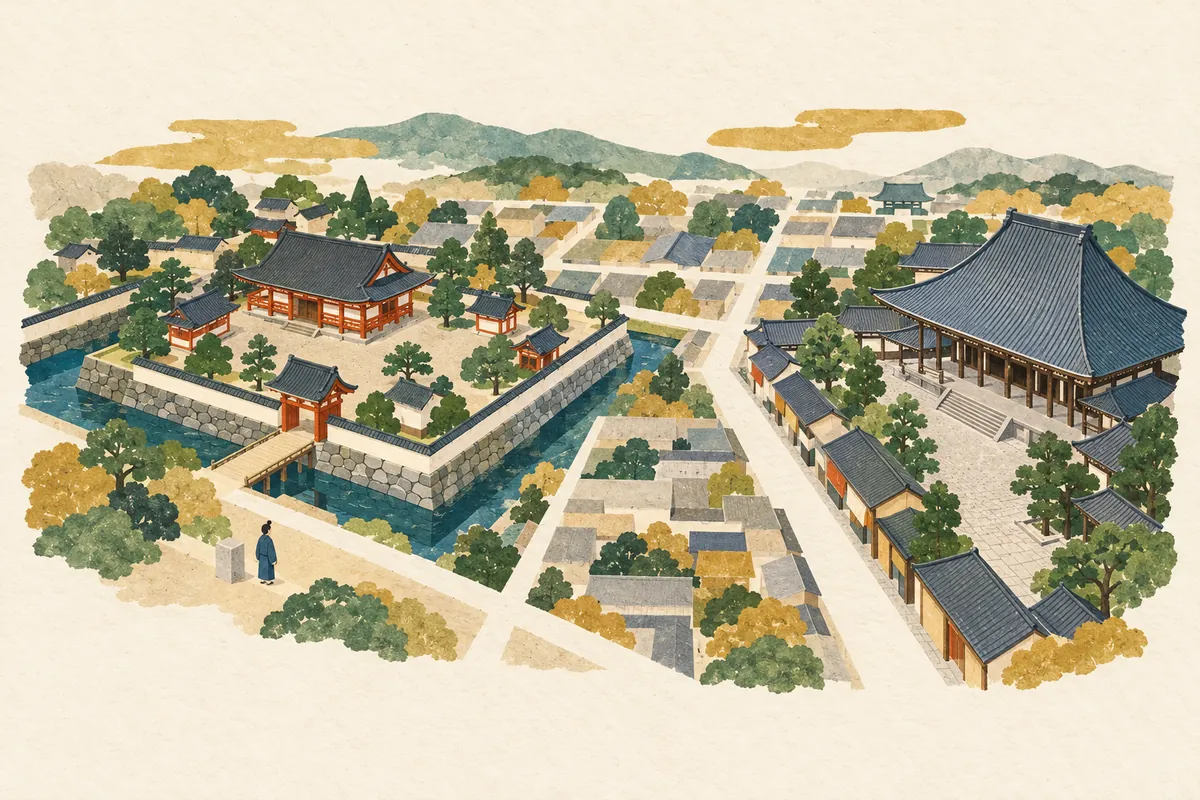
The 2007 excavation showed a temple enclosed by moats and stone walls, much like a castle
Where Honnō-ji stood in 1582
Today's Honnō-ji stands just south of the corner of Teramachi-dōri and Oike-dōri, across from Kyoto City Hall. But the "Honnō-ji Incident," in which Akechi Mitsuhide attacked Oda Nobunaga while he was staying at the temple early on the morning of June 2, 1582 (Tenshō 10), and Nobunaga took his own life, did not happen here.
The Honnō-ji of that time stood in the block bounded by Rokkaku-kōji (today's Rokkaku-dōri) to the north, Shijō Bōmon-kōji (today's Takoyakushi-dōri) to the south, Nishinotōin-ōji (Nishinotōin-dōri) to the east, and Aburanokōji (Aburanokōji-dōri) to the west. On the map it is a little over a kilometer west of the present temple, slightly east of Horikawa-dōri.
The Old and Present Sites of Honnō-ji
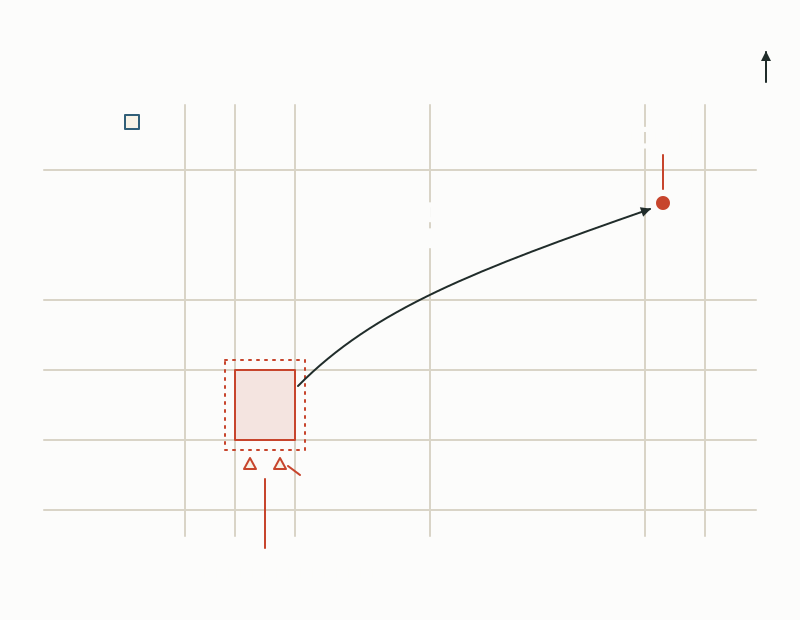
The temple's moves before the Incident
Honnō-ji is the head temple of the Honmon branch of the Hokke (Nichiren) school. According to the temple's tradition, it began in 1415 (Ōei 22), when Nichiryū founded a temple between Aburanokōji Takatsuji and Gojō Bōmon (today's Bukkōji-dōri) and named it Hon'ō-ji (本応寺). The temple was destroyed in 1418 (Ōei 25) and rebuilt in 1429 (Eikyō 1) with the support of Kosodeya Sōku at Uchino (around today's Nishijin).
In 1433 (Eikyō 5) it obtained a large plot at Rokkaku Ōmiya (also called Shijō Bōmon Ōmiya) and moved there, taking the name Honnō-ji at this time. It burned down in the Tenbun Hokke Disturbance of 1536 (Tenbun 5) and moved to Sakai, and around 1545 (Tenbun 14) Nisshō, who was born into the Fushimi-no-miya princely family, rebuilt it at Shijō Nishinotōin, that is, in the block that would become the stage of the "Honnō-ji Incident."
By the temple's custom, the character 能 (nō) in its name is written with the two ヒ on the right side replaced by 去; this is said to be because the temple suffered fire so often that it disliked having two ヒ (which also means "fire") side by side.
The present site, assigned by Hideyoshi
After burning in the Honnō-ji Incident, the temple tried to rebuild on the same site, but by order of Toyotomi Hideyoshi it was moved to today's Teramachi Oike, then called Kamogawa Village, as part of his remodeling of the city, which gathered the temples of the city into Teramachi. The stone marker at the old site records that the order to move came on the very day of the ridgepole-raising ceremony in 1589 (Tenshō 17), and that the monks wept aloud. The move is dated variously to 1589, 1591 (Tenshō 19), or 1592 (Tenshō 20).
The fires continued after the move. The temple burned in the Great Tenmei Fire of 1788 (Tenmei 8) and was rebuilt in 1840 (Tenpō 11), but burned again in the Dondon-yake that accompanied the Kinmon Incident of 1864 (Genji 1). The present main hall is a rebuilding of 1928 (Shōwa 3).
Two stone markers at the old site
There are two stone markers at the old site. One is the "Honnō-ji Site" (本能寺跡) marker in front of the Honnō special nursing home on the east side of Aburanokōji-dōri Takoyakushi-sagaru, Nakagyō Ward, erected by Honnō-ji in 1994 (Heisei 6). It is a wide, horizontal stone with the "Record of the Temple Site" (Honji-ato-ki), a history of the temple, carved on its west face. The other is the "Site of Honnō-ji near here" (此附近 本能寺址) marker at the southwest corner of Takoyakushi-dōri and Ogawa, a slender stone pillar erected by the Kyoto City Education Association in 1915 (Taishō 4).
Both markers stand on the south side of Takoyakushi-dōri, but an excavation in 2002 on the site of the former Honnō Elementary School found the moat of the Shimogyō sōgamae (the enclosure around the lower city), confirming that the temple grounds lay north of Takoyakushi-dōri. The markers simply indicate "near here." The town names Moto-Honnōji Minamichō and Moto-Honnōji-chō and the school district name Honnō also come from the temple.
The 2007 excavation revealed a temple like a "castle"
From summer to winter 2007, three excavations were carried out at the old site, and remains of Honnō-ji's buildings were found for the first time. In the eastern part facing Nishinotōin-dōri, a moat bending in an L shape from north to west and a stone wall built on its west side were found, showing that even the interior of the grounds was divided by moats. From the fill of the moat came ridge-end tiles (onigawara) depicting dragons and other motifs, round eave tiles bearing the temple's name, and tiles discolored red, thought to be tiles from the buildings that burned in the Honnō-ji Incident, discarded there.
Toward the northwest of the central part, three holes for foundation stones were found in a row. At the southeast corner, on the north side of Takoyakushi-dōri, a moat more than 2 meters wide and more than 1 meter deep was found, thought to be Honnō-ji's southern moat. Surrounded by a moat, with its interior divided by moats and stone walls, it looked more like a castle than a temple, and the excavation report uses the name "Honnō-ji Castle Site."
Getting to Honnō-ji and the old-site markers
Today's Honnō-ji is at 522 Shimo-Honnōji-mae-chō, Teramachi-dōri Oike-sagaru, Nakagyō Ward: right by Kyoto Shiyakusho-mae Station on the Tōzai subway line, 5 minutes on foot west of Keihan Sanjō Station, and near the "Kawaramachi Sanjō" city bus stop. The grounds are open free of charge from 6:00 to 17:00. The Daihōden treasure museum, where items connected with Nobunaga are on display, is open from 9:00 to 17:00 (entry until 16:30); admission is 700 yen for adults, 500 yen for junior and senior high school students, and 300 yen for elementary school students, and it is closed during the year-end and New Year period and on days when exhibits are changed (as of October 2026). There is no parking.
The two markers at the old site are about 300 meters from the "Shijō Nishinotōin" city bus stop, or about 10 minutes on foot west of Hankyū Karasuma Station, and since they face the street they can be seen at any time. From Nijō Castle, go south on Horikawa-dōri and turn east on Takoyakushi-dōri and you are almost there; from the old site to the present temple, the Tōzai subway line runs without a transfer from Nijōjō-mae Station to Kyoto Shiyakusho-mae Station.
Mini quiz for this entry
In the Honnō-ji Incident of 1582, which warlord was attacked by Akechi Mitsuhide and took his own life?
By Honnō-ji's custom, the character 能 in its name is written with the two ヒ on the right side replaced by 去. What reason is handed down for this?
In 1915 (Taishō 4), who erected the slender stone pillar "Site of Honnō-ji near here" (此附近 本能寺址) at the southwest corner of Takoyakushi-dōri and Ogawa?
Sources and verification
Content checked: October 17, 2026
Updated: October 17, 2026
References are in Japanese.