
Kyomachiya Numbers and the Kyomachiya Ordinance
Key points
Only 1.8% of designated Important Kyomachiya have been lost since designation, but just 12 of 301 demolition notices led to preservation
Under the ordinance, a kyomachiya is a traditional wooden building that predates the Building Standards Act of 1950
Advance notice of demolition does not ban demolition; it gives the city a year to look for ways to keep the building
The Sugimoto Residence can be visited on Fridays, Saturdays, and Sundays during its open periods, but children of elementary school age and younger are not admitted
The ordinance's definition of "kyomachiya"
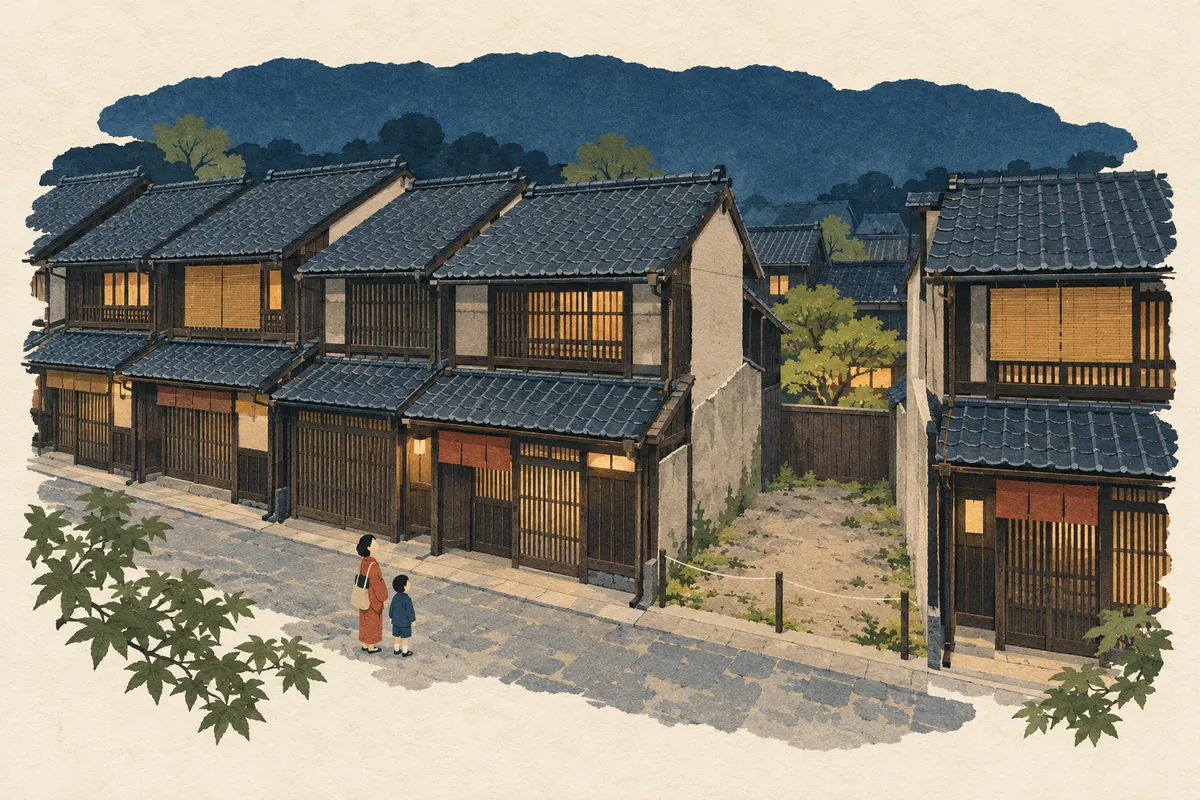
"Machiya" (townhouse) is an everyday word, but Kyoto City's Kyomachiya Ordinance draws its boundaries precisely. Under Article 2 of the ordinance, a kyomachiya is a wooden building that already existed when the Building Standards Act took effect (including those under construction, repair, or alteration at that time) and that has a traditional structure and a form and design born of urban life. The Building Standards Act took effect in 1950 (Shōwa 25), so the ordinance covers wooden buildings built roughly before 1950 that retain traditional forms such as a hira-iri roof, with the entrance on the eave side.
Kyomachiya counts in each survey
Working with experts and residents, Kyoto City has repeatedly carried out the "Kyomachiya Community Survey," checking kyomachiya one by one in the areas urbanized before the war and along the old highways. The FY2008–09 (Heisei 20–21) survey counted 47,735, and the FY2016 (Heisei 28) follow-up survey counted 40,146. Of the difference of 7,589, the exterior survey confirmed 5,602 as lost (an average of 1.68% a year); the remaining 1,987 were buildings that could not be surveyed and the like. Of the remaining kyomachiya, 5,834 were vacant.
The FY2024 (Reiwa 6) survey switched to a method that overlays residential maps and demolition-notice data in a geographic information system (GIS), and found 34,580 remaining. That is a loss of 5,566 in eight years, an average of 1.73% a year, which works out to about two kyomachiya disappearing every day.
Number of Kyomachiya in Kyoto City over Time
- FY2008–09 (Heisei 20–21)
- FY2016 (Heisei 28)
- FY2024 (Reiwa 6)
The 2017 Kyomachiya Ordinance
The "Kyoto City Ordinance on the Preservation and Succession of Kyomachiya" was promulgated on November 16, 2017 (Heisei 29), and its chapters on consultation, notification, and penalties took effect on May 1, 2018. It has two pillars. One is the designation system: the mayor designates especially important kyomachiya as "Important Kyomachiya" and areas where kyomachiya are concentrated as "Kyomachiya Preservation Priority Districts." By the 25th round on September 30, 2026, there were 1,796 Important Kyomachiya and 21 priority districts, including Pontochō, Gion Shinbashi, the live-work district, Senryōgatsuji, Fushimi Minamihama, and Takeda Kaidō. Designated kyomachiya qualify for subsidies for renovation and maintenance, receive a kyomachiya plaque, and from FY2026 can receive a preservation and succession support grant.
The other is advance notification of demolition. For Important Kyomachiya and kyomachiya within priority districts, the owner must notify the city at least one year before the day demolition begins (for other kyomachiya this is a best-effort obligation). For Important Kyomachiya, failure to notify, or demolishing before the year is up, carries a fine of up to 50,000 yen, and demolition contractors may receive a formal warning and have their names published. Notification is not a ban on demolition; it lets the city learn of the danger early and secures a year in which to look for ways to keep the building, such as matching it with people who want to use it.
Effects and limits of the ordinance
The ordinance's effect on designated kyomachiya is clear. Of the 1,418 designated as Important Kyomachiya between September 2018 and November 2024, 25 have been lost since designation, a loss rate of 1.8%. In the priority districts too, the live-work district and others have kept their rate of decline below that of neighboring school districts.
On the other hand, cases in which a building was saved after a demolition notice are limited. Of the 301 notices filed through the end of FY2025 (end of March 2026), 12 led to preservation or succession, 103 were under discussion or undecided, and 186 buildings had been demolished. Finding that overall the loss has not been halted, Kyoto City drew up its second promotion plan in April 2026, expanding the support grant and renovation subsidies. In July–August of the same year, public comment was sought on a draft amendment that would publish the names of owners who violate the ordinance and treat row houses unit by unit.
Machiya designated as cultural properties
Apart from the Kyomachiya Ordinance, some machiya are protected under the cultural property system. Of the 223 national Important Cultural Properties (buildings) in Kyoto City, 3 are classified as "machiya," and no machiya is a National Treasure (as of April 2026). Ten machiya are Kyoto City designated tangible cultural properties, and three are city-registered.
The best-known example is the Sugimoto Residence in Shimogyō Ward. The shop and home of the kimono merchant "Naraya," its roof was raised in 1870 (Meiji 3) after the Great Genji Fire, and as the largest machiya in the city it was designated an Important Cultural Property in June 2010; in February 2011 its garden became a national Place of Scenic Beauty. The Sugimoto Residence was the first case in which a "garden" of this kind, an unplanted indoor passage that doubles as a workspace, was designated a Place of Scenic Beauty. The Ogawa Residence (Nijō Jin'ya) in Nakagyō Ward is also an Important Cultural Property.
The structure of a machiya
Typical features of a kyomachiya are the narrow frontage and deep plot known as an "eel's bed," the earthen-floored passage (tōri-niwa) running from front to back, the cooking hearth "okudosan" set partway along it, lattices that differ by trade, mushiko lattice windows, and the continuous eaves along the street. The townscape is organized in ryōgawachō, neighborhoods formed by the houses facing each other across a street.
Openings of the Sugimoto Residence and machiya on Shinmachi-dōri
The Sugimoto Residence (116 Yada-chō, Ayanokōji-dōri Shinmachi nishi-iru, Shimogyō Ward), an Important Cultural Property, is about 5 minutes on foot from Hankyu Karasuma Station or Shijō subway station. It can be visited without reservation on Fridays, Saturdays, and Sundays during its spring and autumn open periods. In autumn 2026 the open days are the Fridays, Saturdays, and Sundays of November 6–22, with reception 10:00–16:00 and admission of 1,500 yen for adults and 800 yen for high school students and younger. Children of elementary school age and younger are not admitted, so families should take note. During the Gion Matsuri in July it opens as part of the Byōbu Matsuri (folding-screen festival).
The former Yoshida Residence (Kyoto Lifestyle Craft Hall "Mumeisha," built 1909, a Registered Tangible Cultural Property) at Rokkaku-chō, Shinmachi-dōri Rokkaku-sagaru, Nakagyō Ward, was bequeathed to Kyoto City in 2025; during the Byōbu Matsuri in July the front lattices are removed so that the folding screens and decorations inside can be viewed free from the street (you cannot go inside). The Nagae Residence at Funaboko-chō, Shinmachi-dōri Ayanokōji-sagaru, Shimogyō Ward (a Kyoto City designated tangible cultural property since 2005) opened its north building as lodging in January 2026 (check with the operator whether visits are possible).
Mini quiz for this entry
According to Kyoto City's FY2024 survey, about how many kyō-machiya townhouses remain in the city?
Kyoto City's Kyomachiya Ordinance defines a "kyomachiya" as a wooden building that already existed when a certain law took effect in 1950 (Shōwa 25). Which law?
Under the Kyomachiya Ordinance, what can the mayor of Kyoto do to a demolition contractor that breaks the ordinance's rules on demolishing an Important Kyomachiya?
Sources and verification
Content checked: October 18, 2026
Updated: October 18, 2026
References are in Japanese.
- 京都市「京都市京町家の保全及び継承に関する条例」(平成29年11月16日京都市条例第12号)
- 京都市「京町家を保全・継承するために」(京町家の定義・現状)
- 京都市「京町家の指定制度」
- 京都市「指定されている京町家や地区」
- 京都市「京町家を解体する際の届出」
- 京都市「京町家まちづくり調査に係る追跡調査の結果について」(平成29年5月1日広報資料)
- 京都市「京町家の残存状況等(令和6年度 京町家状況調査)」
- 京都市「京都市京町家保全・継承推進計画(第2次)(素案)概要版」
- 京都市「市長記者会見資料 京町家の保全・継承に向けて〜第2次推進計画を策定、令和8年度から取組強化!〜」(令和8年5月14日)
- 京都市「『京都市京町家の保全及び継承に関する条例』の改正案について(意見募集リーフレット)」
- 京都市「『京都市京町家の保全及び継承に関する条例』改正案に関する市民意見の募集」
- 京都市文化財保護課「京都市内文化財件数(令和8年4月1日現在)」
- 京都市「京都をつなぐ無形文化遺産 京町家とその暮らしの文化」
- 奈良屋記念杉本家保存会「杉本家住宅について」
- 奈良屋記念杉本家保存会「一般公開のお知らせ(2026年10月・11月)」
- 奈良屋記念杉本家保存会「交通アクセス」
- 京都市都市計画局「旧𠮷田家における『屏風祭』の開催」(令和8年7月10日報道発表)
- 京都市「京都市教育委員会告示第10号(京都市指定有形文化財 長江家住宅)」(令和2年3月31日)
- 長江家住宅(共同通信PRワイヤー)「江戸時代の京町家が宿泊施設に!京都市指定文化財『長江家住宅』2026年1月開業」