
The Ninomaru Palace of Nijō Castle
Key points
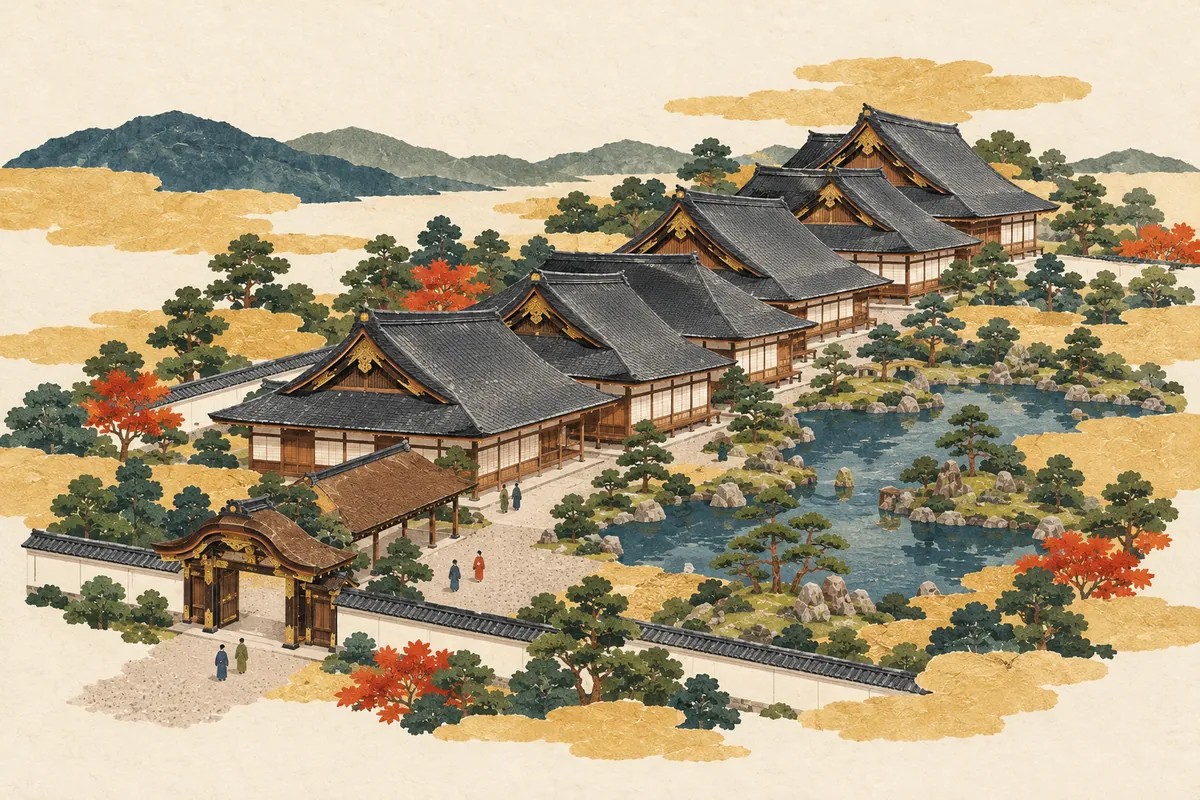
The six buildings, from the Tōzamurai to the Shiroshoin, run diagonally like a skein of geese and grow more private toward the back
Its National Treasure dating spans the Keichō and Kan'ei eras because Ieyasu's buildings were remodeled for the 1626 imperial visit
Most paintings seen inside the palace are copies; the originals are shown at the Painting Gallery in four rotations a year
Students from elementary through high school enter the palace on the castle admission alone; adults need a separate palace ticket
The six buildings and their roles
A castle palace (goten) is the building where a shogun or daimyō lived and conducted government. The palaces of Edo, Osaka, and Nagoya Castles have been lost, and the Ninomaru Palace of Nijō Castle is the only castle palace that is a National Treasure.
From the entrance (front) toward the rear, the six buildings are connected by covered corridors and arranged in a diagonal line. Seen from above, the arrangement resembles a flight of wild geese, so it is called the "flying-geese formation" (gankōkei), and it runs along the pond of the Ninomaru Garden. Each building has a single function, ranked from front to rear: the Tōzamurai, where visitors waited, is the largest, and the farther back you go, the more private the shogun's space becomes. The palace as a whole has 33 rooms and more than 800 tatami mats.
The palace was designated a National Treasure under the old law (equivalent to today's Important Cultural Property) on October 28, 1939, and a National Treasure on March 29, 1952; in the same year 22 other structures, including the Higashi Ōtemon gate, became Important Cultural Properties.
Schematic of the Six Buildings of the Ninomaru Palace in Flying-Geese Formation
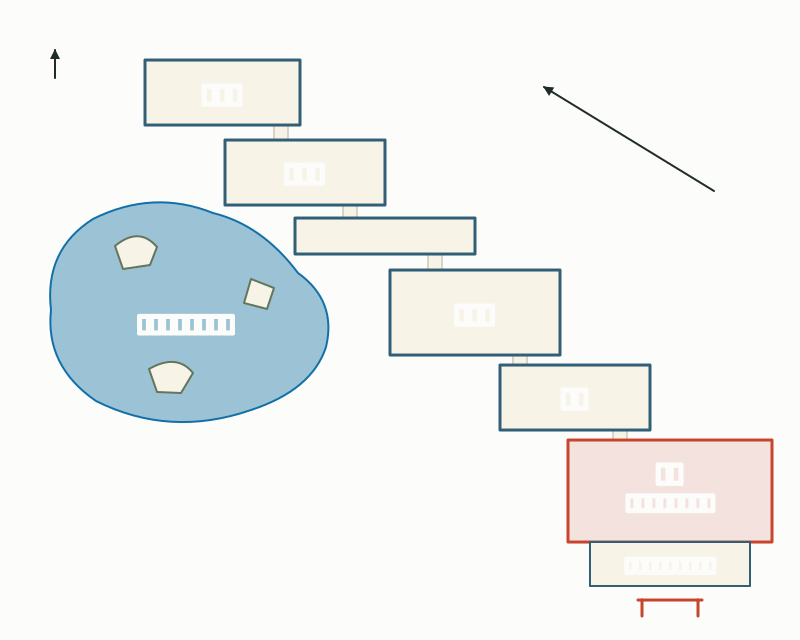
The Six Buildings of the Ninomaru Palace (Front to Rear)
| Building (Japanese reading) | Role | Roof |
|---|---|---|
| Tōzamurai and Kurumayose (遠侍及び車寄) | Waiting rooms for visitors. Also called the "Tiger Rooms" after the tiger paintings; includes the Imperial Messenger's Room for receiving envoys from the court. The Kurumayose is the entrance porch of the palace | Tōzamurai: formal tiles (hongawarabuki); Kurumayose: cypress bark (hiwadabuki) |
| Shikidai (式台) | Where business and gifts for the shogun were received and passed on. Behind it is the Rōjū Room, where the senior councilors waited | Formal tiles |
| Ōhiroma (大広間) | Main hall where the shogun met daimyō and court nobles officially (First and Second Rooms) | Formal tiles |
| Sotetsu-no-ma (蘇鉄之間) | Connecting corridor with gold-leaf walls linking the Ōhiroma and the Kuroshoin | Formal tiles |
| Kuroshoin (黒書院, Small Hall) | Official venue second to the Ōhiroma. Its First and Second Rooms are called the "Cherry Blossom Rooms," with sliding-door paintings by Kanō Naonobu | Formal tiles |
| Shiroshoin (白書院, Goza-no-ma) | Thought to be the shogun's living and sleeping quarters. A calm space unified by ink paintings | Formal tiles |
From the Keichō buildings to the return of power
The National Treasure designation gives two periods for the palace, "Keichō 7–8 and Kan'ei 2–3," because the buildings standing when Ieyasu took up residence in 1603 were extensively altered in the Great Kan'ei Remodeling begun in 1624 (Kan'ei 1) under Hidetada.
The remodeling was in preparation for the visit of Emperor Go-Mizunoo in September 1626 (Kan'ei 3), and the wall and sliding-door paintings were painted at this time by Kanō Tan'yū and his school. The castle keep and the Honmaru Palace were lost to lightning and fire during the Edo period, but the Ninomaru Palace never burned and preserves the archetypal form of Momoyama-period shoin-zukuri.
On October 13, 1867 (Keiō 3), the 15th shogun, Tokugawa Yoshinobu, gathered senior retainers of the domains then in Kyoto in the Ōhiroma of the palace to hear their views on returning governing power to the imperial court (Taisei Hōkan).
Nightingale floors, transoms, and painted walls
When you walk along the palace corridors, you hear a sound like birdsong. These are the "nightingale floors" (uguisubari), and the sound comes from the clamps (mekasugai) that hold the floorboards rubbing against the nails. Highlights include the transoms (ranma) in the Third Room of the Ōhiroma, carved in openwork from both sides out of 35-cm-thick cypress, and, in the Ōhiroma and the Kuroshoin, the metal fittings on the horizontal beams (nageshi) along the pillars, shaped like decorative knots (hananoshi).
Differences in the rank of the rooms are expressed through floor height, ceiling form, and the decorative alcove elements (tokonoma, shelves, and built-in desk). The main rooms have a raised upper level where the shogun sat, with colored wall paintings by the Kanō school on the walls and sliding doors, painted ceilings, and ornamental metalwork on the beams.
About 3,600 wall and sliding-door paintings survive, and 1,016 of them were designated Important Cultural Properties (works of art and craft) in 1982 (Shōwa 57). Most of the paintings now seen inside the palace are copies made from 1972 (Shōwa 47) onward to protect the originals, which are preserved and exhibited in the Nijō Castle Painting Gallery, opened in 2005 (Heisei 17). About 30 paintings can be shown at a time, and the display changes four times a year.
The Ninomaru Garden spreading west of the Ōhiroma
West of the Ōhiroma lies the Ninomaru Garden, with a pond and a waterfall. It is a pond stroll garden with Hōrai Island in the center of the pond, crane and turtle islands to either side, and a three-tiered waterfall at the back; tradition holds that it was remodeled for the imperial visit of 1626 with the involvement of Kobori Enshū and others. It was designed to be viewed from three directions, the Ōhiroma, the Kuroshoin, and the Gyōkō Palace built for the visit, and was designated a Special Place of Scenic Beauty in 1953 (Shōwa 28).
Hours and admission
Nijō Castle is at 541 Nijōjō-chō, Nijō-dōri Horikawa nishi-iru, Nakagyō Ward, facing Horikawa-dōri, right outside Nijōjō-mae subway station. The castle is open 8:45–16:00 (closes at 17:00), and admission to the Ninomaru Palace is 8:45–16:10 (as of October 2026). The castle is closed December 29–31; the Ninomaru Palace is closed December 26–28, January 1–3, and every Tuesday in January, July, August, and December (the following day when Tuesday is a public holiday).
Admission is 800 yen for adults, 400 yen for junior high and high school students, 300 yen for elementary school students, and free for children below elementary school age. Adults need a separate ticket to enter the Ninomaru Palace: 1,300 yen combined with castle admission, or 500 yen if added after entering. Junior high, high school, and elementary school students can view the Ninomaru Palace with castle admission alone. Elementary and junior high school students who live in Kyoto City or attend school in the city enter the castle free; their address or school name is checked at the entrance. The Painting Gallery costs a further 100 yen.
Photography is prohibited inside the Ninomaru Palace, and eating and drinking are not allowed within the castle except in designated areas. The exterior of the palace, the Karamon gate, and the Ninomaru Garden can be seen with castle admission alone.
Mini quiz for this entry
Walking the corridors of the Ninomaru Palace of Nijō Castle, you hear a sound like birdsong: the "nightingale floors." What makes the sound?
Most of the Kanō-school wall paintings now seen in the rooms of the Ninomaru Palace of Nijō Castle are what?
Of the six buildings of the National Treasure Ninomaru Palace of Nijō Castle, what kind of building is the "Sotetsu-no-ma" (蘇鉄之間)?
Sources and verification
Content checked: October 18, 2026
Updated: October 18, 2026
References are in Japanese.
- 文化庁「国指定文化財等データベース 二条城 二の丸御殿遠侍及び車寄」
- 文化庁「国指定文化財等データベース 二条城 二の丸御殿式台」
- 文化庁「国指定文化財等データベース 二条城 二の丸御殿大広間」
- 文化庁「国指定文化財等データベース 二条城 二の丸御殿蘇鉄之間」
- 文化庁「国指定文化財等データベース 二条城 二の丸御殿黒書院(小広間)」
- 文化庁「国指定文化財等データベース 二条城 二の丸御殿白書院(御座の間)」
- 文化庁「国指定文化財等データベース 世界遺産 古都京都の文化財 構成資産 二条城」
- 文化庁「文化遺産オンライン 世界遺産 二条城」
- 京都市元離宮二条城事務所「二の丸御殿・庭園」
- 京都市元離宮二条城事務所「城内の文化財と施設」
- 京都市元離宮二条城事務所「二条城の歴史」
- 京都市元離宮二条城事務所「二条城年表」
- 京都市元離宮二条城事務所「二条城の概要」
- 京都市元離宮二条城事務所「二条城障壁画 展示収蔵館」
- 京都市元離宮二条城事務所「入城料等」
- 京都市元離宮二条城事務所「ご利用案内」
- 京都市元離宮二条城事務所「交通アクセス」
- 京都市観光協会「京都観光Navi 元離宮二条城」