
Japanese轆轤町(ろくろちょう)
Rokuro-chō
Key points
轆轤 is the kanji for rokuro, a potter's wheel used to shape vessels as it turns
Recorded as 坂面町 in 1637 (Kan'ei 14) and as 坂面轆轤町 in 1674 (Enpō 2)
Rokudō no Tsuji is the T-junction formed where a road turns south off Matsubara-dōri at the boundary of Rokuro-chō and Atarashi-chō
About a 15-minute walk from Keihan Kiyomizu-Gojō Station to Rokudō Chinnō-ji
Read Rokuro-chō
轆轤町 is read Rokuro-chō (ろくろちょう). 轆轤 (rokuro) is a word for tools that use rotation, such as the potter's wheel, a turntable that spins clay placed on it to shape round pottery, and the pulley used to haul up heavy objects. The two characters both have the "vehicle" (車) radical, and since the word is almost never written in kanji in daily life, the town name is hard both to read and to write.
In addresses it is Rokuro-chō, Higashiyama Ward, and Kyoto City's list of town names by school zone also gives ろくろちょう. 新シ町, which meets it at Rokudō no Tsuji, is read Atarashi-chō (あたらしちょう), another town name that is easy to misread.
Rokudō no Tsuji on Matsubara-dōri and Rokuharamitsu-ji
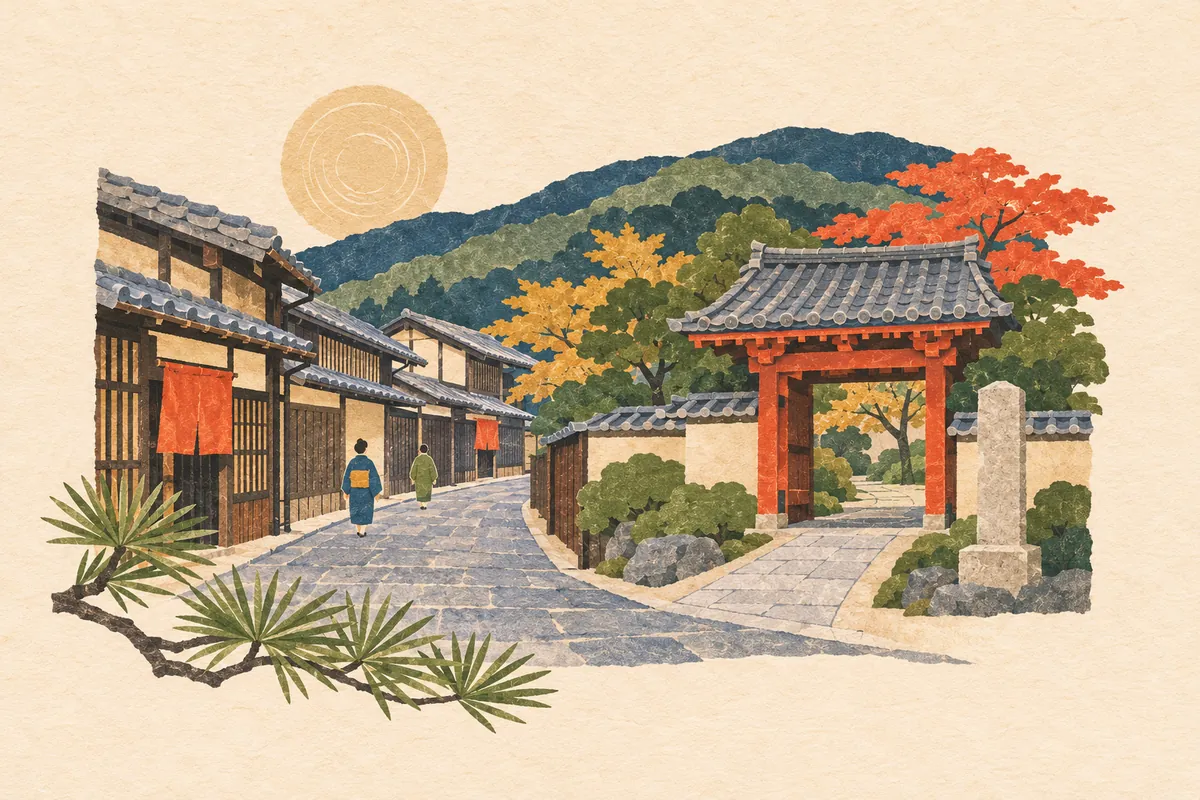
Rokuro-chō is a town along Matsubara-dōri, between Yamato-ōji-dōri and Higashiōji-dōri. The area in front of the gate of Rokudō Chinnō-ji is called Rokudō no Tsuji, long thought of as the threshold of the underworld. At the boundary of Rokuro-chō and Atarashi-chō, a road turns south off Matsubara-dōri, and the T-junction it forms is Rokudō no Tsuji. In front of the temple stand a 1913 (Taishō 2) stone marker reading "Former Site of Lord Ono no Takamura" and a 1995 (Heisei 7) marker reading "Rokudō no Tsuji," both located in Rokuro-chō. Another "Rokudō no Tsuji" marker stands in front of Saifuku-ji to the west.
Rokuharamitsu-ji is also in Rokuro-chō, set back a little south of Matsubara-dōri. The nearest station is Kiyomizu-Gojō on the Keihan line, about a 15-minute walk to Rokudō Chinnō-ji; by city bus, get off at Kiyomizu-michi and walk about 5 minutes (as of November 2026).
Where the town name comes from: Sakaomote and Rokuro
The town name can be traced back to early Edo-period records. 坂面町 in a 1637 (Kan'ei 14) survey of the number of towns and houses in Kyoto corresponds to this town, and a 1674 (Enpō 2) record lists 坂面轆轤町 in front of the gate of Kennin-ji. Sakaomote (坂面) is said to have been a name given because the town, together with neighboring Yumiya-chō, lay at the bottom of Kiyomizu-zaka (the old Gojō-zaka).
No record can be confirmed explaining why the characters 轆轤 were added. For the nearby place name Rokuhara, there is a theory that it comes from Rokurogahara (轆轤原), an old place name. Other theories trace it to 麓原 (rokuhara), meaning the field at the foot of the Higashiyama hills; to 髑髏原, a "field of skulls" (髑髏 is read dokuro, "skull") as a funeral ground leading to Toribeno; or to Rokuharamitsu-ji, and none of them has been settled. How the name Rokuro-chō connects with these theories is also unclear.
The entrance to Toribeno and Obon visits
The Kyō Machikagami, a Kyoto town guide published in 1762 (Hōreki 12), says that Chinkō-ji is on the north side of Rokuro-chō and Myōyū-ji of the Nichiren school on the south side, and that the area is called Rokudō because it was originally the mujōsho (charnel ground) of Toribeno (鳥部野・鳥辺野), land opened up for the dead. It also records that on the 9th and 10th days of the 7th month of the old lunar calendar, crowds came to welcome the spirits of the dead, rang the welcoming bell, and that sprigs of kōyamaki (Japanese umbrella pine) were sold. Today Rokudō Chinnō-ji's address is Komatsu-chō.
Toribeno was known, along with Adashino and Rendaino, as a place for funerals and burials. Rokudō Chinnō-ji is still crowded every year from August 7 to 10 during Rokudō Mairi, with people coming to welcome the oshōrai-san (お精霊さん), the spirits of their ancestors.
Mini quiz for this entry
How is 轆轤町, a town name in Higashiyama Ward, read?
Under what town name does the town corresponding to Rokuro-chō in Higashiyama Ward appear in a record of 1637 (Kan'ei 14)?
A guide to the towns of Kyoto published in 1762 (Hōreki 12) says which temple is on the north side of Rokuro-chō?
Sources and verification
Content checked: November 8, 2026
Updated: November 8, 2026
References are in Japanese.