
Yuba
Other spellings and names湯波 / Kyō-yuba (京湯葉) / Nama yuba (生湯葉) / Hoshi yuba (干し湯葉) / Tofu skin
Key points
Made from soybeans and water; no coagulant is added, and the film on heated soy milk is lifted off
There is nama yuba, used as lifted, and hoshi yuba, which is dried
Besides 湯葉, it is also written 湯波 or 油皮
Protein makes up about 53% of dried yuba and about 22% of fresh yuba
Made by lifting the film off soy milk
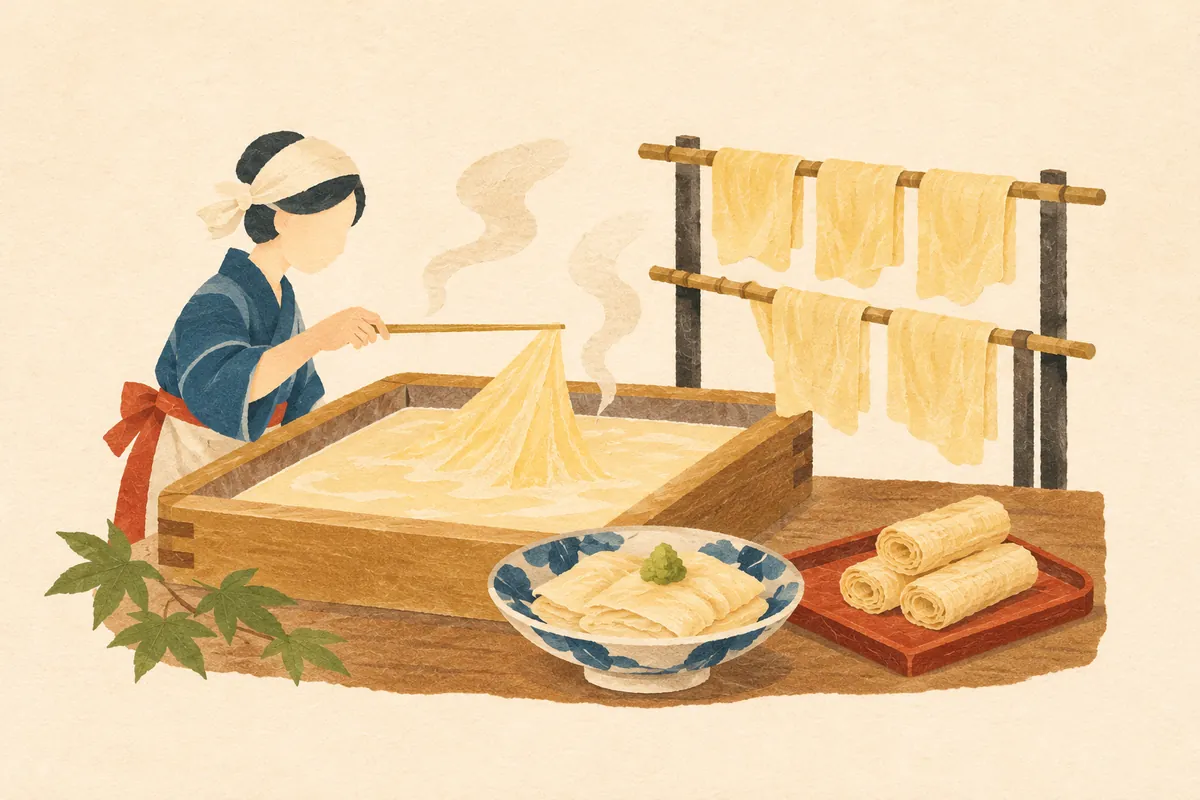
To make yuba, soybeans are first soaked in water, ground in a mill, and simmered over low heat, then separated into soy milk and okara (soy pulp). The soy milk is poured into a pan fitted with square wooden frames, and when it is warmed in a water bath or over low heat, a thin film forms on the surface. This film, scooped up by hand or with a skewer, is nama yuba. Unlike tofu, which is set with nigari or similar agents, no coagulant is added.
After the first sheet, the film can be taken about six or seven more times, but with each round the wrinkles on the surface are said to become coarser and the quality to drop. Because it is like concentrated soy milk, it is rich in protein: about 53% of dried yuba and about 22% of fresh yuba is protein. It also contains fat, calcium, and iron.
Fresh yuba and dried yuba
Yuba that has been lifted and drained is nama yuba, also called "hikiage yuba" (lifted yuba). Hoshi yuba (dried yuba) is nama yuba that has been dried, and it is used after soaking in lukewarm water. Both come as processed yuba that has been rolled or tied.
Main kinds of fresh and dried yuba
| Type | Name | Form and how it is made |
|---|---|---|
| Fresh yuba | Hikiage yuba | The lifted film, folded into a large piece |
| Fresh yuba | Botan yuba (Tōji yuba) | Fillings such as ginkgo nuts and lily bulb rolled up in fresh yuba and deep-fried |
| Dried yuba | Ita yuba (hira yuba) | Hikiage yuba dried flat |
| Dried yuba | Musubi yuba, maki yuba | Yuba tied or rolled and then dried |
From China to the Buddhist vegetarian table
Yuba reached Japan from China in the Kamakura period and was at first eaten by court nobles and at temples. For Zen monks, who did not eat meat, it became an important source of protein and was treated as an essential ingredient of shōjin ryōri. In the Tenshō era (1573–1592) it was also taken up in kaiseki for the tea ceremony, and Sen no Rikyū is said to have liked it. By the late Edo period it appeared in the cookbook Tōfu Hyakuchin ("A Hundred Tofu Delicacies"), and townspeople began eating it too.
In Kyoto it became one of the important processed foods, alongside kombu, hijiki, tofu, and nama-fu (fresh wheat gluten), partly under the influence of Zen Buddhism. It is also an essential ingredient of Kyō-ryōri (Kyoto cuisine), which blends yūsoku ryōri (court cuisine), shōjin ryōri, and other traditions.
There are several theories about where the name "yuba" comes from.
- From uwa (浮皮), the skin floating on the surface of soy milk
- From tōfu no uwamono (豆腐上物, "the top of the tofu"), which appears as "tōfu uwamono" in the Yūgaku Ōrai of the early Muromachi period
- From tōfu no uba (豆腐の姥, "tofu's old woman"), likening the color and wrinkles of the film to an old woman; shortened to uba, which then shifted to yuba
湯葉 and 湯波
Dictionaries give the characters 湯波 and 油皮 as well as 湯葉, and it is sometimes written 湯婆. Alongside Kyoto, the place usually named as a long-standing home of yuba is Nikkō in Tochigi Prefecture. Yuba there, too, has been handed down through its ties to shōjin ryōri, and it is usually written 湯波.
In Kyoto, too, some shops use 湯波 in their names, so the spelling is not clearly divided by region. One explanation is that it is written 湯波 ("hot-water wave") because its surface ripples, and 湯葉 ("hot-water leaf") because it looks like the veins of a leaf.
How Kyoto eats it, and Nishiki Market
In Kyoto, nama yuba is eaten as it is, dipped in ponzu or in soy sauce with wasabi; it is also added to hot pots and soups such as miso soup, or wrapped around shrimp or fish and fried. Hoshi yuba is used in simmered dishes, clear soups, and barazushi. Nama yuba does not keep, so it is refrigerated and eaten up soon. Hoshi yuba lasts a long time, but because it contains fat, it oxidizes and loses flavor if it gets old or is left somewhere hot.
Yubakichi in Nishiki Market (Nishikikōji-dōri Gokomachi nishi-iru, Nakagyō Ward) says it set up shop in Nishiki Market in 1790 (Kansei 2). It makes fresh and dried yuba and is the only shop in Nishiki Market that both makes and sells yuba (as of November 2026). In Nishiki Market, visitors are asked to eat what they buy in front of or inside the shop and to refrain from eating while walking.
Mini quiz for this entry
"Botan yuba" is made by rolling fillings such as ginkgo nuts and lily bulb in fresh yuba and deep-frying it. What is its other name, taken from a Kyoto temple?
Sources and verification
Content checked: November 8, 2026
Updated: November 8, 2026
References are in Japanese.