
Kurama-dera and Kifune
Key points
2 National Treasures: the "Wooden Standing Bishamonten, Kisshōten, and Zennishi Dōji" and the "Kurama-dera Sutra Mound Relics"
The Aizanhi (mountain conservation fee) is 500 yen (since April 1, 2023). Admission to the Reihōden is a separate 200 yen
About a 30-minute walk from the Honden Kondō to the Oku-no-in Maōden, and about 20 minutes from the Maōden to Kifune Shrine
The Hongū is where the shrine moved in 1055; the original site is the Okumiya, which was washed away in a flood
The origins of Kurama-dera
The temple's founding legend, the Kurama Gaiji Engi, says that in 770 (Hōki 1), Gantei, a leading disciple of Jianzhen (Ganjin), who founded Tōshōdai-ji, climbed Mount Kurama guided by a revelation in a dream and a white horse, was saved by Bishamonten, and built a thatched hermitage to enshrine Bishamonten. Fujiwara no Isendo built up the temple's halls in 796 (Enryaku 15) and later enshrined the Thousand-Armed Kannon as well.
In the Heian period, it drew faith as a temple guarding the north of the capital, and Sei Shōnagon mentions in The Pillow Book the winding tsuzura-ori approach that continues from the Niōmon gate. The faith, which had been influenced by the Ritsu, Shingon, Tendai, and other schools, was brought together as "Kurama Kōkyō" in 1947 (Shōwa 22), and Kurama-dera became its head temple in 1949 (Shōwa 24).
The Niōmon was rebuilt in 1911 (Meiji 44), and its left door dates from around the Juei era (1182–84). The Honden Kondō and the Tahōtō pagoda are reinforced-concrete buildings rebuilt in recent years. The worship hall (haiden) of Yuki Shrine (an Important Cultural Property), partway along the approach, is a building in the kakezukuri (cantilevered) style rebuilt by Toyotomi Hideyori in 1607 (Keichō 12), and the shrine is also known for the Kurama Fire Festival on October 22.
The Bishamonten triad and the sutra mound relics
The National Treasure "Wooden Standing Bishamonten, Kisshōten, and Zennishi Dōji" is a set of three Heian-period statues: Bishamonten, Kisshōten, and Zennishi Dōji. They were designated on April 15, 1903 (Meiji 36), and became a National Treasure on November 22, 1952 (Shōwa 27). Bishamonten holds a halberd in his right hand and raises his left hand above his eyes to gaze toward Kyoto, a figure guarding the north. The triad is enshrined in the Buddhist image room on the 3rd floor of the Reihōden (Kuramayama Museum), together with a standing Shō Kannon and other statues.
The other National Treasure, the "Kurama-dera Sutra Mound Relics," is a group of objects excavated from sutra mounds of the Heian to Kamakura periods (1120–1260). It includes a sutra container inscribed with the date 1120 (Hōan 1), stone, bronze, and iron hōtō pagodas, and a gilt-bronze triad. It was designated in 1933 (Shōwa 8) and became a National Treasure in 1955 (Shōwa 30).
Important Cultural Properties owned by Kurama-dera
| Name (official designation name) | Type | Period | Designation |
|---|---|---|---|
| Wooden Standing Kannon Bosatsu | Sculpture | Kamakura (1226) | Important Cultural Property (April 15, 1903) |
| Wooden Standing Bishamonten (Chinju Yasha Bishamonten, in the Fudō-dō) | Sculpture | Heian | Important Cultural Property (April 15, 1903) |
| Bronze lantern | Craft | Kamakura | Important Cultural Property (April 17, 1911) |
| Kurama-dera Documents, ink on paper | Historical documents | Kamakura to Nanboku-chō | Important Cultural Property (May 24, 1916) |
| Black-lacquered sword (by temple tradition, the sword of Sakanoue no Tamuramaro) | Craft | Heian | Important Cultural Property (August 29, 1950) |
| Sword (unsigned; mounting with three-pronged vajra hilt and black-lacquered scabbard) | Craft | Heian | Important Cultural Property (August 29, 1950) |
The path of the Ushiwakamaru legend
According to local legend, Minamoto no Yoshitsune (childhood name Ushiwakamaru) entered Kurama-dera around the age of 7, spent his days learning Buddhism at Tōkōbō, which stood higher up than Yuki Shrine, and at night went out to Sōjō-ga-dani, where tengu taught him the art of war. He left the temple around 16 and went down to Hiraizumi in Ōshū.
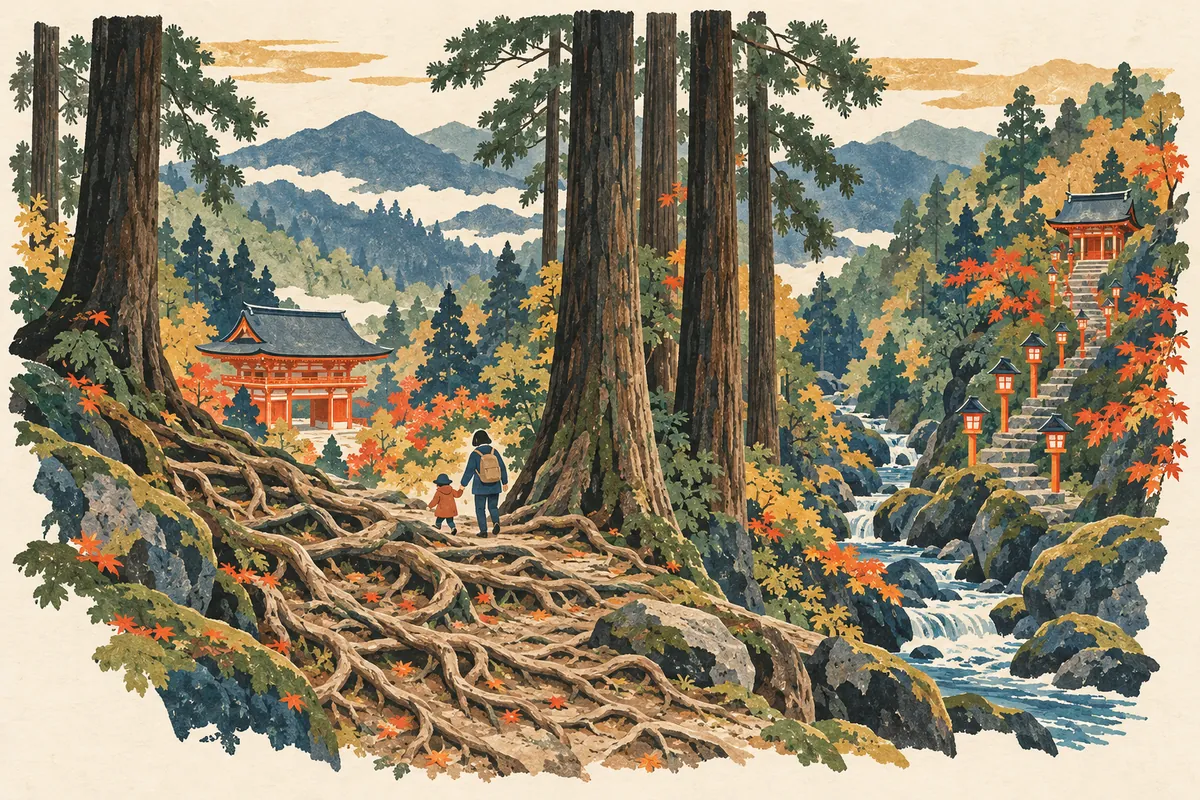
The mountain path from the Reihōden to the Oku-no-in Maōden is lined with places tied to the Ushiwakamaru legend: the "Ikitsugi no Mizu" (Water for Catching One's Breath), where he drank; the "Sekurabe-ishi" (Height-Measuring Stone), where he measured his height against the stone in farewell when leaving for Ōshū; and the Yoshitsune-dō, which enshrines Yoshitsune as Shanaō-son. The "Ki-no-ne-michi" (Path of Tree Roots), where tree roots crawl over the ground, formed because the bedrock is so hard that the roots cannot grow downward, and it is counted among the places where Ushiwakamaru trained.
Kifune Shrine and the reading "Kifune"
Kifune Shrine (180 Kurama Kibune-chō, Sakyō Ward), along the Kibune River west of Mount Kurama, enshrines Takaokami-no-kami, the deity who governs the water supply, and is the head shrine of some 2,000 shrines to the water god across Japan. The imperial court offered a black horse in times of drought, and a white or red horse in times of long rain, to pray for rain or for the rain to stop. Mount Kibune is part of the source area of the Kamo River.
The shrine's name is read "Kifune," and in the past it was also written 氣生根 ("the root where ki, vital energy, arises"). The name has also been written 木船 and 貴布祢, and it became 貴船 in 1871 (Meiji 4). Meanwhile, the Eizan Electric Railway's Kibuneguchi Station is romanized with "bune."
The date of the shrine's founding is unknown. According to tradition, it began when Tamayorihime-no-mikoto, mother of Emperor Jinmu, rode a yellow boat (kifune) from Osaka Bay up the Yodo, Kamo, and Kibune rivers and built a small shrine at the site of today's Okumiya, and one theory traces the shrine's name to this "yellow boat." Visitors make the "three-shrine pilgrimage" around the Hongū, the Yui-no-yashiro, and the Okumiya; because the Okumiya, on the original site, was washed away in a flood, the Hongū was moved to its present site in 1055 (Tengi 3). The Yui-no-yashiro is a shrine for matchmaking and relationships, known from the story of Izumi Shikibu praying there about her relationship with her husband and having her wish granted.
Visiting Kurama-dera and hiking over to Kifune
Kurama-dera's Niōmon is about a 3-minute walk from Kurama Station, the terminus of the Eizan Electric Railway. It is about 30 minutes on the Eizan Electric Railway from Demachiyanagi Station, and about 25 minutes from Kokusaikaikan subway station to "Kurama" on Kyoto Bus (bound for Kurama Onsen). The temple has no parking lot.
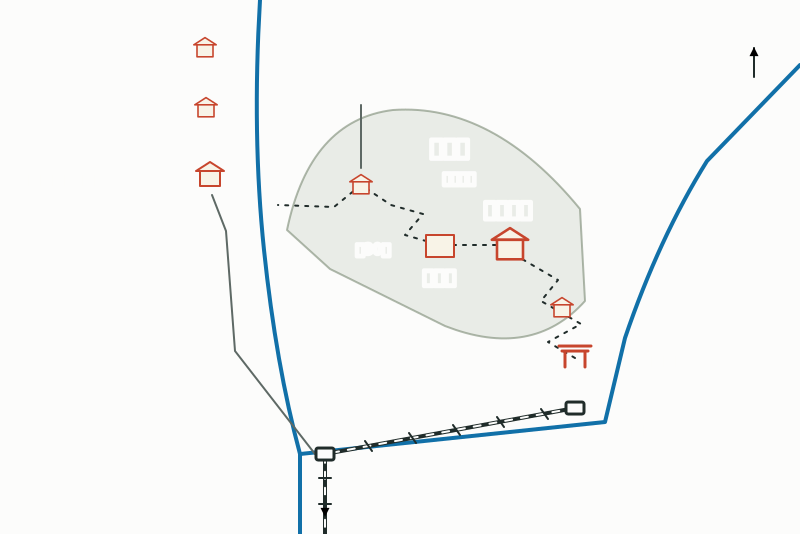
Locations of Kurama and Kifune (Schematic)
- Kurama-dera: Aizanhi (mountain conservation fee) 500 yen. The Honden Kondō doors are open 9:00 to 16:15 (as of October 2026)
- Reihōden: admission 200 yen. Open 9:00 to 16:00; closed on Tuesdays (the following day if Tuesday is a national holiday) and from December 12 to the end of February
- Cable car (Sanmon Station to Tahōtō Station, about 2 minutes): run by the temple, and the charge is a thank-you for a donation toward the upkeep of the temple buildings rather than a fare. One way 200 yen for adults and 100 yen for elementary school students and younger. The last car up leaves at 16:20
- Hiking over the mountain: Kurama Station → Niōmon (3 min) → Yuki Shrine (5 min) → Tsuzura-ori approach → Honden Kondō (20 min) → Maōden (30 min) → Kifune Shrine (20 min)
- Kifune Shrine: the Hongū is free to visit and open 6:00 to 20:00 from May 1 to November 30. About a 30-minute walk (about 2 km) from Kibuneguchi Station, or about a 5-minute walk from the "Kibune" stop on Kyoto Bus route 33. The 2026 autumn-leaves illumination runs November 7–24 (sunset to 20:30)
Mini quiz for this entry
At Kifune Shrine, west of Mount Kurama, what does Takaokami-no-kami, the deity enshrined in the Hongū (main sanctuary), govern?
Kurama-dera's National Treasure statue of Bishamonten is designated together with two other statues as a triad. Which two statues accompany Bishamonten?
The cable car on Mount Kurama links Sanmon Station and Tahōtō Station. Among railways licensed under the Railway Business Act, what is said to make it unique?
Sources and verification
Content checked: October 22, 2026
Updated: October 22, 2026
References are in Japanese.
- 文化庁「国指定文化財等データベース 木造毘沙門天及〈吉祥天/善膩師童子〉立像〈/(本堂安置)〉」
- 文化庁「国指定文化財等データベース 鞍馬寺経塚遺物」
- 文化庁「国指定文化財等データベース」(国宝・重要文化財〈美術工芸品〉、所有者「鞍馬寺」で検索)
- 文化庁「国指定文化財等データベース 由岐神社拝殿」
- 鞍馬寺「歴史」
- 鞍馬寺「山内案内」
- 鞍馬寺「文化財」
- 鞍馬寺「霊宝殿」
- 鞍馬寺「入山に際して」
- 鞍馬寺「交通地図」
- 鞍馬寺「総本山 鞍馬寺」(本殿開扉時間)
- 京都市観光協会「京都観光Navi 鞍馬寺」
- 京都市観光協会「京都観光Navi 駒札 鞍馬寺」
- 京都市観光協会「京都観光Navi 鞍馬山霊宝殿」
- 京都市観光協会「京都観光Navi 由岐神社」
- 貴船神社「貴船神社について」
- 貴船神社「参拝のご案内」
- 貴船神社「貴船の杜づくり」
- 貴船神社「Kifune Shrine」(英語版トップ・交通案内)
- 京都市観光協会「京都観光Navi 貴船神社」
- 京都市観光協会「京都観光Navi 駒札 貴船神社」
- 京都市観光協会「京都観光Navi 駒札 貴船神社奥宮」