
Sanzen-in and Ōhara
Key points
About a 10-minute walk from the Kyoto Bus "Ōhara" stop; the temple has no parking lot
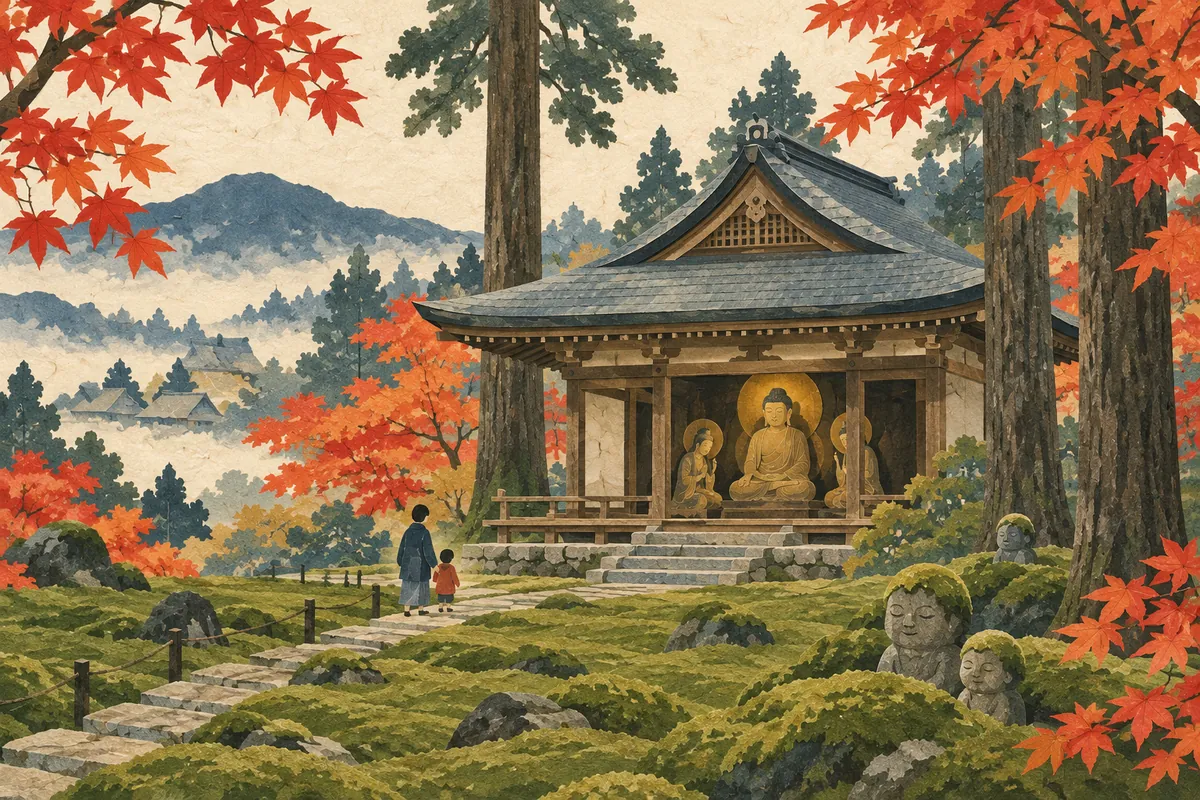
The Ōjō Gokuraku-in is a simple hall from 1148 whose ceiling is raised in a boat-bottom shape to hold the large triad
An inscription inside the statues dates the triad to 1148 with the monk Jisshō as sponsor, and no other raigō triad this large survives
The temple moved from Mount Hiei via Sakamoto and the city to Ōhara after the Meiji Restoration, and has been called Sanzen-in since 1871
A monzeki temple traced back to Saichō
According to temple tradition, Sanzen-in began when Saichō (Dengyō Daishi) built a hall at Tōtō Minamidani (the south valley of the Eastern Precinct) on Mount Hiei in the Enryaku era (782–806). It was passed on to Ennin (Jikaku Daishi), and after Prince-Abbot Saiun entered it, it became a monzeki temple headed by members of the imperial family from the late Heian period onward.
Because of fires, the Ōnin War, and other events, the temple moved many times, from inside Mount Hiei to Sakamoto in Ōmi and then into the city of Kyoto, and it was called by names such as Enyū-bō, Nashimoto-bō, Nashimoto Monzeki, and Kajii-no-miya. The name "Sanzen-in" dates from 1871 (Meiji 4) and comes from an imperial plaque in the hand of Emperor Reigen that hung in the private Buddhist hall of the Kajii Palace. It moved to its present site in Ōhara after the Meiji Restoration.
The Ōjō Gokuraku-in
The Ōjō Gokuraku-in in the grounds is a hall that was merged into Sanzen-in in the Meiji period. Its official national designation name is "Ōjō Gokuraku-in Amida-dō," and it was designated an Important Cultural Property on December 28, 1897 (Meiji 30). It is a late Heian-period building from 1148 (Kyūan 4), a simple hall with an irimoya (hip-and-gable) roof, an entrance on the gable end, and kokera (wood-shingle) roofing.
The Gokuraku-in was founded by Shinnyobō Shōnin, apparently a Tendai Pure Land teacher, as recorded in the Heian-period diary Kikki. Another tradition holds that Eshin Sōzu Genshin, author of the Ōjōyōshū, built it with his elder sister Annyō-ni in 985 (Kanna 1).
Because the triad is large for the size of the hall, the ceiling inside is raised high in a shape like the bottom of a boat and is called a "funazoko tenjō" (boat-bottom ceiling). Heavenly maidens and bodhisattvas dancing in the Pure Land are painted on the ceiling in rich colors, but they are now hard to see with the naked eye. In the exhibition room of the Enyūzō, the temple's storage facility, the ceiling has been reproduced at full size, with its original colors brought back to life based on a survey with infrared cameras.
The Amida triad and "Yamato-zuwari"
The official national designation name of the principal image is "Wooden Seated Amida Nyorai with Two Attendants (enshrined in the Ōjō Gokuraku-in Amida-dō)." It was designated on July 31, 1902 (Meiji 35), and became a National Treasure on June 26, 2002 (Heisei 14). An inscription dated 1148 (Kyūan 4) inside the statue of Seishi Bosatsu shows that the statue was made with the monk Jisshō as its sponsor.
The central Amida Nyorai forms the raigō-in (welcoming) mudra; Kannon Bosatsu, on the right as you face it, holds out a lotus pedestal, and Seishi Bosatsu, on the left, joins its hands in prayer. The bodhisattvas on either side sit with their knees spread a little and their bodies leaning forward, a way of sitting known as "Yamato-zuwari." The posture shows them at the very moment they arrive to welcome a dying person to the Pure Land. The statues are 232.0 cm tall (Amida Nyorai), 132.2 cm (Kannon Bosatsu), and 132.7 cm (Seishi Bosatsu).
Welcoming (raigō) triads with kneeling attendants were made from the 11th century on, but most are small, and no other surviving raigō-type Amida triad is this large, with a central figure of shū-jōroku size and attendants of han-jōroku size. At the time, Yūzū Nenbutsu, in which many people chant the nenbutsu together, flourished in Ōhara, and a connection with that faith has also been suggested.
Sanzen-in's nationally designated cultural properties
The national cultural properties owned by Sanzen-in are 1 National Treasure and 10 Important Cultural Properties (including a building). The principal image of the Konjiki Fudō-dō, the Konjiki Fudō Myōō (Important Cultural Property), is a hidden Buddha (hibutsu), and its doors are opened for about a month during the Fudō Grand Festival every April. The books and documents handed down in the Enyūzō sutra repository (3,021 items) are also designated together as an Important Cultural Property.
Other Important Cultural Properties owned by Sanzen-in
| Name (official designation name) | Type | Period | Designation |
|---|---|---|---|
| Wooden Standing Fudō Myōō (Konjiki Fudō Myōō) | Sculpture | Heian | Important Cultural Property (July 10, 2008) |
| Wooden Standing Fudō Myōō (attributed to Ennin) | Sculpture | Kamakura | Important Cultural Property (April 15, 1903) |
| Wooden Half-Seated Guze Kannon | Sculpture | Kamakura (1246) | Important Cultural Property (February 2, 1955) |
| Fragmentary Scroll of the Shitennō-ji Engi (Origins of Shitennō-ji) | Calligraphy and books | Heian (1173) | Important Cultural Property (May 27, 1907) |
| Kobun Kōkyō (Old-Text Classic of Filial Piety) | Calligraphy and books | Kamakura (1277) | Important Cultural Property (May 27, 1907) |
| Jikaku Daishi Den (Biography of Jikaku Daishi) | Calligraphy and books | Muromachi | Important Cultural Property (June 20, 1969) |
| Shōkū Shōnin Denki Izokushū (Biography of Shōkū Shōnin) | Calligraphy and books | Kamakura | Important Cultural Property (June 20, 1969) |
| Teiō Keizu (Genealogy of Emperors) | Historical documents | Muromachi | Important Cultural Property (June 20, 1969) |
| Books and Documents of the Sanzen-in Enyūzō | Calligraphy and books | Heian to Edo | Important Cultural Property (June 6, 1988) |
The village of Ōhara and Raigō-in, Shōrin-in, and Jakkō-in
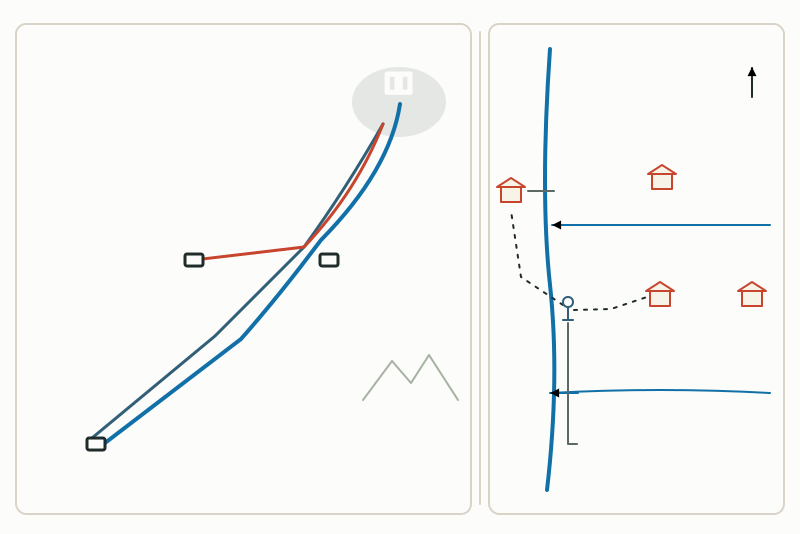
Ōhara is a small basin at the foot of Mount Hiei, about 12 km north of central Kyoto along the Wakasa Kaidō (Saba Kaidō, "Mackerel Road"), which follows the Takano River. The Ritsu River (Ritsusen) flows on the north side of Sanzen-in and the Ryo River (Ryosen) on the south side, and their names are said to come from ryoritsu, the tonal scales of shōmyō (Buddhist chant).
Raigō-in, further in (east of) Sanzen-in, is said to have been founded by Ennin in the Ninju era (851–854) as a training hall for shōmyō; after Ryōnin restored it at the end of the Heian period it became the central training hall of Tendai shōmyō. Shōrin-in, its neighbor to the north, was founded by Jakugen in 1013 (Chōwa 2) and was the setting of the "Ōhara Mondō" (Ōhara Debate) in 1186 (Bunji 2), to which Hōnen was invited to debate. Its temple bell and stone hōkyōintō pagoda are Important Cultural Properties.
Jakkō-in, west of the Takano River, is a Tendai convent where Kenreimon-in lived out her life after the fall of the Taira clan. Awa no Naishi, who served Kenreimon-in and later entered Jakkō-in, is regarded as the model for the "Ōhara-me," the women of Ōhara who walked about selling firewood. In Ōhara, where the temperature differs greatly between day and night, good red shiso is grown, and shibazuke is the local specialty. Eggplant and red shiso pickled with salt alone and left to undergo lactic-acid fermentation are called "nama-shibazuke." It is also written with characters meaning "purple-leaf pickles," and tradition credits Kenreimon-in with the name.
Location of Ōhara and Its Temples (Schematic)
Kyoto Bus to Ōhara and Sanzen-in visiting hours
Sanzen-in is at 540 Ōhara Raikōin-chō, Sakyō Ward, about a 10-minute walk from the Kyoto Bus "Ōhara" stop. The temple has no parking lot, and Ōhara is outside Kyoto Bus's flat-fare zone. The National Treasure Amida triad is enshrined in the Ōjō Gokuraku-in and can be seen at any time during visiting hours.
- From Kokusaikaikan Station on the Karasuma subway line, about 22 minutes on Kyoto Bus route 19 (about 20 minutes by subway from Kyoto Station to Kokusaikaikan Station)
- From Demachiyanagi Station, about 30 minutes on Kyoto Bus route 17. From JR Kyoto Station, about 60 minutes on route 17. From Yase-Hieizanguchi Station on the Eizan Electric Railway, about 15 minutes on route 19
- Visiting hours: 9:00 to 17:00 (8:45 to 16:45 in November, 9:00 to 16:30 from December to February), open every day (as of October 2026)
- Admission: 700 yen for general visitors, 400 yen for junior high and high school students, 150 yen for elementary school students
- Jakkō-in and Shōrin-in are each about a 15-minute walk from "Ōhara"
Mini quiz for this entry
In the National Treasure Amida triad at Sanzen-in's Ōjō Gokuraku-in, what does Kannon Bosatsu, on the right as you face it, hold out in both hands?
At Sanzen-in's Ōjō Gokuraku-in, the ceiling was specially designed to fit an Amida triad that is large for the size of the hall. What is this ceiling called?
The Ryo River (呂川, Ryosen) and the Ritsu River (律川, Ritsusen) flow south and north of Sanzen-in. What are these river names said to come from?
Sources and verification
Content checked: October 22, 2026
Updated: October 22, 2026
References are in Japanese.
- 文化庁「国指定文化財等データベース 木造阿弥陀如来及両脇侍坐像(往生極楽院阿弥陀堂安置)」
- 文化庁「国指定文化財等データベース 往生極楽院阿弥陀堂」
- 文化庁「国指定文化財等データベース 木造不動明王立像(三千院)」
- 文化庁「国指定文化財等データベース 三千院円融蔵典籍文書類」
- 文化庁「国指定文化財等データベース」(国宝・重要文化財〈美術工芸品〉、所有者「三千院」で検索)
- 文化庁「国指定文化財等データベース 勝林院宝篋印塔」
- 文化庁「国指定文化財等データベース 梵鐘(勝林院)」
- 三千院「三千院のご案内」
- 三千院「拝観時間・料金」
- 三千院「文化財」
- 三千院「境内」
- 三千院「アクセス」
- 三千院「京都洛北ガイド」
- 京都市観光協会「京都観光Navi 三千院」
- 京都市観光協会「京都観光Navi 駒札 三千院」
- 京都市観光協会「京都観光Navi 駒札 来迎院」
- 京都市観光協会「京都観光Navi 勝林院」
- 京都市観光協会「京都観光Navi 駒札 勝林院」
- 京都市観光協会「京都観光Navi 清香山 玉泉寺 寂光院」
- 寂光院「歴史」
- 農林水産省「うちの郷土料理 京漬物 京都府」