
Sennyū-ji: "Mitera," the Imperial Family Temple, and the Yōkihi Kannon
Other spellings and namesSennyū-ji (泉涌寺) / Mitera (御寺, the Imperial Temple) / みてら / Tsukinowa no Misasagi (月輪陵) / Yōkihi Kannon / Sennyū-ji Gozasho / Sennyū-ji Butsuden / Sennyūji-michi
Key points
The address is 27 Sennyūji Sannai-chō, Higashiyama Ward. A 20-minute walk from Tōfukuji Station (JR and Keihan)
Tsukinowa no Misasagi and Nochi no Tsukinowa no Misasagi hold the tombs of 14 emperors in all: Emperor Shijō and the emperors from Go-Mizunoo to Ninkō
The Butsuden (Buddha Hall) was completed in 1669 (Kanbun 9) and became an Important Cultural Property in 1966
General admission to the temple buildings is 500 yen for adults and 300 yen for elementary and junior high school students (as of October 2026)
The temple's beginnings and the spring that gave it its name
Sennyū-ji is said to have begun as Sen'yū-ji (仙遊寺), a temple made in 855 (Saikō 2) when the Minister of the Left, Fujiwara no Otsugu, gave his mountain villa to the monk Shinshu. Another account says it began as a thatched hermitage built by Kūkai in the Tenchō era (824–834).
In 1218 (Kenpō 6), Utsunomiya Nobufusa donated this land to Shunjō (俊芿, later known as Gachirin Daishi, 月輪大師). Shunjō, who had studied in Song China for 12 years, built the temple buildings in the Song style, and it is said that when clear water welled up in one corner of the grounds, the temple's name was changed to Sennyū-ji (泉涌寺, "temple of the welling spring"). Some explanations date the renaming to 1218 (Kenpō 6), and others to 1226 (Karoku 2), when the buildings were completed. The Sennyūsui Yakata, a small roofed structure covering the spring, stands beside the Butsuden, and the water is said to keep welling up even today.
Why is it called "Mitera"?
In the first month of 1242 (Ninji 3), the funeral of Emperor Shijō, who died at the age of 12, was held at Sennyū-ji, and his tomb was also built in the grounds. From Retired Emperor Go-Kōgon in 1374 (Ōan 7), it became the cremation site of nine emperors, and in the Edo period the funerals of emperors and empresses from Emperor Go-Yōzei to Emperor Kōmei were held here, and the tombs of Emperor Go-Mizunoo and later emperors were built in the grounds.
Because it was long revered in this way as the family temple of the imperial family (Gokōge-in, 御香華院), it is called "Mitera." The Reimeiden enshrines the memorial tablets (sonpai) of successive emperors and empresses, and for memorial services on the anniversaries of their deaths, the Imperial Household Agency sends someone to worship on their behalf.
Tsukinowa no Misasagi: imperial tombs managed by the Imperial Household Agency
East of the Reimeiden are Tsukinowa no Misasagi (月輪陵) and Nochi no Tsukinowa no Misasagi (後月輪陵), managed by the Imperial Household Agency. Emperor Shijō and the 11 emperors from Go-Mizunoo to Go-Momozono are in Tsukinowa no Misasagi, and Emperors Kōkaku and Ninkō in Nochi no Tsukinowa no Misasagi, and every tomb takes the form of a nine-story pagoda. On the hillside behind them is Emperor Kōmei's Nochi no Tsukinowa no Higashiyama no Misasagi, and Emperor Go-Horikawa's Kannonji no Misasagi is southeast of Imakumano Kannon-ji.
The tombs came under the Imperial Household Ministry in 1878 (Meiji 11). They can still, as a rule, be visited throughout the year, at the same hours as Sennyū-ji's opening and closing times.
The Butsuden, Shariden, Reimeiden, and Gozasho: buildings in the grounds
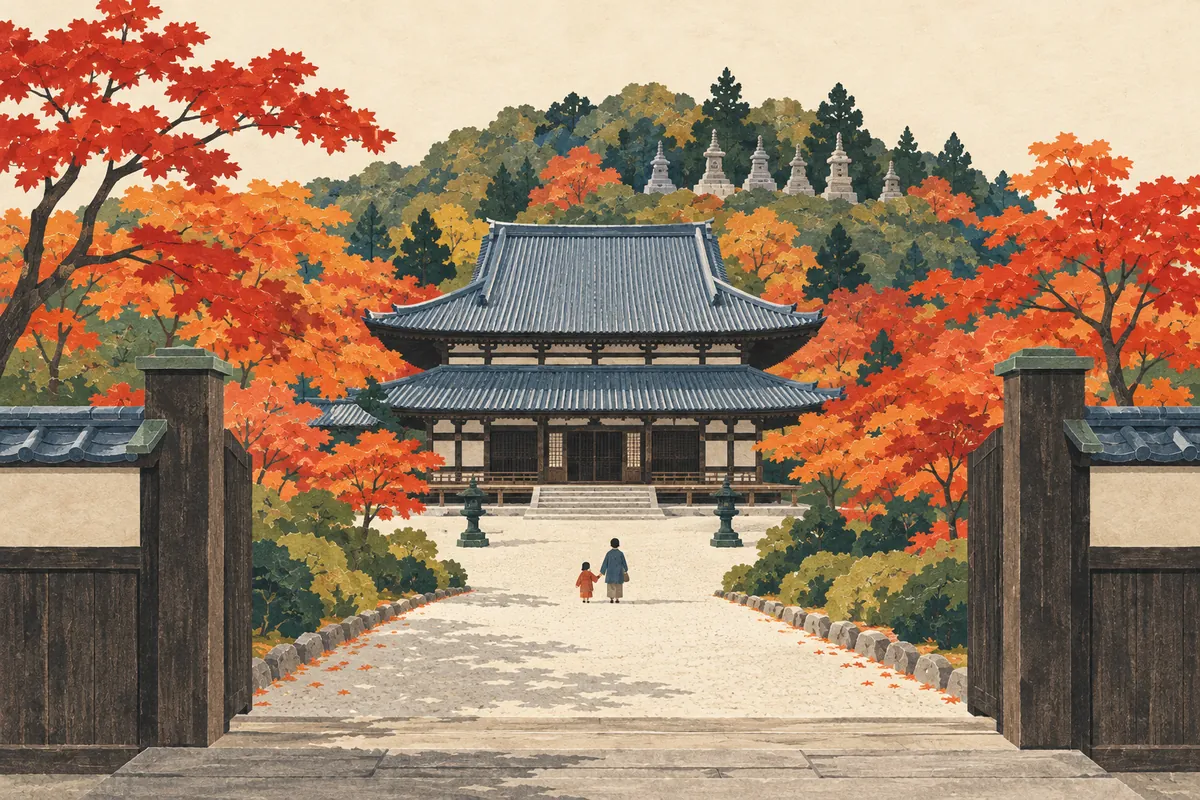
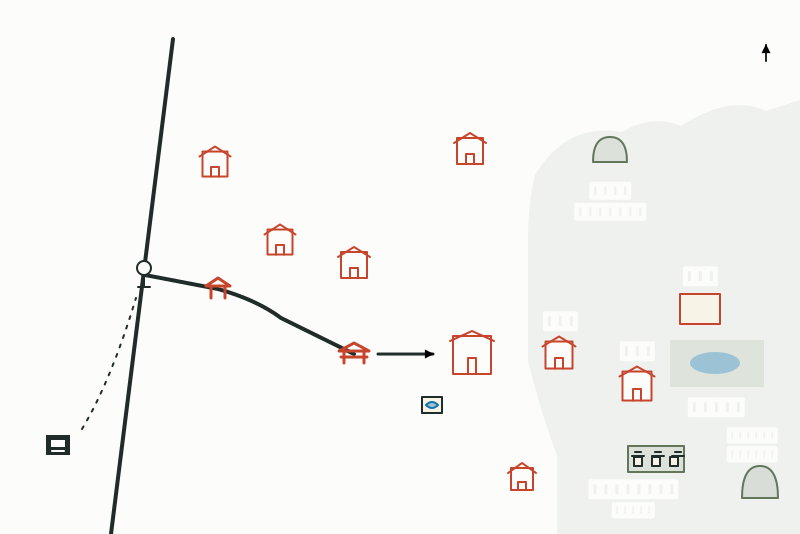
Going up the approach from the Sōmon (outer gate), the Daimon gate (Important Cultural Property) stands at the highest point of the grounds, and the Butsuden faces you at the end of the approach going down from there. The Butsuden was rebuilt by Tokugawa Ietsuna and completed in 1669 (Kanbun 9) (some explanations give 1668, Kanbun 8). It is a single-story Zen-style building with a hip-and-gable (irimoya) roof and a pent roof (mokoshi); the carpenter was Nakai Mondo (Masatomo), and the paintings are by Kanō Tan'yū. The triad of Amida, Shaka, and Miroku, said to be by Unkei, is regarded as following the "Buddhas of the Three Ages" (sanze butsu) style popular in Song-dynasty temples.
The Shariden east of the Butsuden is said to be a building moved from the imperial palace of the Keichō era, and it enshrines a relic (butsuge shari) said to be a tooth of the Buddha. The Reimeiden behind it was rebuilt by the Imperial Household Ministry in 1884 (Meiji 17) after a fire in 1882 (Meiji 15). The Gozasho, which continues to the northeast, is the Osato Goten (built in 1818, Bunka 15) of the empress's palace at the Kyoto Imperial Palace, moved here, and it is still used as a resting place when members of the imperial family visit the tombs.
The Approach and Grounds of Sennyū-ji (Schematic)
Main buildings and statues of Sennyū-ji
| Name | Date | Type of cultural property | Viewing |
|---|---|---|---|
| Daimon | Momoyama period (thought to date from the Keichō era) | Important Cultural Property (1966) | General admission |
| Butsuden | 1669 (Kanbun 9) | Important Cultural Property (1966) | General admission |
| Wooden seated Kannon Bosatsu (Yōkihi Kannon) | Southern Song dynasty | Important Cultural Property (1997) | General admission (Yōkihi Kannon-dō) |
| Shariden | Said to be a building moved from the imperial palace of the Keichō era | — | Within the general admission area (interior closed) |
| Reimeiden | Rebuilt in 1884 (Meiji 17) | — | Closed to the public |
| Gozasho | Built in 1818 (Bunka 15), moved here in the Meiji era | — | Special admission (with the Gozasho Garden and the Kaie-dō) |
| Founder's Pagoda and Founder's Hall | Founder's Pagoda early Kamakura period, Founder's Hall around the Kanbun era | Important Cultural Property (1966) | Closed to the public |
| Tsukinowa no Misasagi and Nochi no Tsukinowa no Misasagi | From the tomb of Emperor Shijō in 1242 (Ninji 3) | Imperial tombs managed by the Imperial Household Agency | Can be visited |
The Yōkihi Kannon: a statue thought to have been made in Southern Song China
The Shō Kannon enshrined in the Yōkihi Kannon-dō, at the back on the left after you enter the Daimon, has the national designation name "Wooden Seated Kannon Bosatsu" and became an Important Cultural Property in 1997 (Heisei 9). It is a life-size seated statue made of a white, hard wood not used in Japanese wood carving; its jeweled crown and the objects it holds are original, and much of its coloring remains. Its facial features and the way its robes are carved suggest it was made in China in the Southern Song dynasty.
It is said to have been brought back from Southern Song China by Shunjō's disciple Tankai (湛海); some explanations say it was brought in 1230 (Kangi 2), and others when Tankai returned to Japan in 1255 (Kenchō 7). Because the statue is so beautiful, a story is told that Emperor Xuanzong of Tang, mourning his late consort Yang Guifei (楊貴妃, Yōkihi), had it made to resemble her, and the name "Yōkihi Kannon" is said to date from around the beginning of the Edo period.
Subtemples and openings in the autumn foliage season
Subtemples (sannai jiin) line both sides of the approach and other areas. They include Imakumano Kannon-ji, associated with Retired Emperor Go-Shirakawa; Unryū-in, a branch temple whose main hall (around 1646, Shōhō 3) is an Important Cultural Property; and Kaikō-ji, which enshrines a jōroku-size (丈六, "sixteen-foot") standing Shaka Nyorai (Important Cultural Property) said to be the joint work of Unkei and his son Tankei.
Openings in the autumn foliage season change from year to year. In 2025, there was a special early-morning visit (reservations required, 3,000 yen) every Monday from November 3 to December 29, in which a monk guided visitors through the inner sanctum of the Yōkihi Kannon-dō, the Butsuden, and the Gozasho, and on November 29 and 30 the "Senzan-tei" garden made by Shigemori Mirei was opened to the public. In 2026, "Autumn Limited Sutra Copying" is held in the inner sanctum of the Yōkihi Kannon-dō until November 8 (reservations required), and Unryū-in plans an autumn special viewing from November 14 to 30.
Where can you see it now? / Getting there
Sennyū-ji is at 27 Sennyūji Sannai-chō, Higashiyama Ward, a 20-minute walk from Tōfukuji Station on the JR Nara line and Keihan line, or a 15-minute walk from the "Sennyūji-michi" city bus stop. The Yōkihi Kannon and the Butsuden can be seen with general admission, and the Gozasho with special admission.
- City bus: route 208 from Kyoto Station (Karasuma exit), or route 207 from Gion Shijō or Shijō Kawaramachi, to "Sennyūji-michi"
- Reception: 9:00–16:30 from March to November, 9:00–16:00 from December to February. The Shinshōden (treasure hall) is closed on the fourth Monday of every month
- General admission (Daimon, Butsuden, Yōkihi Kannon-dō, Shariden, Shinshōden, and more): 500 yen for adults, 300 yen for elementary and junior high school students
- Special admission (Gozasho, Gozasho Garden, and Kaie-dō): 500 yen for junior high school students and older. Free for elementary school age and under when accompanied. It may be canceled without notice for imperial visits or memorial services
- Photography is not allowed inside the buildings
Mini quiz for this entry
Sennyū-ji in Higashiyama Ward is called "Mitera" (御寺). Which is the correct reason?
When and where is Sennyū-ji's "Yōkihi Kannon" (Important Cultural Property) thought to have been made?
Sennyū-ji's Gozasho is a building moved from another place in the Meiji era. What was it originally?
Sources and verification
Content checked: October 28, 2026
Updated: October 28, 2026
References are in Japanese.
- 泉涌寺「泉涌寺について」
- 泉涌寺「泉涌寺と皇室」(略年表を含む)
- 泉涌寺「文化財・施設」
- 泉涌寺「山内寺院」
- 泉涌寺「年中行事」
- 泉涌寺「拝観ご案内」
- 泉涌寺「よくあるご質問」
- 泉涌寺「楊貴妃観音堂 秋の限定写経 開催」(2026年9月17日)
- 泉涌寺「11月29日(土)30日(日)重森三玲作庭「仙山庭」特別公開」(2025年11月26日)
- 宮内庁「四條天皇 月輪陵」
- 宮内庁「孝明天皇 後月輪東山陵」
- 宮内庁「後堀河天皇 觀音寺陵」
- 文化庁「国指定文化財等データベース 泉涌寺仏殿」
- 文化庁「国指定文化財等データベース 泉涌寺大門」
- 文化庁「国指定文化財等データベース 泉涌寺開山塔及び開山堂」
- 文化庁「国指定文化財等データベース 雲竜院本堂」
- 文化庁「国指定文化財等データベース 木造観音菩薩坐像(泉涌寺)」
- 京都市観光協会「京都観光Navi 泉涌寺」
- 京都市観光協会「京都観光Navi 皇室の菩提寺・御寺(みてら)泉涌寺 秋の早朝特別拝観を開催」(2025年)
- 京都市観光協会「京都観光Navi 泉涌寺別院 雲龍院(秋の特別拝観&ライトアップ)」