
Tenryū-ji and the Sōgenchi Garden: Arashiyama's World Heritage Temple and Musō Soseki's Garden
Other spellings and namesTenryū-ji (天龍寺) / Tenryū-ji (天竜寺) / Sōgenchi Pond (曹源池) / Sōgenchi Garden / Tenryū-ji Garden / Musō Soseki (夢窓疎石) / Musō Kokushi / Tenryūji-bune (天龍寺船) / Cloud Dragon (Unryū-zu) / Kayama Matazō
Key points
To pay for construction, the "Tenryūji-bune" ships were sent, reopening trade with Yuan China, and the temple's completion was celebrated in 1345 (Kōei 4)
There were 8 great fires between 1358 (Enbun 3) and 1864 (Genji 1). The Hattō, Ōhōjō, and Kuri were all in place by 1899 (Meiji 32)
The Tenryū-ji Garden became a Historic Site and Place of Scenic Beauty in 1923 and a Special Place of Scenic Beauty in 1955
The garden costs 500 yen for high school students and older and 300 yen for elementary and junior high school students, free for preschoolers (as of October 2026). The Cloud Dragon in the Hattō is a separate 500 yen and is open until December 6 in 2026 (with some closed days)
A Zen temple built on the site of an imperial villa, and the Tenryūji-bune
This area is the site of Danrin-ji (檀林寺), founded by Tachibana no Kachiko (橘嘉智子), empress of Emperor Saga; later, Retired Emperor Go-Saga built a palace for his retirement (sentō gosho) here, and Retired Emperor Kameyama a temporary palace. Tenryū-ji was created in 1339 by turning into a Zen temple the detached palace that had been built in 1255 with Arashiyama behind it.
The temple was founded in 1339 (Ryakuō 2) to pray for the soul of Emperor Go-Daigo, with Ashikaga Takauji as its founding patron and Musō Soseki invited as its founding priest. Estates donated by Takauji and Retired Emperor Kōgon still fell short of the building costs, so Ashikaga Tadayoshi, talking it over with Musō, decided to send trading ships to Yuan China again, a trade cut off since the Mongol invasions, and to cover the costs with the profits. These ships were the "Tenryūji-bune" (Tenryū-ji ships). The temple's completion was celebrated in 1345 (Kōei 4). In 1386 (Shitoku 3) a ranking was fixed that placed Nanzen-ji "above the Five Mountains" and Tenryū-ji first of the Five Mountains, and this position lasted for a long time.
Eight great fires and rebuilding from the Meiji era on
The temple's wide grounds and magnificent halls were repeatedly struck by fire. Counting only the great ones, there were eight: in 1358 (Enbun 3), 1367 (Jōji 6), 1373 (Ōan 6), 1380 (Kōryaku 2), 1447 (Bun'an 4), 1468 (Ōnin 2), 1815 (Bunka 12), and 1864 (Genji 1). The Bun'an fire and the Ōnin War hit hardest: only with Toyotomi Hideyoshi's donations in 1585 (Tenshō 13) did the temple get back on its feet. In 1864, with rebuilding after the 1815 fire still under way, the Chōshū army set up camp at the temple during the Hamaguri Gate Incident, the temple was drawn into the fighting, and its halls were lost to fire once more.
In the Meiji era, the land requisition order (jōchi-rei) took away most of the grounds, including Arashiyama and Kameyama, and today's grounds are 30,000 tsubo (about 10 hectares), one tenth of what they once were. Even so, the Hattō, Ōhōjō, and Kuri were all in place by 1899 (Meiji 32), and by 1935 (Shōwa 10) the temple looked much as it does today. The subtemples Shōgan-ji, Jisai-in, and Kōgen-ji escaped the fighting of 1864.
Number of Great Fires at Tenryū-ji (by Century)
- 14th century
- 15th century
- 16th–18th centuries
- 19th century
The Sōgenchi Garden: a pond and Arashiyama seen from the Hōjō
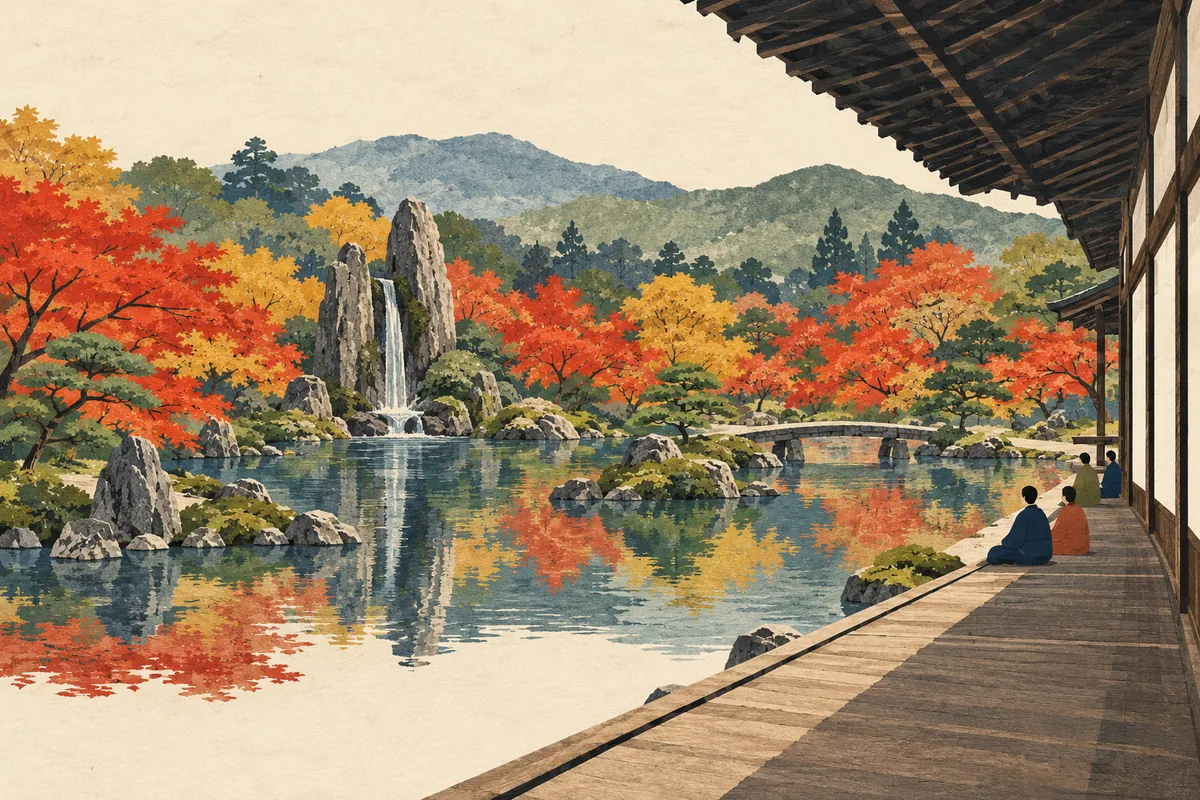
The Sōgenchi Garden is a pond stroll garden spreading west of the Ōhōjō, and it is said to keep the look it had when Musō Soseki made it about 700 years ago. It is also a garden of borrowed scenery (shakkei), taking in Kameyama beyond the pond and Arashiyama across the Ōi River. Its national designated name is "Tenryū-ji Garden"; it became a Historic Site and Place of Scenic Beauty in 1923 and a Special Place of Scenic Beauty in 1955.
Looking out over the pond from the Hōjō, you see the "Ryūmon no Taki" (Dragon Gate Waterfall) straight ahead, two huge rocks set upright. The waterfall arrangement draws on the Chinese legend of the Dragon Gate: the carp stone (rigyoseki), standing in for a carp, sits beside the flow rather than below the falls, and it is said to show the carp partway through becoming a dragon. The pond garden, with its waterfall stones, stone bridges, and rock islands, is said to have influenced dry landscape gardens from the Muromachi period on through its composition, which puts weight on the view from the Hōjō, and its techniques of stone arrangement.
The pond's name is said to come from a stone tablet inscribed "Sōgen itteki" (曹源一滴, a single drop from the source of Cao) that turned up when Musō Soseki dredged mud from the pond. The north to east banks of the pond were altered several times after the garden was made, and in 1983 the stonework of the banks was restored.
The Cloud Dragon in the Hattō
The Hattō (Dharma Hall) is the Zen hall of Ungo-an, built in the late Edo period, which was moved here in the Meiji era after the earlier hall burned in the fighting of 1864. Its ceiling had a dragon painted by Suzuki Shōnen in 1899 (Meiji 32), but it was badly damaged, and in 1997 (Heisei 9), to mark the 650th memorial of Musō Soseki, the Japanese-style painter Kayama Matazō painted a new "Cloud Dragon" (Unryū-zu).
The dragon is painted on a ceiling 10.6 m by 12.6 m, a surface of 159 cedar boards, each 3 cm thick, joined together and prepared with lacquer and white clay. Drawn straight onto it in ink, the "happō nirami" dragon, which seems to glare in every direction, fits within a double circle 9 m across. Part of Suzuki Shōnen's Cloud Dragon is preserved and is shown in the Ōhōjō every February.
Where can you see it now? / Getting there
Tenryū-ji is at 68 Saga Tenryūji Susukinobaba-chō, Ukyō Ward, and its Sōmon (main gate) faces Nagatsuji-dōri. From the Sōmon toward the west stand the Chokushimon, the Hōjōchi pond, the Hattō, the Ōhōjō, and Sōgenchi Pond. The north gate, reached through the Hyakka-en garden beyond the Tahōden, opens onto the Bamboo Grove Path (Chikurin no Komichi), which runs from Nonomiya Shrine to Ōkōchi Sansō. The north gate also has a reception, so you can enter the garden from the bamboo grove side.
The Tenryū-ji Grounds and Arashiyama: from the Sōmon to Sōgenchi Pond, and from the North Gate to the Bamboo Grove Path
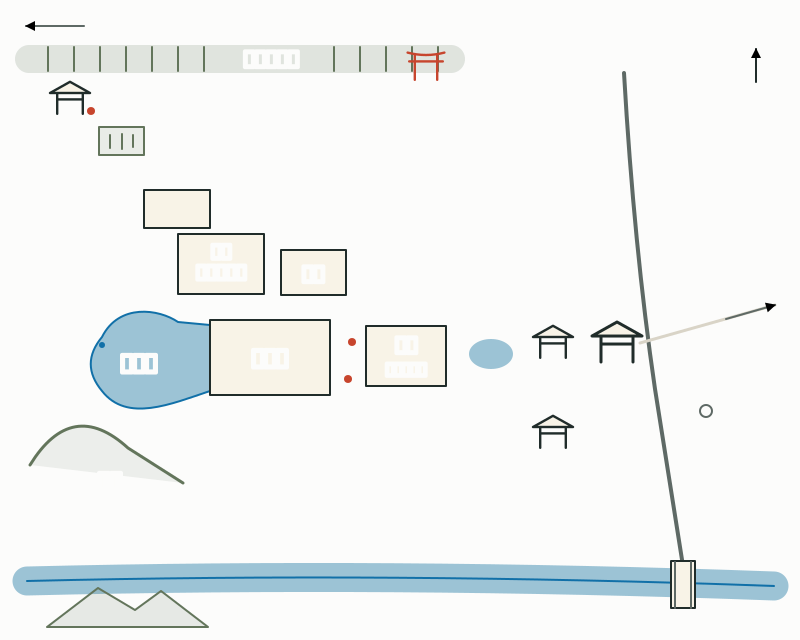
- Train: in front of Arashiyama Station on the Randen (Keifuku Electric Railroad). 13 minutes on foot from Saga-Arashiyama Station on the JR Sagano Line, and 15 minutes from Hankyu Arashiyama Station
- Bus: city bus routes 11, 28, and 93 to "Arashiyama Tenryūji-mae," or Kyoto Bus routes 61, 72, and 83 to "Keifuku Arashiyama-ekimae," right by the stop
- Garden (Sōgenchi and Hyakka-en): 8:30–17:00 (last admission 16:50). 500 yen for high school students and older, 300 yen for elementary and junior high school students, free for preschoolers. From November 14 to 30, 2026, opens at 7:30 (garden reception only)
- Halls (Ōhōjō, Shoin, and Tahōden): 300 yen added to the garden fee. 8:30–16:45 (last admission 16:30)
- Cloud Dragon in the Hattō: 500 yen per person (free for preschoolers; separate from the garden and halls fees). 9:00–16:30. Normally open on Saturdays, Sundays, and holidays; in 2026 it is open every day from March 1 to May 31 and from September 19 to December 6 (with some closed days)
- One of the component sites of the World Heritage "Historic Monuments of Ancient Kyoto" (inscribed in 1994)
Mini quiz for this entry
Which Japanese-style painter painted the "happō nirami" Cloud Dragon, which seems to glare in every direction, on the ceiling of Tenryū-ji's Hattō in 1997 (Heisei 9)?
The "Tenryūji-bune" ships were sent to pay for building Tenryū-ji. Trade with which country, which had stopped, did they reopen?
The name of Tenryū-ji's Sōgenchi Pond is said to come from something that turned up when Musō Soseki dredged mud from the pond. What was it?
Sources and verification
Content checked: October 29, 2026
Updated: October 29, 2026
References are in Japanese.